At Palazzo Ferreria in Valletta, Josette Fenech's exhibition Where Hands Meet unfolds not merely as a visual event, but as a psychological space. Curated in support of The Malta Trust Foundation for the Ta' Saura Empowerment Hub, a state-of-the-art centre dedicated to empowering children and young people with special needs through music and the arts - the exhibition becomes both an aesthetic experience and an ethical commitment.
Running until 5 April, with a special Meet the Artist afternoon on Saturday, 28 March at 4.30pm, this exhibition invites viewers into what might best be described as a field of psychic encounter.
Painting as externalised subjectivity
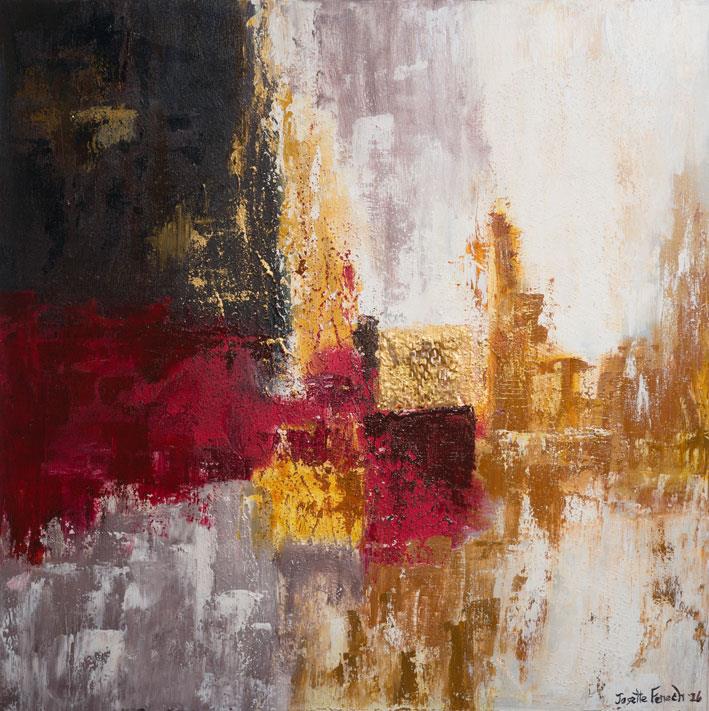
Standing before Fenech's large canvases, one is immediately aware of gesture. Paint is layered, scraped, ruptured, reconstituted. In the work dominated by crimson and burnished gold, a central red mass appears suspended between darkness and illumination. The left side, weighted with blackened density, presses against a luminous right field of ochres and pale whites. The painting feels less constructed than wrestled into being.
Here, George Hagman's insight becomes particularly relevant: "Through the making of art the artist's subjectivity exists outside self-expression and becomes the focus of his or her creative intent." The painting is not simply expressive; it is an act of psychic displacement. Subjectivity moves outward into matter. What might otherwise remain internal - conflict, tension, longing, and rupture - acquires material presence.
The thick impasto, the abrasions in the surface, the sedimentation of pigment, these are not decorative decisions. They are traces of psychic labour.
The unconscious in colour and gesture
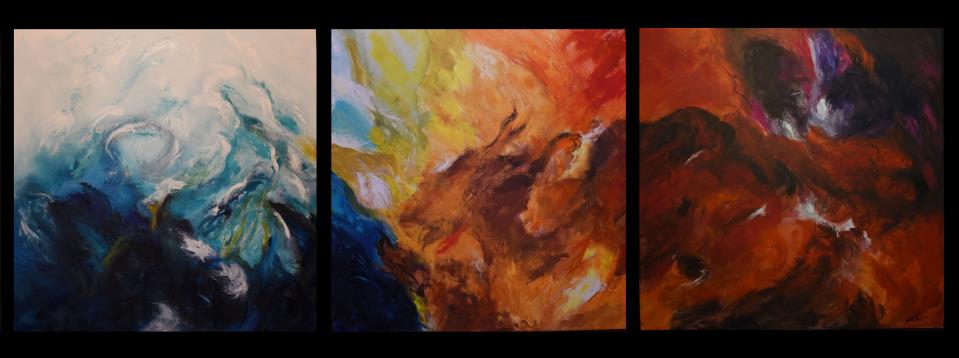
In another series, blues dissolve into translucent whites, evoking currents of water or vapour. In contrast, fiery oranges erupt into yellows and deep rust tones, as if the canvases were registering elemental combustion. These paintings resist representation, yet they are charged with affect. Abstraction, here, does not deny the world; it returns us to the primordial layers beneath conscious narration. Colour operates as emotional carrier. Gesture becomes bodily memory. The viewer senses movement before identifying form.
From a psychoanalytic perspective, such work inhabits what Donald Winnicott described as "potential space", the intermediate realm between inner and outer reality where creativity emerges. Fenech's canvases function precisely within this threshold. They are neither private confessions nor objective descriptions. Rather, they form a transitional field in which the viewer participates. The painting becomes a site of co-creation: the artist's gesture meets the viewer's projection.
Surface as skin
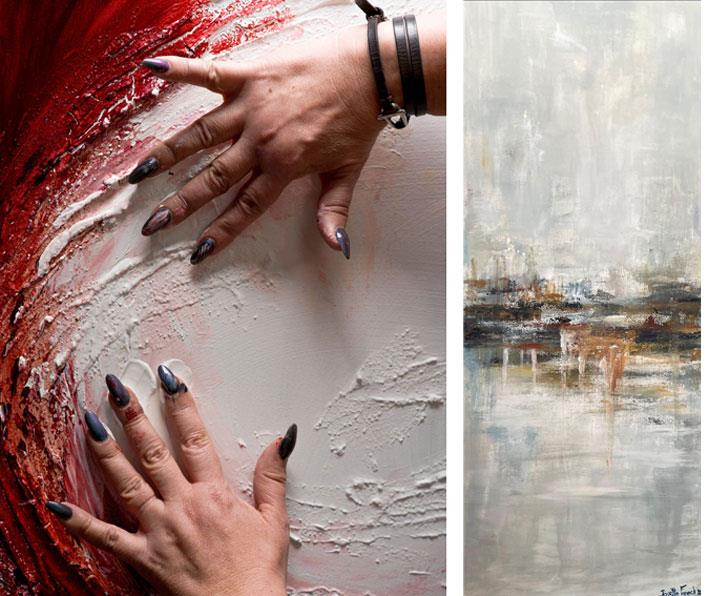
Particularly striking in several works is the tactile quality of the surface. Greys, slate blues, and muted whites intersected with passages of burnt orange suggest architectural memory, perhaps fragments of urban landscape dissolved into abstraction. Yet more than architectural, the surface feels epidermal. The canvas behaves like skin: layered, scarred, healed over, marked by time. Scraping reveals what lies beneath; overpainting conceals and transforms. In this sense, Fenech's practice resonates with contemporary understandings of the psyche as stratified rather than unified. Identity, like paint, is layered.
The artist's hand does not conceal its presence. On the contrary, it insists on it. The drag of pigment across the canvas becomes a form of embodied thinking, a gesture that precedes language.
Creativity and empowerment
It is deeply significant that this exhibition supports The Malta Trust Foundation's Ta' Saura Empowerment Hub. The arts, especially for children and young people with special needs, are not secondary embellishments to education; they are fundamental to psychic integration.
Creative practice offers a means of symbolisation, the transformation of raw feeling into communicable form. For many young people, particularly those whose experiences resist verbal articulation, art becomes a language of containment and possibility.
In this context, the exhibition's title, Where Hands Meet, acquires expanded meaning. It speaks not only of the meeting between artist and medium, but of the meeting between individuals, between those who create and those who are empowered to create. It gestures toward relationality. Art, at its deepest level, is encounter.
A mature abstraction
Fenech has, over the years, exhibited in both solo and collective shows locally, steadily refining her abstract language. Earlier works already demonstrated her commitment to chromatic intensity and gestural immediacy. Yet in Where Hands Meet, there is a discernible maturation, a confidence in restraint, in silence, in allowing space to breathe.
These paintings exhibited at Palazzo Ferreria in Valletta do not overwhelm; they invite. They hold tension without collapsing into chaos. They embody a delicate balance between impulse and control, a balance that mirrors the creative process itself.
Ultimately, Fenech's work reminds us that abstraction is not absence. It is condensation. It is the distillation of psychic experience into colour, texture and movement.
In entering Palazzo Ferreria, at the heart of Valletta, one does not simply view paintings. One encounters subjectivity made material, gesture made visible, and the profound reminder that creativity remains one of the most transformative forces available to us, individually and collectively.
'Where Hands Meet' runs until 5 April at Palazzo Ferreria, Valletta. A special Meet the Artist afternoon will be held on Saturday, 28 March at 4.30pm.
Professor Louis Laganà PhD (Lough) is an academic, curator and practising artist