Modern art often reveals itself not in what artists depict, but in how they declare the nature of their medium. This insight offers a compelling way to reconsider the work of Maltese sculptor Edward Pirotta (1939-1968). Though rooted in the figurative and narrative traditions of 19th century academic sculpture and trained at the Malta School of Art, Pirotta introduced an unexpectedly experimental approach to surface. By allowing liquid plaster to drip and harden across his carefully modelled figures, he disrupted the polished finish of academic sculpture and foregrounded the expressive possibilities of material itself. In doing so, he placed his work at a significant intersection between tradition and a distinctly modern sensibility.
Indeed, Pirotta's work stands at a crossroads between tradition and modernity. In 1966, The Sunday Times Magazine in London described Pirotta as a promising modern sculptor in his own right, while also noting his profound feeling for the antique. This dual sensibility was partly shaped during his years in England, where he worked in the workshop of the master framer Vilmo Gibello producing reproduction antique ornaments. Although such work was primarily a means of earning a living, it immersed Pirotta in the craft of simulating age and patina, an experience that would later inform his own sculptural experimentation with surface and texture.
Yet Pirotta's tendency toward experimentation had appeared much earlier. As a student at the Malta School of Art, he had already shown a willingness to challenge convention. According to accounts by art historian Fr Marius Żerafa, Pirotta sometimes mischievously provoked his tutor, the sculptor George Borġ, by deliberately distorting the proportions of his figures. Borġ represented the academic tradition: he favoured the smooth, idealised surfaces typical of classical sculpture, as exemplified in his Diana (1934). For him, sculptural beauty lay in harmony, polish and technical perfection.
Pirotta, however, began moving in a different direction. His process often started in the most orthodox way. He would model the figure carefully, paying attention to anatomical accuracy and naturalistic detail. At this stage the sculpture resembled the kind of academic study that would have satisfied the strict standards of the art school. But then came the unexpected transformation.
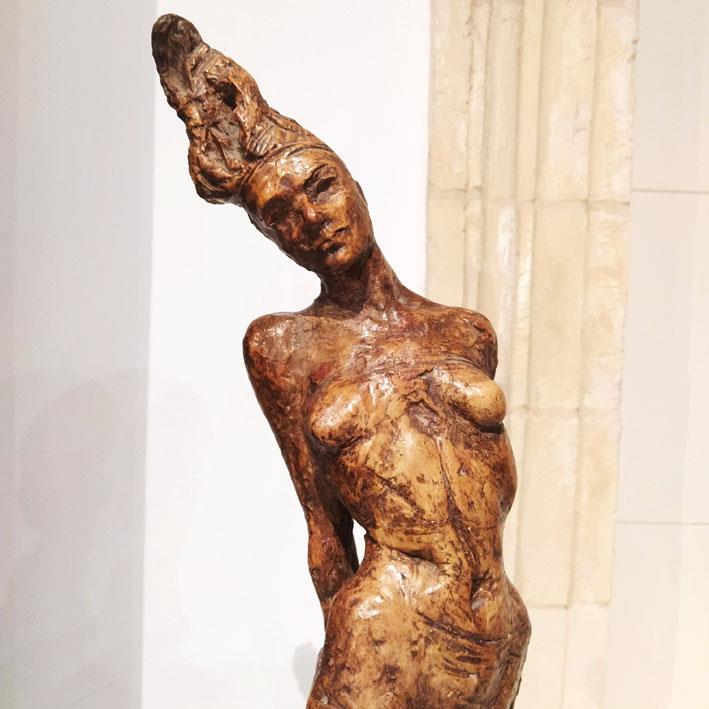
Pirotta would pour liquid plaster over the finished form. The plaster dripped and hardened unevenly across the surface, creating a rugged, irregular texture that partially obscured the underlying anatomy. What had begun as a polished academic figure was suddenly altered. Its surface became rough, tactile and visually restless.
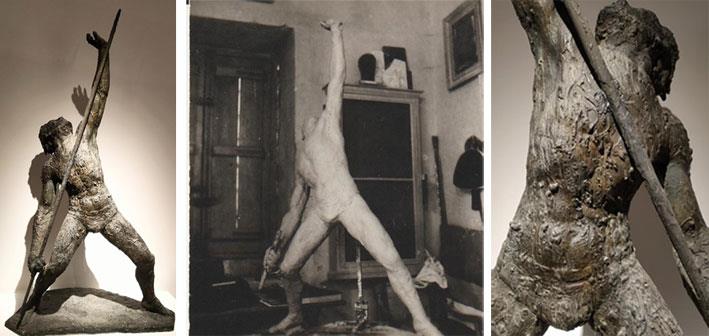
The effect was striking. Instead of the calm perfection of classical sculpture, the viewer encountered a surface alive with movement and material presence. The plaster drips emphasised the physical substance of the sculpture itself, the fact that it was not merely a representation of a figure, but an object made from matter. This approach is epitomised in his Javelin Thrower (1958), where the textured surface conveys both the dynamism of the athlete and the autonomy of the medium itself, reflecting modernist debates that valued the intrinsic properties of materials as integral to artistic expression.
In this sense, Pirotta's work resonates with the ideas of modern art critic Clement Greenberg, who argued that modern art asserts itself through the artist's direct engagement with the medium. According to Greenberg, modern painting began with Édouard Manet, whose work openly acknowledged the flat surface of the canvas rather than hiding it beneath illusionistic depth. As Greenberg famously argued, modernist painting begins when artists accept "the ineluctable flatness of the surface" and make it the basis of their art.
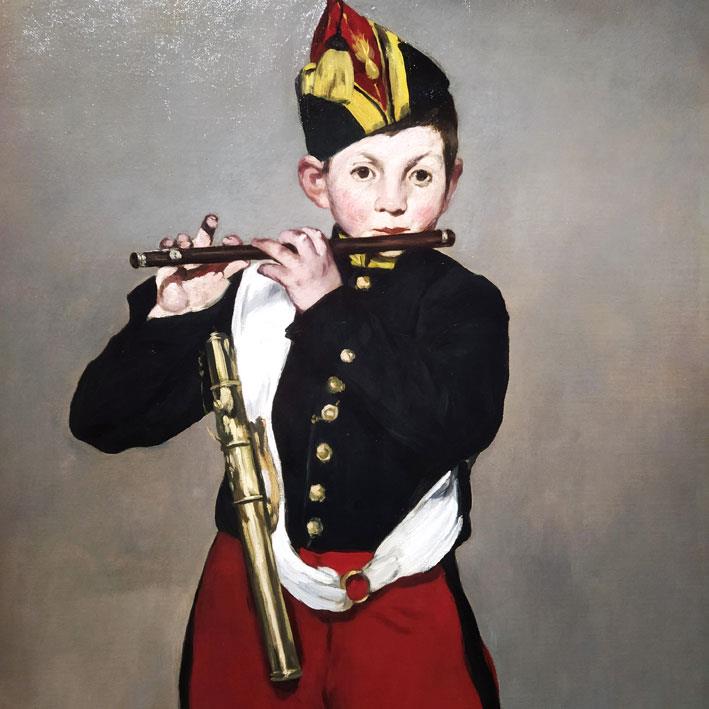
A particularly telling example is Manet's The Fifer (1866), which portrays a young boy playing a flute while dressed in a striking red, black and white military uniform. When submitted to the Paris Salon in 1866, the work was rejected by the jury, who were unsettled by its bold simplification, frontal presentation and seemingly unfinished brushwork. I recently encountered the painting in person at the Musée d'Orsay, and what proved most striking was precisely the quality that scandalised many early viewers: its radical flatness. The figure stands against a neutral ground with almost no illusion of depth, appearing nearly cut out against the surface. In this sense, the painting openly asserts its own condition as paint on a flat canvas rather than a convincing illusion of space, thus declaring itself as a painting.
Pirotta's sculptures pursue a similar logic in three dimensions. By emphasising the surface through his dripping technique, he drew attention to the material conditions of sculpture itself. The work did not attempt to conceal the medium but instead foregrounded it. The rough plaster became a declaration of sculptural presence.
Such an approach must have appeared provocative within the conservative atmosphere of the Malta School of Art. Academic sculpture traditionally sought smoothness and clarity. Texture was something to be controlled and refined. Pirotta's "adulterated" surfaces disrupted this expectation. They suggested that meaning in sculpture might reside not only in form and subject matter but also in the expressive possibilities of the surface.
This concern with surface aligns Pirotta with earlier modern sculptors such as Auguste Rodin and Medardo Rosso, both of whom treated sculptural texture as an active site where meaning could be lodged. Like them, Pirotta seemed interested in how the texture of the sculpture could carry expressive force.
His experiments with texture may have been further encouraged by the work executed in the workshop of Gibello, where he learned to imitate antique patinas by improvising with everyday materials such as shoe polish, bronze powder and metallic pigments. These techniques allowed him to recreate the appearance of aged surfaces with remarkable conviction.
The most famous episode in Pirotta's career occurred in 1966, when The Sunday Times of London commissioned him to produce two blackamoor figures as part of a journalistic stunt designed to expose the gullibility of the antiques trade. Pirotta's creations were presented to leading experts in Britain and France, who confidently identified them as authentic 18th century Venetian pieces. One dealer even made a substantial written offer for the pair.
The experiment was an amusing demonstration of Pirotta's technical bravura. Tragically, however, his potential was never fully realised. Pirotta's career was cut short when he died in a motorcycle accident at the age of just 29, depriving Maltese art of a sculptor who, while working within a largely conservative artistic environment, was already beginning to push against its limits. In the roughened surfaces of his sculptures one senses the emergence of a voice that might have played a significant role in bridging Malta's academic traditions with the wider currents of European modernism.
Rowna Baldacchino is a Maltese art historian and cultural critic with postgraduate specialisation in art history, literature, and translation, focusing on modern and contemporary art in Malta