How can an artwork give form to the living, perpetually evolving body without trapping it in rigidity? At the intersection of fluid design, material experimentation and perceptual inquiry, Gilbert Calleja's latest works challenge how we understand the contemporary living body in relation to its environment.
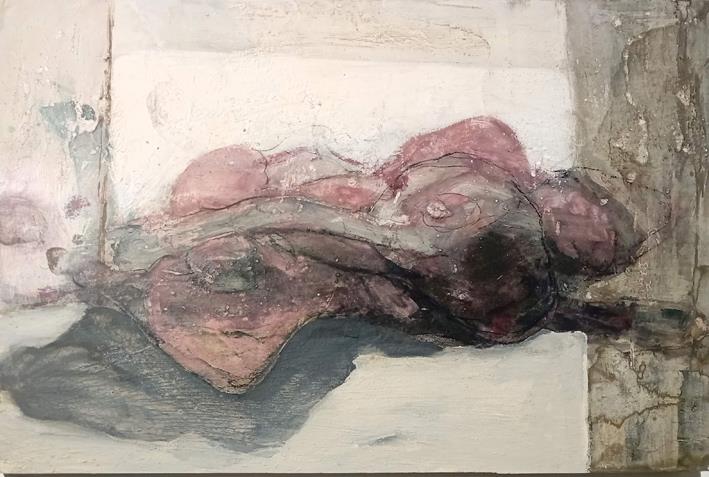
Calleja (b. 1978) is a Maltese documentary mixed media artist and photographer who primarily focuses on creative storytelling, based on ethnographic research methods, spanning long-term socially engaged projects across Malta and the wider Mediterranean. Trained in fine arts and art history, and later completing doctoral research in creative media at the University of Westminster, he has exhibited widely both locally and internationally, and is currently a lecturer of Fine Art with the Department of Art and Art History at the University of Malta.
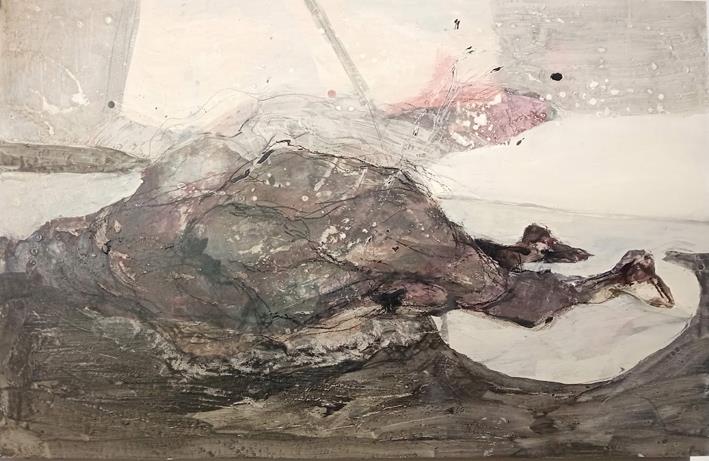
His latest exhibition at Valletta Contemporary presents mixed media paintings and drawings that explore how living bodies inhabit and interact with their surroundings, and how internal and external forces shape perception. Here, the body, understood broadly as any living organism, extends beyond a purely biological structure of atoms, emerging instead through on-going processes of perception and experience. It cannot, and should never, be cleanly separated from the spaces it inhabits, whether physical, social, or psychological. As Calleja notes: "It is always in relation to, and it is this relation to that interests me, not the other way around."
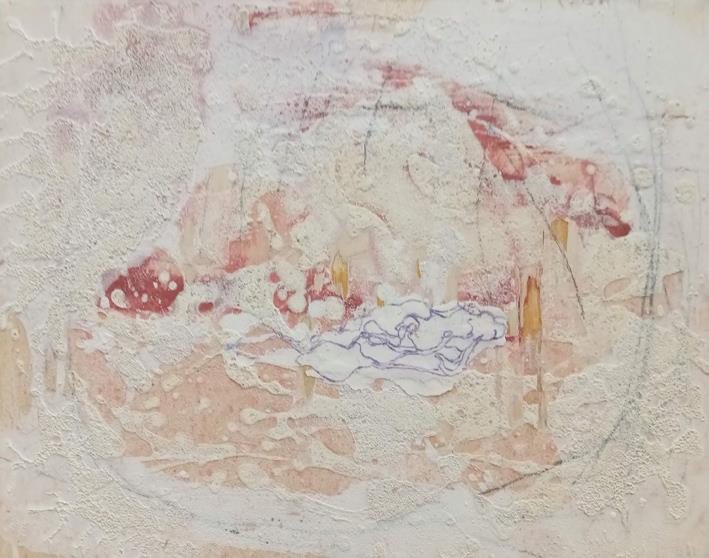
Visually, there is a strong emphasis on the fluidity of form and space, echoing the natural development of living bodies. Rather than presenting the body as fixed, with clear beginnings and ends, it is understood as unstable and constantly in flux. While he often begins with model-based studies, he quickly moves away from them, recognising their inherent constraints. Such structures impose limits on design, introducing a rigidity and sense of finitude that living bodies themselves naturally resist.
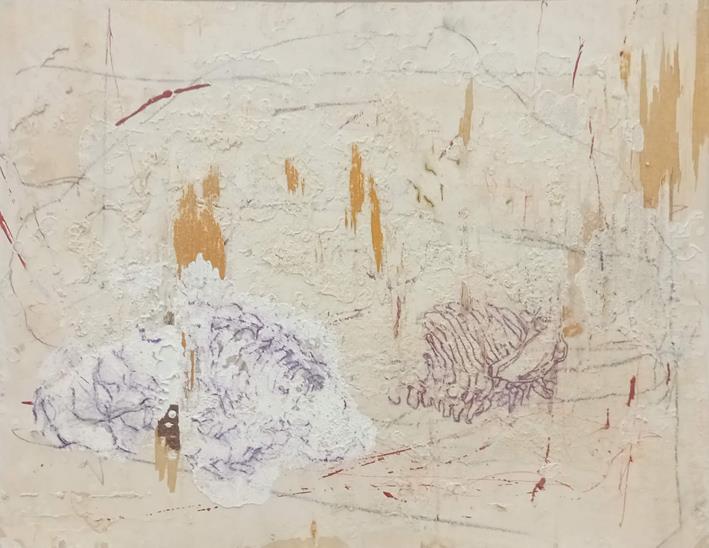
To counteract this and reflect this innate fluidity, the works emphasise both form and method of creation, through an organic methodological approach and a deliberate emphasis on materiality. The methodology is defined by a deliberate resistance to the limitations that come with formal education. While historical designs of centuries past remain impressive, he insists that the contemporary context demands a different visual language that is grounded in the realities of today. His works bear the traces of extensive reworking: incisions, erasures, and the partial destruction of prior images, all of which challenge the idea of a fixed composition. In his own words, Calleja provocatively declares: "If someone tells me that I am creating a painting, I will respond with I am doing everything to destroy the painting. I am creating a design to break the idea of design as we understand it today," framing destruction itself, and a back-and-forth process, as an essential gesture to reflect the shifting realities of living forms.
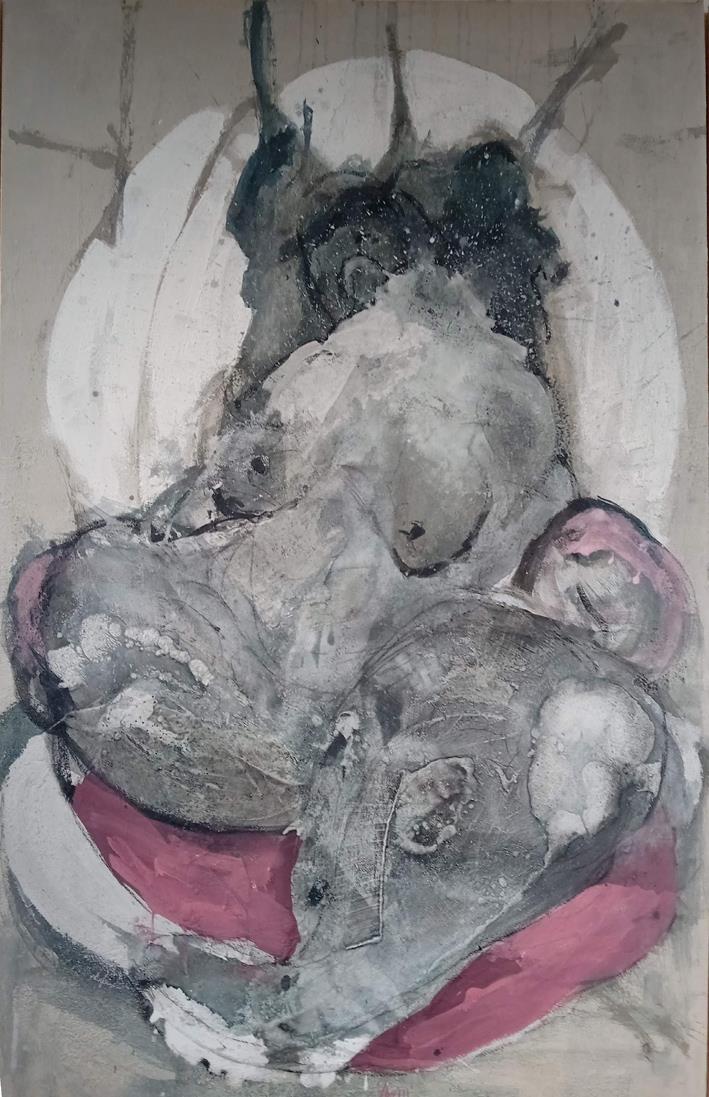
In addition is the importance to the chosen materials. One example is the striking combination of traditional gesso with concrete, made even more unconventional when paired together with paint or charcoal. Calleja reflects: "I purposefully create these tensions because I know I am not supposed to, and that 'not supposed to' draws me more than what the discipline of painting deems permissible." Together with the idea of destruction, the construction materials echo a negotiation process from which the form emerges. This is not only contemplated in the process but also the display. By having composite pieces layered with these various materials and on different panels in direct communication with one another, they reflect both an immediate continuation and tension. Whether through an emphasis on line or a more organic approach, the shared environment invites viewers to reconsider the body as a tangle of limbs navigating entropic spaces.
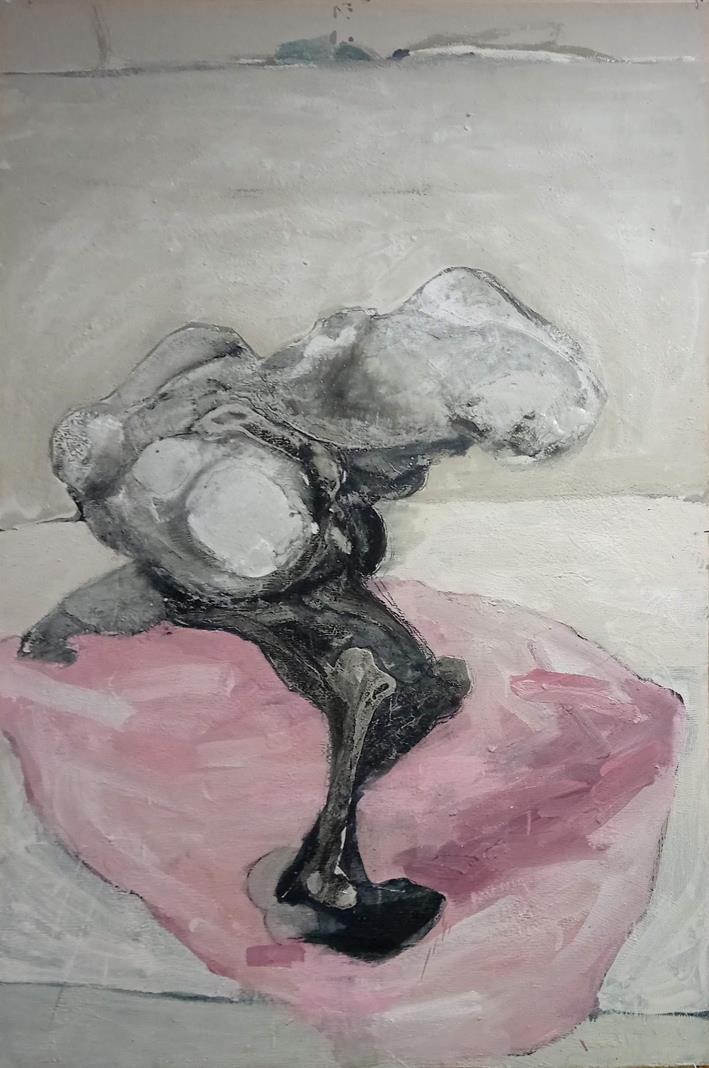
This shared environment and ever-changing nature of growing, dialoguing, and becoming one with, is not merely explored in the two-dimensional space or that of the public exhibition, but also that of the private studio. In his series, multiple paintings occupy the same working space, and by deliberately avoiding finalisation, he allows them to evolve together and alongside him. In turn, he also grows with them, both as an artist and as an individual. This interplay between paintings and artist mirrors Calleja's broader awareness of the environments that shape experience today, where bodies and images are never isolated but exist within complex social and digital networks. He observes that the experience of the body is no longer private, but that most of the time it unfolds as a very public engagement running parallel to the private one, always in relation to what we see and to social expectations placed upon us. Directly or indirectly, we are all participants in this network of perception.
In navigating these ever-shifting forms and environments, Calleja's work challenges how we perceive bodies, and by extension, ourselves, within the fluid networks of contemporary life.
Gilbert Calleja's Paintings is open to the public until 25 April at Valletta Contemporary.