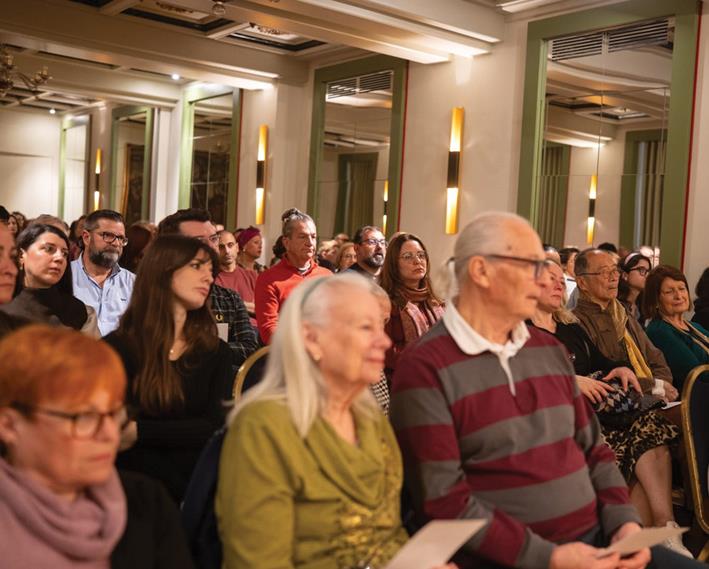
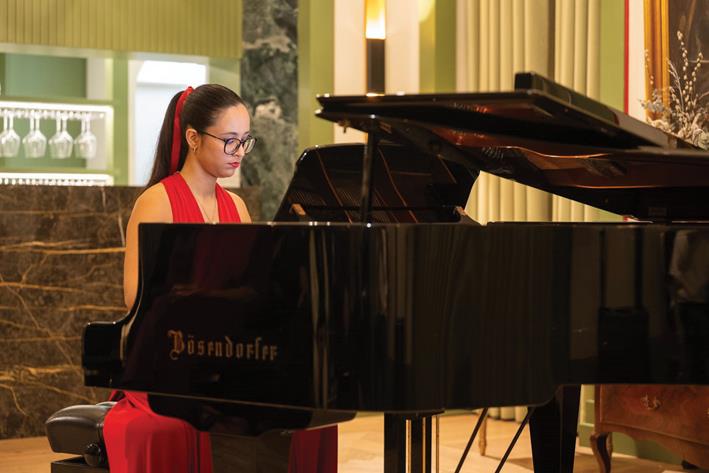
On Sunday 15th March I went to Isouard Hall to listen to Alessia Bonnici who was playing the piano at a concert, Music Speaks. I had heard her play briefly at the Cavalieri Art Hotel a couple of weeks before where I was admiring Anna Nightingale's paintings. The well-attended concert felt less like a performance and more like entering the inner circle of a family's long, patient journey. Alessia Bonnici introduced the programme reading from her tablet. She presented each piece tablet in hand.
She then sat at the piano - composed, luminous, entirely herself - but I could not watch her without hearing her mother's words echoing through the hall. Her mother was there, tall, slim and attractive giving her daughter support but allowing her to get on with introductions without too much interference.
Earlier, I had emailed Cynthia Bonnici about Alessia and she had written back with a clarity that was almost fierce in its gentleness. "Alessia is on the autism spectrum. She was not 'affected' by something that needs to be cured it is a lifelong neurodevelopmental condition that shapes how a person communicates, processes sensory information, and relates to others and their environment."
And again: "I feel it's important to gently reframe how we speak about autism, so that we move away from seeing it only as a limitation, and instead understand it as a different way of experiencing and engaging with the world... nor is autism something that can be reduced to medication. It is not treated with pills.
When Alessia was younger, we as parents knew very little about autism. Like many families, we had to learn - step by step - how to understand her world. I made a conscious decision early on to be fully present in her therapeutic journey. I attended her speech therapy, early intervention sessions, and even horseback riding therapy. These were not just appointments for Alessia; they were learning spaces for me as a mother. Being present allowed me to carry those strategies into our everyday life, extending the therapy beyond the session and into our home, our routines, and our relationship."
I kept imagining her - this woman who sat through speech therapy, early intervention, anything that was going to help Alessia - absorbing every technique, every gesture, every small breakthrough, so she could carry it home and weave it into daily life. That kind of dedication is not loud. It is not applauded. It is lived quietly, hour by hour, year by year.
She explained further. "Eventually, we discovered music and music therapy - and this was a turning point. Alessia has perfect pitch, which gave her a unique advantage in connecting with sound, reading and memorising quickly, and experiencing music in a deeply intuitive way. Through the guidance of her first formal teacher, pianist and music therapist Rosetta Debattista, music became something embodied. Alessia was not just taught to play notes; she was taught through movement, language, and touch. For the first time, she could make holistic sense of what she was hearing and expressing."
From there, her journey continued to grow. Alessia has since performed both locally and internationally, was named a Rising Star in 2022 with her debut at the Manoel Theatre, collaborated with artists such as Gigi D'Alessio, and recently took on the role of the pianist in the theatrical production Novecento which was also staged on the Manoel Theatre stage last year. She is also co-creator of Music Speaks, a concert series that celebrates inclusion and diverse musical encounters.
Music entered their lives almost like grace. "For the first time, she could make holistic sense of what she was hearing and expressing." That sentence alone could have been the programme note for the entire evening.
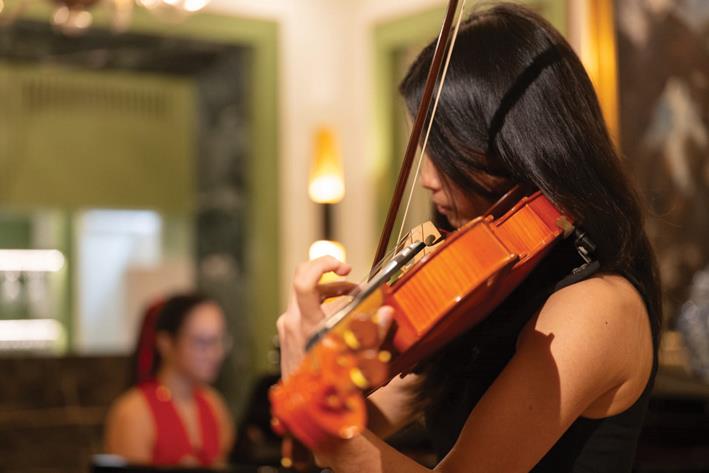
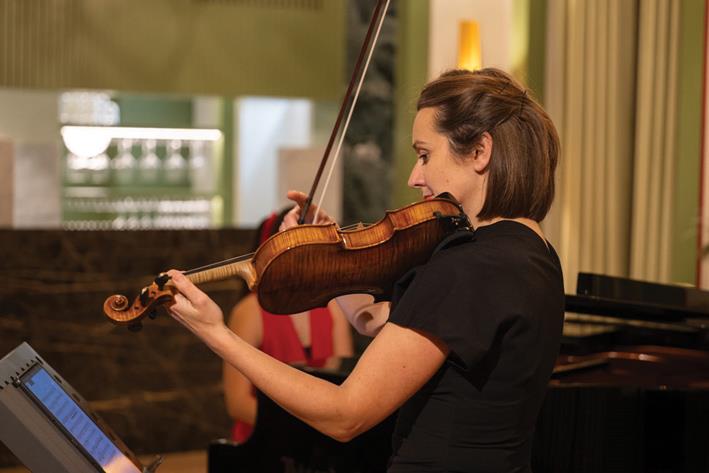
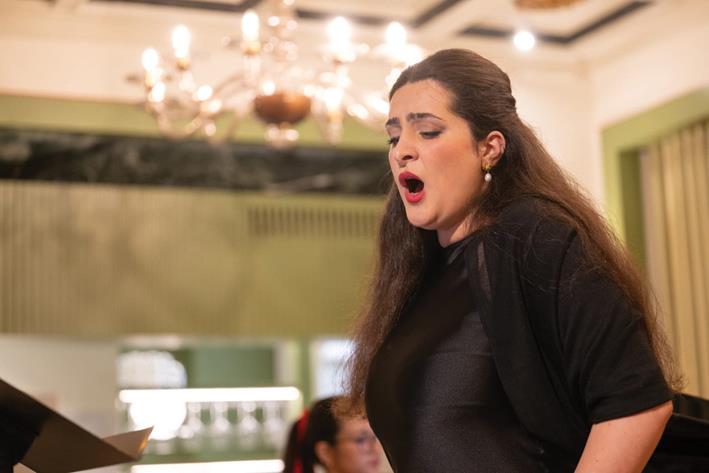
The concert itself unfolded like a mosaic of voices: Alessia at the piano, Agnieszka Kuzma and Mikaela Baluyot on strings, and Mariah Costa singing. Bartók's Romanian Folk Dances opened with rustic brightness; Braga's La Serenata softened the air; Dvořák's Songs My Mother Taught Me felt almost too perfectly placed, as though the universe had chosen it for this mother-daughter story.
Ligeti's Musica Ricercata - those sharp, rhythmic movements - revealed the contemporary direction Alessia has been exploring under Gabi Sultana's mentorship. Then came Vieuxtemps' Élégie, Albeniz's Castilla, and finally Saint‑Saëns' Danse Macabre, each piece carried by a different combination of musicians, each one adding another facet to the morning's texture.
At one point, soon after the concert started President Emeritus Marie-Louise Coleiro Preca swept in, wearing a white track suit and trainers, to listen to the concert. She was there representing the very active Malta Trust Foundation which she had set up in 2015. The aim of this Foundation is to encourage vulnerable young people, experiencing difficulties in life, to improve their lives through education and training. Her sudden appearance, especially wearing such casual clothes, was a surprise. However, The Trust had helped Alessia as it has so many others. Later Dr Coleiro Preca explained to me that she had just returned from a fund-raising walk with no time to change and after this concert had another event to attend. Che energia. God bless her. Here is a woman who after reaching the pinnacle of her career as President of Malta, did not just disappear to live the rest of her life in comfort. She has been active ever since constantly helping others. Another woman I greatly admire.
But the music, beautiful as it was, felt secondary to the human truth behind it.
Cynthia Bonnici, the devoted mother, had also written to me with quiet insistence, "Alessia's father... has always been a loving and present figure in her life." A reminder that this journey was not borne by one parent alone, but held by two people who continued to show up for their daughter even after their marriage ended.
And then the line that pierced me most: "Alessia's story is not simply about 'overcoming' something to perform in public.
Alessia's music is not a victory over autism; it is an expression shaped through it. A way of being. A language."
As I walked out of Sala Isouard, I found myself thinking of all the parents who live inside these long, demanding journeys. How much unseen labour, how much love, how much exhaustion, how much hope... Oh what it must be like to have a child, sometimes even two, who move through the world needing constant scaffolding. How difficult to have an even steeper path to walk than the average parents, but how lovingly many parents carry their burden always wanting to do the best for their child.
Tonight, I witnessed not just a concert, but the flowering of years of devotion - music as bridge, music as refuge, music as the place where a young woman can stand fully in her own light.