It is remarkable how a handful of discarded commercial documents from the 1930s, discovered at a local flea market, can shed valuable light on Malta's past.
Not only do these documents provide insights on how trade was carried out in the past, but they also shed light on prevailing political sentiments of the time when the Maltese were divided into two main political camps; those favouring Italian culture and language and those who were pro-British (anglophile).
The correspondence emanates from the Import department of a firm by the name, Giuseppe Rizzo & Coy, which was situated at Flagstone Wharf, Menka, Marsa. The firm acted as an agent, importer, exporter, contractor and supplier to the local government. They were established in 1829 and owned by Agius Catania Bros. whose head office was situated at 2, Second Street, Floriana.
A chronological time-frame of the correspondence reveals information of the items imported which were deemed important for the British colonial war machine based on the Maltese islands.
Importation of cement
One important item was cement. On 15 December 1936, the Trade Development Office (which was situated at 178, Strada Crisforo, Valletta) replied to an enquiry by the firm, Giuseppe Rizzo & Coy on their wish to be placed in contact with UK manufacturers and exporters of cement.
The department provided a list, which was submitted by the Deparment of Overseas Trade, (which was situated at 33, Old Queen Street, London) with the following list of manufacturers of portland cement:
- Cement Marketing Co. Ltd, Portland House, Tothill Street, London
- Tunnel Portland Cement Co. Ltd, Victoria Station House, London
- Aberthaw & Bristol Channel Portland Cement Co. Ltd, Merthyr House, Cardiff
- C. Burley Ltd, Sittingbourne
- Caswebourne & Co. (1926) Ltd, Billingham, Stockton-on Tees
Malta relied totally on the importation of cement. This product was a very important resource for the British colonial authorities because cement was used, mostly in the construction and maintenance of military infrastructure and installations.
Since the tide of war was approaching in the 1930s, having enough cement at hand was vital for, among other matters, the reinforcement of military structures against high-calibre bombs As a matter of fact, when hostilities broke out in 1940, cement was much needed to reinforce private, public and military zone shelters, among other structures.
Importation of chemicals
When contracting business with new British and/or foreign firms, Giuseppe Rizzo & Coy submitted references on their firm found in British commercial publications. This was the case when they expressed an interest in the importation of chemicals (nitrate of potash and chlorate of potash) from Crowther Horatio & Co. Ltd of Leeds, England on 8 November 1932. Giuseppe Rizzo & Coy provided this firm with references found in Kelly's Direcories Ltd, London and the British Trade Review, London and in other requests, references from the Collector of Customs. Nitrate of potash and chlorate of potash are used in explosives, fireworks, pyrotechnics and the manufacture of safety matches.
Another quotation was requested from Glasgow Corporation Chemical Works Department on 5 November 1932 for the following:
- 20 casks of one cwt each of nitrate of potash
- 20 casks of one cwt each of chlorate of potash
Other imports
Other expressions of interest for importation were made in respect of the following:
- Oriental Carpets Manufacturers Ltd, Kerman, Persia (now Iran) on 16 January 1934. This Persian firm manufactured hand and machine-made carpets and shawls
- Carpets from S. A. Manifattura Italiana Tappeti on 3 December 1934
- Perfumery from Dubarry Perfumery Manufacturers on 4 November 1936
- Portland cement from a portland cement factory, in Palmonticeva, Yugoslavia (now Beograd, Serbia), 1936
- Other cement firms from ex-Yugoslavia, 1936
It is noted that private importation of explosive material (along with most essential goods) to Malta effectively stopped after Italy's declaration of war in June 1940 and the government took control over practically all importation.
Reference to Enrico Mizzi
One letter that stands out gives a somewhat clear idea of the firm's political leanings, which seemed anglophile. This comes as no surprise, as the firm supplied the British government and had a vested interest in maintaining a favourable reputation with the British, both locally and in Britain.
The firm Giuseppe Rizzo & Coy, writing to the editor of the Times, London enclosed a cutting from the Malta Chronicle in a letter dated 11 November 1933 calling the attention of the London Times regarding the mentioning of Enrico Mizzi. The firm asked the London Times to reproduce the cutting in the Times' widely-circulated papers for the information of the British public.
Although the cutting from the Malta Chronicle was not found as part of the cache of documents and its contents are not known, the letter by Giuseppe Rizzo and Coy contained the following:
"I am sure you know perfectly well that the Enrico Mizzi mentioned was Minister for Public Instruction in the last Dismissed Ministry and the same one who was court martialled and found guilty during the Great War."
The above letter may have been motivated by some prejudice against Mizzi, who at the time was seen in bad light by the British.
Following the landslide victory in 1932, the Nationalist government pursued pro-Italian policies. "Dismissed Ministry" refers to Mizzi's previous tenure as Minister for Public Instruction for one year from 1932 until the suspension of the Maltese Constitution in November 1933. Suspension of the Constitution was made due to a combination or intense political instability, conflics over language and culture, and imperial security concerns.
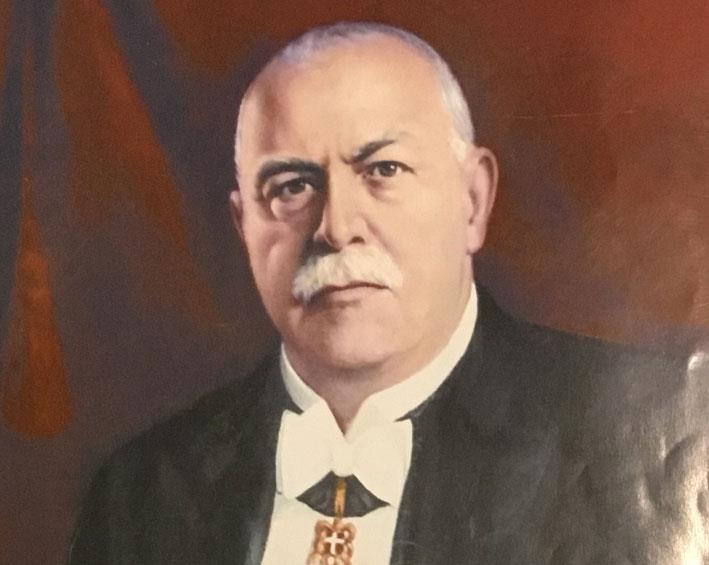
Enrico Mizzi
Mizzi is considered as the politician who fought hard so that the Maltese would be the ones who govern themselves democratically and he did so at a time when all power was vested in the hands of the British colonial government. It is also no secret that Mizzi had two meetings with Benito Mussolini, the Fascist leader of Italy in 1931 and 1936. These meetings did little to help his image with the British.
As a result, Mizzi was subjected to a lot of political persecution and prejudice, ultimately being interned and later exiled to Uganda in 1940, together with other Maltese citizens. Just a few days before Italy declared war, the internment of the Maltese started on 15 May 1940. Subsequently, all the interned were exiled in Uganda from 1942 until 1945, when they were returned to Malta.
The cache of documents presented in this feature is not exhaustive (representing only the tip of the iceberg of the trade volume undertaken by Giuseppe Rizzo & Coy). Nevertheless, it offers a small window through which the connection between political complexities and private business interests can be observed.