Back at il-Kamra ta' Fuq, our Andrew E. Zarb returns with a new collection of photographic works titled Memoirs of an armchair, curated by yours truly.
Starting with the usual, mandatory background check: Zarb is a self-taught photographer who approaches the medium as both passion and pursuit, constantly waiting for and seeking the right moment. His deep connection to nature is reflected throughout his work; his photographs convey his thoughts while capturing the emotions and impressions that emerge from his relationship with his subjects, whether human or inanimate, over time. Zarb works with both digital and analogue cameras. While the coloured world fascinates him, it is the black-and-white realm that evokes a deeper sense of curiosity and emotion, as is evident throughout this new collection.
It all began while Andrew was experimenting with various ideas for other projects, when this body of work, which is centred entirely around the armchair, started to take shape. Across the series, a number of armchairs emerge as both backdrop and, at times, protagonist. Female sitters occupy this domestic object in shifting states, from semi-dressed and masked to nude or holding a large book, each posture negotiating intimacy, control, and display. Masks, along with Zarb's bravura in camera manipulation, obscure identity, while gestures and poses heighten the tension between presence and concealment, between the intimacy of a private moment and the assertion of power over the viewer.
Why memoirs? A memoir is not a full autobiography, but a selective, subjective account of lived experience. Not necessarily factual, it can be fragmentary and interpretative, where emotion often takes precedence, focusing on moments rather than fixed timelines. It is composed of fragmented recollections, some remembered, others forgotten, and many reshaped over time.
Historically, the armchair has functioned as a symbol of authority, seen in thrones and ecclesiastical seating, as well as of status, repose, and private leisure. Here, it is reimagined both as a silent observer, absorbing the imprints of each body that temporarily inhabits it, and as a kind of podium for the sitter. At times, Zarb employs it playfully, positioning the body in ways that challenge the chair's conventional use.
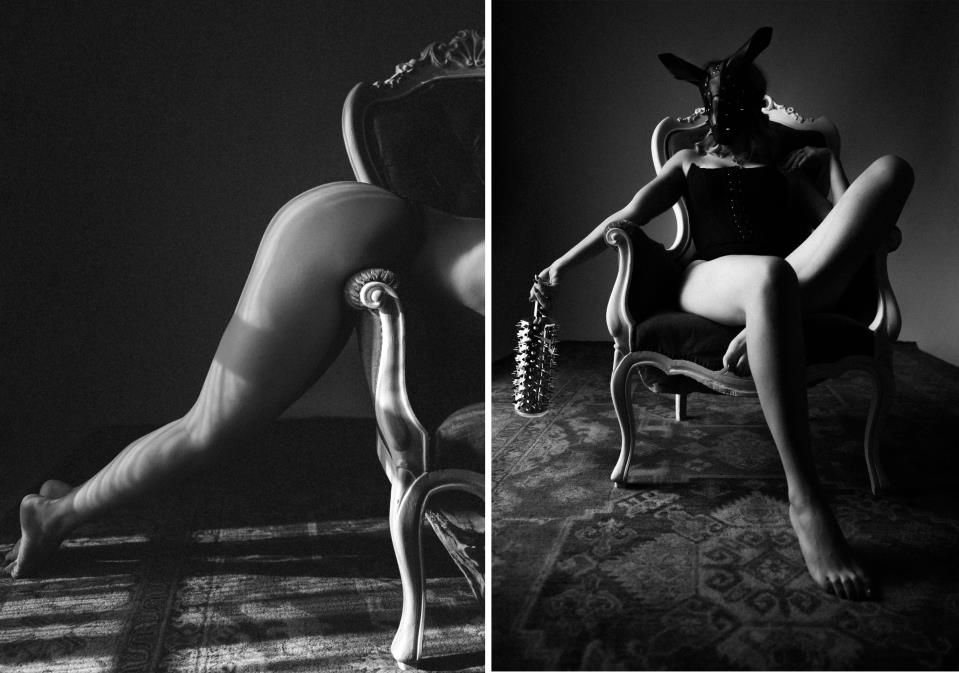
One such example is Bent over, where the armchair acts as a podium for the central focus of the composition: the highlighted derriere. A curved shaft of soft light follows the exact curvature of the buttocks, emphasising the form in a direct and deliberate manner. The figure stands on the armchair and bends forward, positioning the body high within the frame and firmly directing the viewer's gaze. (A small spoiler alert: this topic is set to continue in a future project by Zarb.)
Anatomy of an armrest is another unconventional composition, where the model balances her body along the armrest, creating an almost playful extension of its padded form. The pose recalls the familiar gesture of placing a folded garment or a folded blanket over an armrest, subtly echoing domestic routines.
Haloes presents another unconventional pose: the model, dressed in a leopard-print lingerie set, turns away from the viewer, exposing her derriere. Zarb captures soft rays of light across the surface of the body, forming luminous shapes that resemble halos.
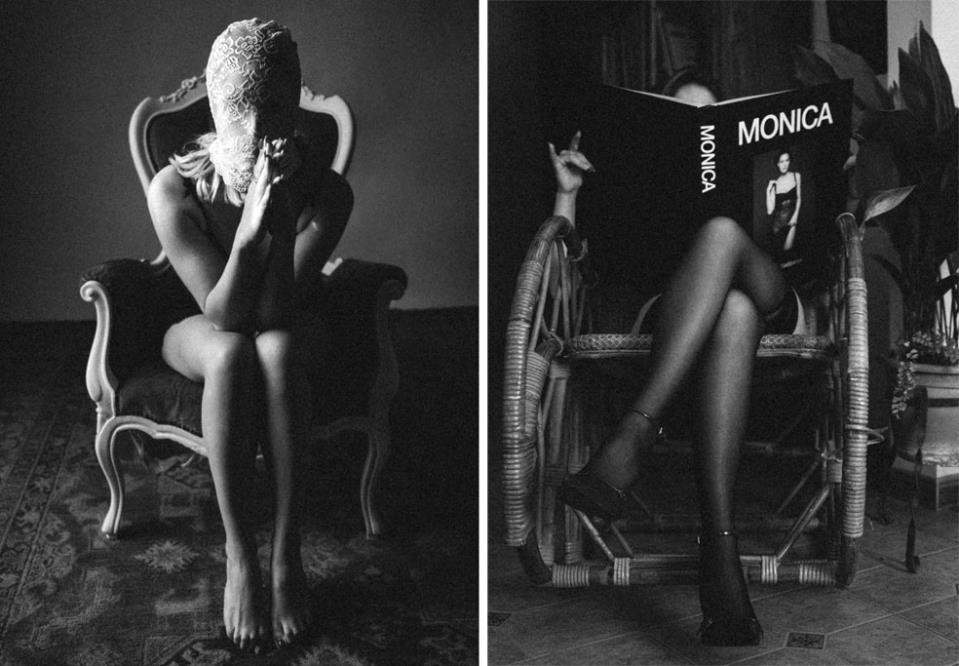
Most of the faces remain concealed. Zarb uses veils and masks to obscure identity, creating what can be perceived as a sensual, intimate exchange between sitter and viewer. A white patterned fabric appears in some works, including Echoes of a sinful plea and Restless repose, where in both cases the model is dressed in a black lingerie corset. In the former, the "plea" is far from one of mercy; in the latter, it suggests a restless desire rather than repose.
More daring are two works in which the model wears a black leather bunny mask paired with a black corset. In Masquerade of memory, the sitter commands the scene like a boss, legs spread wide, arms resting on the armrests, ready to seduce but never to be seduced, the undisputed mistress of the game. The same model appears in my personal favourite, Drunken bunny, wearing the same corset and mask, but this time with an additional prop (my Christmas gift to Andrew!): a vodka bottle fully adorned with spikes. Yes, I am really good with presents.
The two most audacious works are The Soul's nutrition and Lingering warmth, where the models are fully nude. The armchair here is minimalist and made of leather. In The Soul's nutrition, it recedes almost entirely, folding around the model like an open cape while she stares directly, unapologetically, into the viewer's eyes, the only sitter in the series whose face is fully visible. Here, the chair supports yet never dominates, allowing the figure to claim absolute presence. Titles throughout the series guide interpretation and frame each moment. In this case, the title wittily references the sitter's chest tattoo: Starve the ego, Feed the soul. The interplay between title, gesture, and setting transforms the work into more than a photograph. It becomes a staged meditation on power, vulnerability, and self-possession.
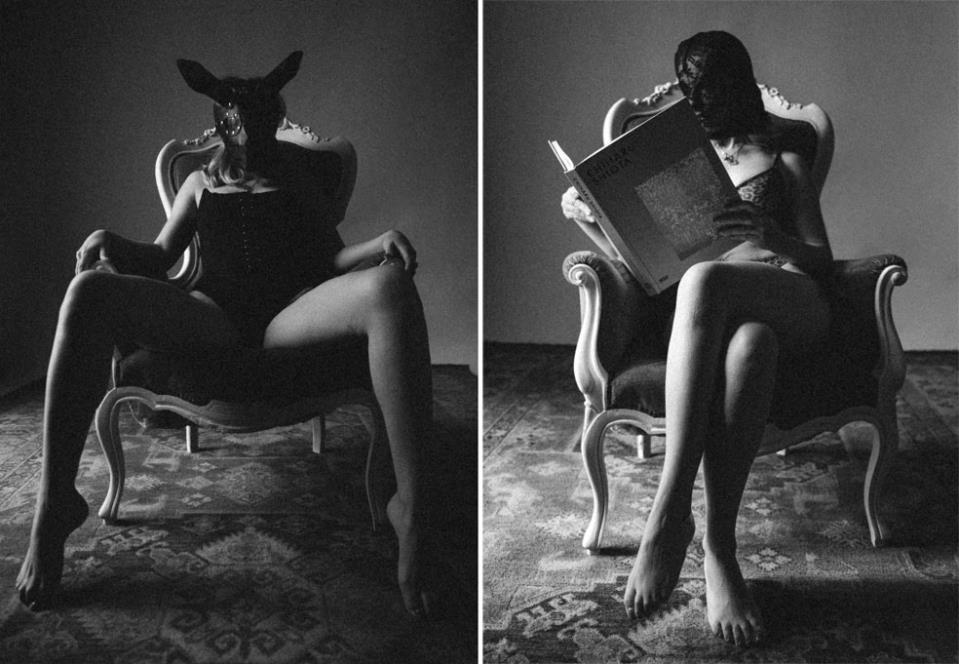
In three of the works, we encounter a recurring motif: seated figures holding oversized books that conceal their faces while exposing the body, particularly the legs, creating a playful tension between intellect and eroticism, visibility and withdrawal. The act of reading becomes theatrical, even ironic. Knowledge shields identity while the body remains on display.
The titles of these works relate directly to the content of the books. In Iconography, the model holds my birthday gift to Andrew: a monumental book on Monica Bellucci. (Yes, I did mention I'm exceptionally good at gift-giving!) In Helmut's legacy, the model leafs through a volume on one of Zarb's most revered photographers, Helmut Newton. The final piece in this informal "triptych", Intertwined memoirs, features a catalogue from a major exhibition I had the pleasure of visiting with Andrew and his better half, Sylvana, in Paris last year, The Soul trembles by Chiharu Shiota, held at the Grand Palais. These works mark the beginning of a larger, ongoing series.
Through these accumulated "memoirs", constructed via encounters with armchairs and the careful manipulation of light, Zarb creates an archive of gestures, narratives, and possible intrigues, with the armchair acting as both witness and, at times, stage. Here, the armchair becomes an unlikely memoirist, recording traces of bodies rather than words.
Zarb is a full-time technical manager and photographer, and a part-time farmer. He has participated in numerous exhibitions in Malta and was also selected to take part in a major collective exhibition in Venice. Memoirs of an armchair is his third solo exhibition.
The exhibition runs until 26 April at il-Kamra ta' Fuq. For more information, follow us on social media