Malta must confront global challenges head-on while strengthening collaboration between government, businesses, and society, Deputy Prime Minister and Foreign Affairs Minister Ian Borg said during a business breakfast held as part of the Labour Party's weeklong Congress 2026.
Addressing stakeholders, Borg stressed that the event should be seen as more than a routine conference, describing it instead as "a moment where we need to clearly look to where we want to be."
He framed the Congress as an ongoing process through which the party engages with society and listens to key sectors, reaffirming its belief in its ability to continue leading the country.
Borg highlighted the scale of global transformations currently underway, pointing to conflicts abroad, the rapid rise of artificial intelligence, and intensifying competition over energy resources. He warned that Malta cannot afford to view these developments from a distance.
"As a country we are not looking at these challenges from far away," he said, emphasising that their impact will inevitably be felt locally.
A central theme of Borg's address was the need for collective effort. He posed what he described as the "biggest question" facing the country: whether stakeholders are willing to work together to navigate the future. Expressing confidence, he added that he believes such cooperation will materialise.
Turning to economic opportunities, Borg noted that a direct flight route between Malta and New York is expected to begin operating soon. He said the connection would serve as a boost for tourism and further strengthen Malta's international links.
He also underscored the importance of continued dialogue on key political issues, including immigration, noting that engagement with businesses and society remains essential.
"We are here to prepare for the future," Borg concluded, urging sustained collaboration as Malta positions itself in an increasingly complex global landscape.
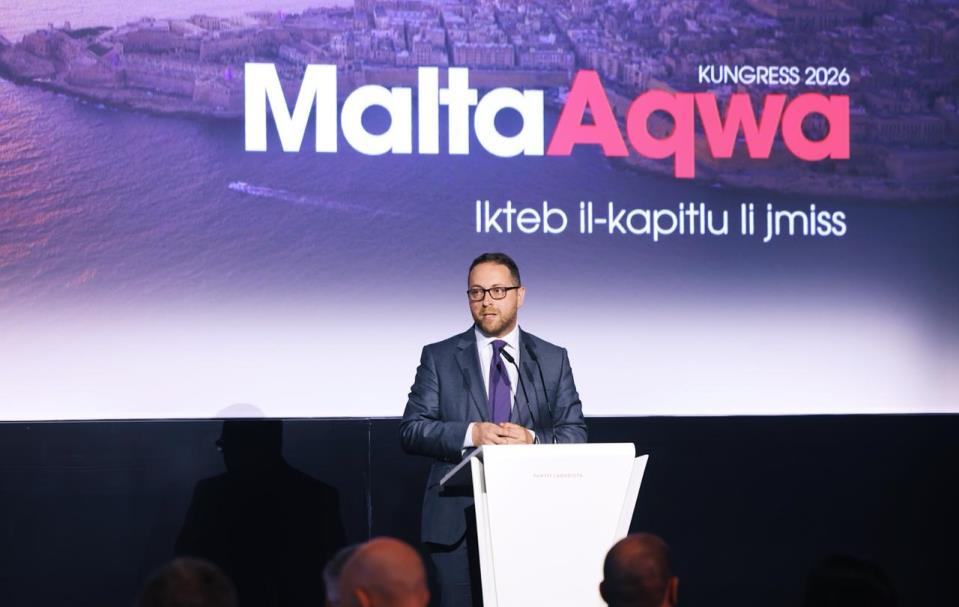
Alex Agius Saliba stresses productivity and AI adoption
Deputy Leader of the Labour Party Alex Agius Saliba underscored the importance of innovation and inclusive economic growth during the same event.
"I believe in the value of the word 'together'," he said, noting the significance of cross-sector dialogue in shaping Malta's economic future.
Reflecting on developments over the past 13 years, he pointed to the transformation of industrial zones across Malta as a key achievement. Once a major challenge, these zones are now fully occupied, he said, contributing significantly to the country's economic strength.
Agius Saliba also referenced recent data showing Malta as a European leader in the adoption of generative artificial intelligence in the workplace. He stressed that technological advancement must go hand in hand with investment in people.
"Every worker has the potential to contribute to our economy," he said, adding that productivity can be strengthened by placing workers at the centre of decision-making.
Beyond economic output, he emphasised the importance of quality of life, arguing that social progress should accompany economic growth. He described social dialogue as essential in achieving consensus and shaping effective policy.
The Deputy Leader also invited stakeholders to contribute ideas toward the party's upcoming electoral manifesto, saying it should be built on input from across society. Drawing on his experience as a Member of the European Parliament, he highlighted dialogue and compromise as key tools for achieving balanced outcomes.
"Compromise is the way to make everybody feel like a winner," he said.
Concluding his remarks, Agius Saliba reiterated his vision for the Labour Party as a broad and inclusive movement.
"We want to work so that no sector of society is left behind," he said, reaffirming the party's commitment to representing all segments of the population.