Frans Galea (1945-1994)'s sculptural practice occupies a marginal position within the narrative of Maltese modernism. His engagement with modern art unfolded in distinct phases, marked by a commitment to geometric simplification, without ever fully surrendering to abstraction. This tension between figuration and abstraction reveals a sculptor negotiating a discreet attempt to align Maltese sculpture with broader 20th century artistic currents.
Galea's tension between figuration and abstraction begins to find expression in his work from the early 1970s, where subject matter becomes a vehicle for formal experimentation rather than narrative. This negotiation is particularly evident in his cyclist-themed sculptures. Here, what interests Galea is not so much the cyclist theme per se, but the bicycle as a vehicle of motion, rhythm, and modernity. The bicycle as a mechanical and kinetic object allowed Galea to engage with the dynamism of the modern age in a manner reminiscent of early 20th century avant-garde movements. One is inevitably reminded of the futurist fascination with speed, particularly in works such as Dynamism of a Cyclist by Umberto Boccioni that sought to capture the energy of a mechanised world. The choice of such a subject thus becomes a daring aesthetic proposition within Maltese sculpture, enabling Galea to advance his own form of geometric abstraction. Yet, Galea's approach is less concerned with futurist fragmentation and more focused on the articulation of movement.
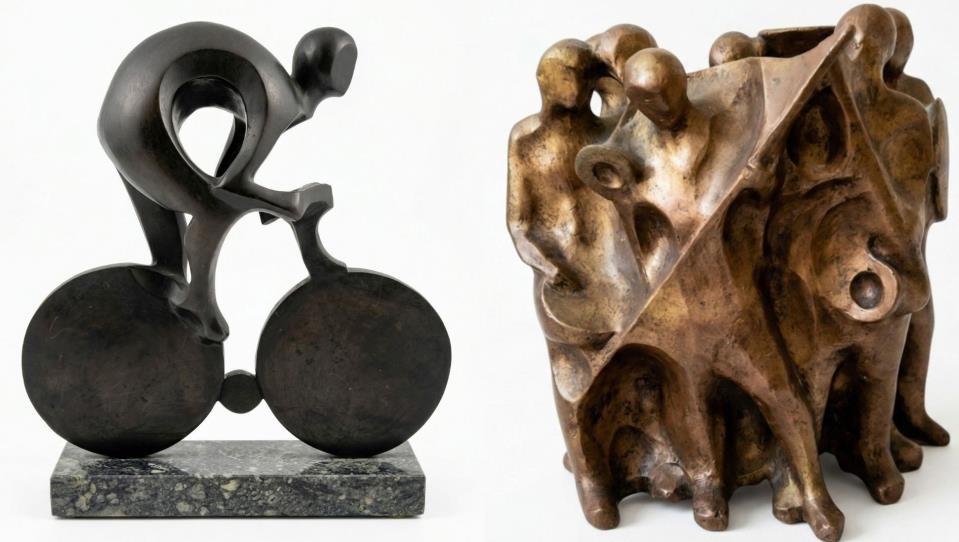
Left: Frans Galea, Cyclist, bronze, MUŻA, Valletta. Right: Frans Galea, Band, 1977, fibreglass, family collection.
The emphasis on the articulation of movement situates Galea within a broader discourse on kinetic art that had been developing since the early 20th century. While Futurism introduced the concept of motion into art, it was the constructivists who sought to reconcile the illusion of movement with real time and space. Naum Gabo's reflections on kinetic rhythms are particularly relevant here, especially his insistence on the distinction between perceived motion in traditional art and genuine experience of real motion. Gabo was thus in search of an aesthetic of real motion. This aspiration toward real motion would later find different expressions in the work of artists such as Alexander Calder, whose mobiles introduced actual movement through air currents, and László Moholy-Nagy, whose experiments with light and mechanics explored the intersection of art and technology.
Galea was among the few sculptors of Malta's modern pioneer generation to engage, in his own way, with a kinetic aesthetic. His cyclist-themed sculptures exploit the bicycle wheel mechanism to link art, science, and technology, reflecting a desire to imbue sculpture with motion. Though materially static, these works participate in a kinetic language. The bicycle wheel, the circular motif, the rhythmic interplay of forms, all contribute to a sense of movement. In this respect, Galea's work dialogues with the experiments of Calder and Moholy-Nagy, even if he never fully embraces their technological ambitions. His use of circular forms, often generated with the precision of a compass, furthermore, recalls Bauhaus methodologies and underscores a modernist concern with unifying art, design, and technology.
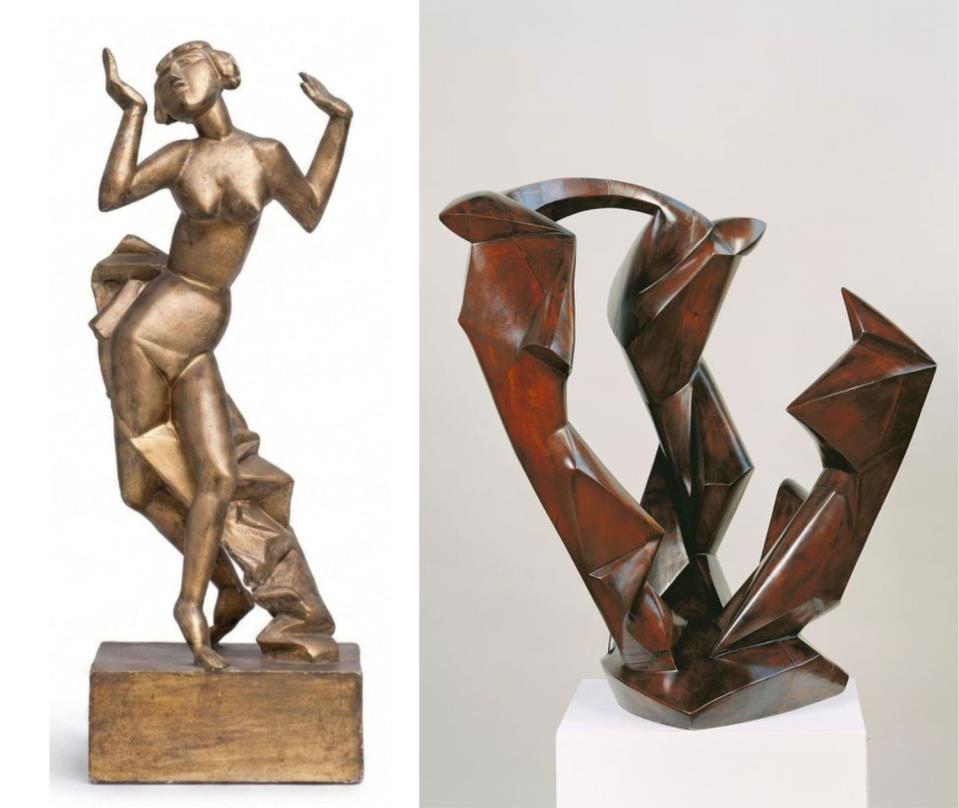
Left: Rudolf Belling, Tänzerin,1916, bronze, Kunsthandel Wolfgang Werner Bremen Berlin. Right: Rudolf Belling, Triad,1919, bronze, The Kröller-Müller Museum, Otterlo.
Another avant-garde style in Galea's oeuvre manifests in his angularly stylised sculptures. Within an international milieu, this angular stylisation brings Galea's work close to the German expressionists William Wauer and Rudolf Belling who belong to the second generation phase of the German Expressionist movement, both sculptors displaying that unmistakable synthesis and crossover of stylistic resources that art historian Eberhard Roters has called "Cubo-Futuro-Expressionism". Combining Expressionism with the forceful lines of Futurism and Cubism's fracturing of the surface plane, their style is characterised by a synthesis of Cubism, Futurism and Expressionism where the human form is reduced to simplified geometric shapes.
Similarly, in his angularly stylised sculpture, in addition to distilling figurative elements to essential forms, Galea introduces a dynamic rhythm through pronounced angularity. This effect is achieved through a cubist-informed approach to breaking down surface planes, resulting in a distinctly geometric treatment of form. Angular, faceted, and simplified planes predominate, producing sharp-edged compositions that generate a vibrant interplay of light and shadow. Through the strategic use of fractured surfaces and abstracted forms, Galea infuses his work with a sense of movement, dynamism, and modernity, evoking the technological innovations of the machine age. It is particularly interesting to observe how Galea transposes this angular stylisation into a distinctly Maltese subject matter in his sculpture Għonnella, where the traditional headdress is reinterpreted through a series of sharply defined, angular planes that both preserve its recognisable silhouette and transform it into a modernist, quasi-architectural structure.
Galea's Tutto-Tondo style is an evolution of his angularly stylised sculpture, a style in which he tackles the problem of the sculptural group, his personal concept of multiple-view sculpture. This aspect had already been confronted by other sculptors, such as Italian sculptor Arturo Martini as exemplified in his Le collegiali. Galea, however, retains his angular stylisation previously discussed, as manifested in his Umbrellas, an aspect that infuses his sculptural ensemble with a distinctly modern sensibility that is missing in Martini's sculpture.
The circular compositional motif was also very interestingly explored by the German expressionist Käthe Kollwitz in her sculpture-in-the-round, where the traditional compositional mode is transformed into figures that coalesced until they were indistinguishable from one another. This style demanded careful attention on the part of the viewer in order to determine the meaning of the figure's placement, as evident in her Tower of Mothers. Like Kollwitz, in his Tutto-Tondo sculptures Galea explores the sculptural potential of clustered figures, yet their intentions differ significantly. While Kollwitz retains the particularities of form in her figures, her work being deeply rooted in Social Realism and emotional expression, Galea moves towards abstraction and formal experimentation.
Galea, however, never manages to abstract his human figures to the point of dispensing altogether with recognisable subject matter, as Belling does in his sculpture-in-the-round Triad, where he combines tendencies of Cubism, Futurism, and Expressionism to depict spatial bodies progressing towards pure abstraction. Compared to Belling's Triad, the human figures in Galea's Band are still very discernible.
Galea's artistic development ultimately reflects both the possibilities and limitations of modernism within a Maltese context. While he never fully embraced abstraction to the extent of eliminating recognisable subject matter, his work nonetheless reveals a sustained engagement with rethinking sculpture through movement, space, and form. Although he did not revolutionise Maltese sculpture, he had the potential of introducing modern regenerative alternatives to traditional art. Galea thus emerges as an artist seeking a new language within the constraints of the old, balancing caution with innovation.
Rowna Baldacchino is a Maltese art historian and cultural critic with postgraduate specialisation in art history, literature, and translation, focusing on modern and contemporary art in Malta