Steven Xuereb Haber's work as an art director for film was brought to an unexpected pause during the 2023 actors' and writers' strike in the UK. In this interval, the Dance of Death was born. The launch of Xuereb Haber's debut graphic novel will open the associated exhibition on Friday 1 May, at the Malta Society of Arts, where Xuereb Haber's work will be on display, allowing us to peer further into the murky depths of the novel's world, as well as giving us insights into the behind-the-scenes process.
At the centre of the exhibition is the graphic novel itself, a 200-page hardcover volume in full colour. Visitors will be treated to behind-the-scenes material that reveals the artistic journey towards the book, including original works in charcoal and ink as well as printed pieces showing the phases of production, such as early sketches, preparatory artwork, and developmental pieces. A selection of these pieces, including preliminary sketches and character studies exclusive to this exhibition, will be available for purchase. The exhibition is structured to guide the viewer from the final result back to its origins, allowing them to understand "not just what the work is, but exactly how it came to be".
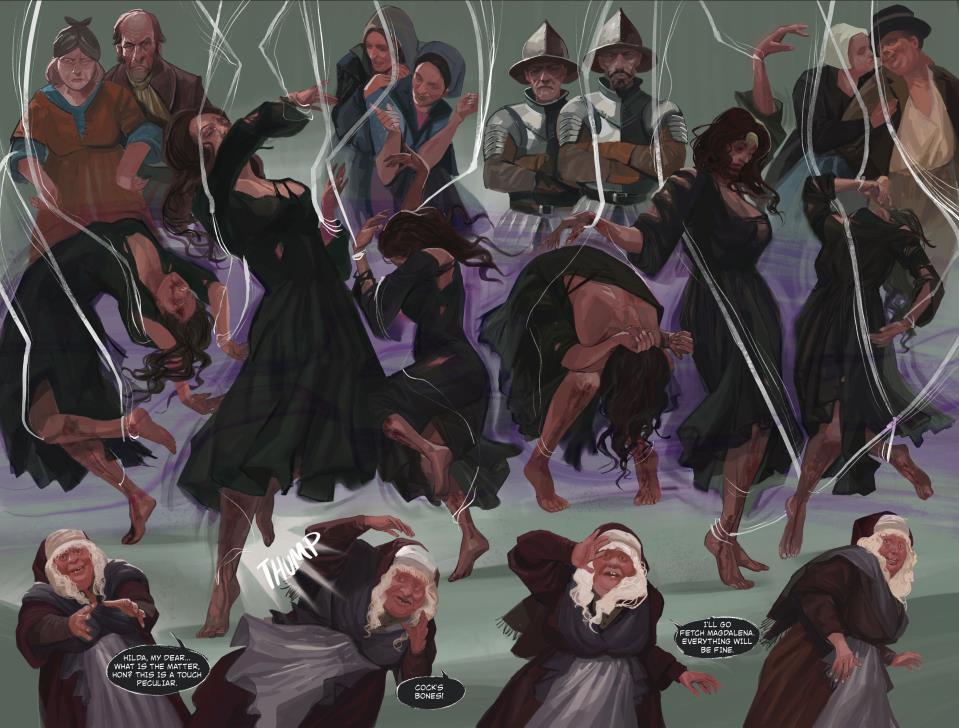
Xuereb Haber declares a long-standing fascination with horror, especially when it has its source in history: "I have always been drawn to horror, because of the uncanny, almost alien way these stories from our past mirror our anxieties in the not-so-distant future." He finds the so-called "Dancing Plague" of 1518 to be a "particularly haunting" incident: "What fascinated me most was how something intangible and unspoken could spread through a community with such intensity, almost like a social wildfire. I have always been deeply intrigued by social mania: the way people can lose themselves within a collective behaviour that defies logic." For Xuereb Haber, this historical incident "represents the moment when individuals stop acting independently and become part of a shared rhythm". The exhibition thus explores themes of social mania, oppression, and the ways in which societies respond to trauma.
Xuereb Haber describes St Vitus - the patron saint of dance, believed to be the source of the curse - as a "quasi-Pied Piper of Hamelin who puppeteered and drew a group of vulnerable people from all walks of life into a maelstrom of dance". Ideas of control and loss of control became central to the project: "At its core, the work looks at how collective behaviour can emerge in moments of extreme pressure and how individuals can lose themselves within a larger, uncontrollable force," as more and more people joined the dance, abandoning their willpower (to another?) without understanding the origin of, or reason for the compulsion.
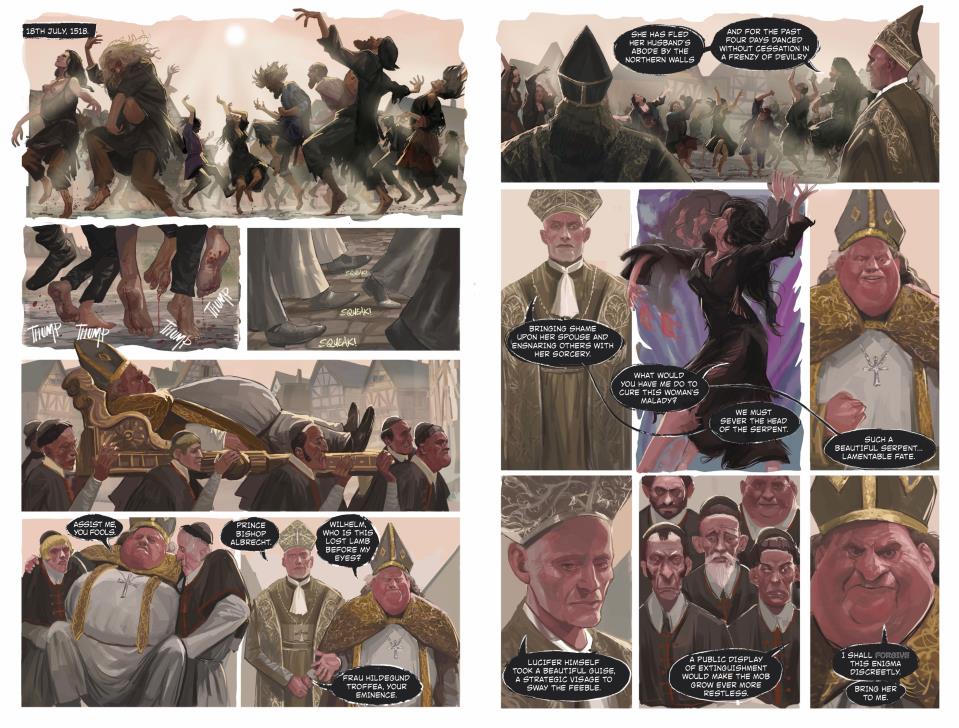
Xuereb Haber's graphic novel does not aim to be a historical retelling, "instead, it blends historical inspiration with a supernatural perspective". He explains: "As the period itself was deeply rooted in superstition, it felt fitting to represent that worldview in a more tangible way. The 'dance' becomes more than a literal event, serving as a cry for help, a response to repression, and a way of dealing with trauma. It is an attempt to escape pain through movement, even if it leads to self-destruction."
While these ideas are rooted in history, Xuereb Haber sees clear parallels with modern society, as "forms of social contagion still exist today" although these are "more subtle". The work also touches on self-destruction as "both a symptom of trauma and a form of expression", as people collectively seek "a way to cope with things they cannot fully articulate".
Alongside developing the written scripts, Xuereb Haber works first in ink, an inscribing that is a very gestural and deliberate form of expression, facilitating the capture of mood moment-by-moment throughout the story. Care was taken to preserve this "gestural spirit" in the subsequent process of digital development. The design of the visual language progressed through dialogue with the illustrator Hassan Hameed Tabrizi, an intensive and transformative process in which the artwork "evolved and adapted". The story benefited from Astrid Thorvalsen's capable editing as both an award-winning film director and horror fan. The entire project took around two-and-a-half years to complete.
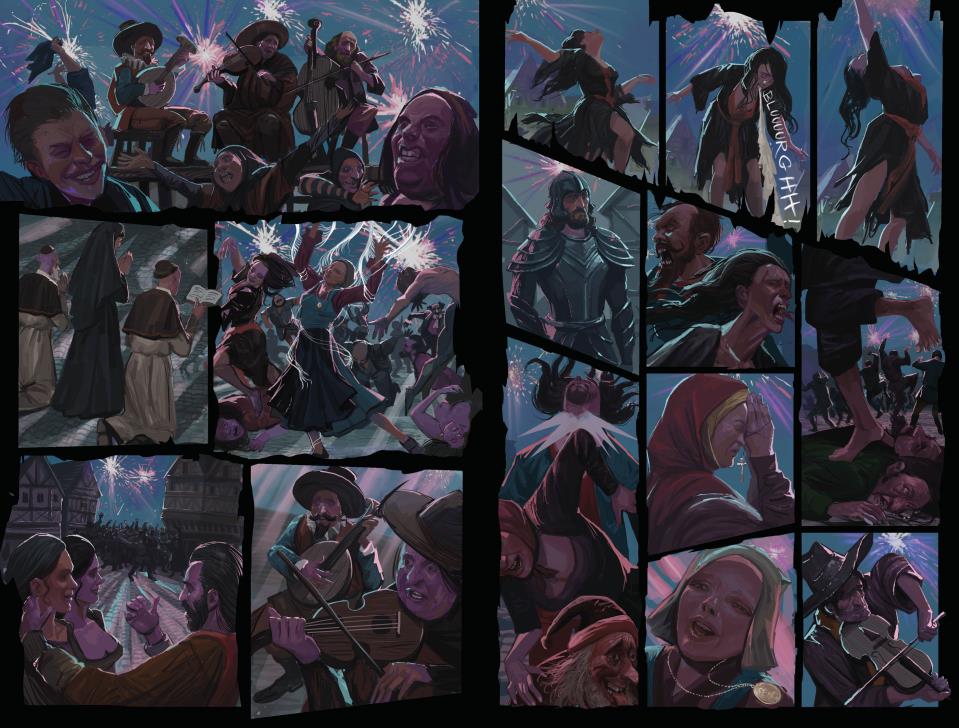
The exhibition at the Malta Society of Arts shares several key emotional and visual moments of the story, specifically depicting pivotal scenes from the dancing plague, including one of Xuereb Haber's favourite moments: "when Frau Troffea, the catalyst of the dancing plague, takes to the streets to topple the first domino".
The exhibition opens with the book launch on Friday, 1 May at 8pm and will remain open until 5 May. It offers an opportunity to support the medium of the graphic novel locally. As Xuereb Haber notes: "Graphic novels are a powerful and often under-appreciated medium, combining visual art and storytelling in a way that is both immediate and deeply immersive." Xuereb Haber hopes that the exhibition will encourage people to engage more deeply with the medium and the processes of its production. Beyond this, this exhibition will ultimately appeal to anyone with a love for stories, and Xuereb Haber further hopes that visitors will "come away with a deeper understanding of human behaviour and of how individuals respond to pressure, trauma, and shared experience".
The project is supported by Arts Council Malta and guided by writer Clare Azzopardi.
Dr Joe Borg, president of the Malta Society of Arts, comments: "Xuereb Haber's exhibition showcases the collaborative journey towards the production of his debut graphic novel, and is a testament to storytelling through art. The MSA is pleased to support the growing local graphic novels scene."
'Dance of Death', an exhibition by Steven Xuereb Haber, is on from 1 to 5 May at the Basement Vaults of the Malta Society of Arts, Palazzo de La Salle, 219 Republic Street, Valletta. The exhibition is open Monday and Tuesday from 9am to 3pm and Saturday and Sunday from 9am to 1.30pm. Admission is free.
For further information visit www.artsmalta.org or www.facebook.com/maltasocietyofarts