The Manoel Theatre has a particular way of holding an audience before anything even begins. Its gilded balconies, its soft amber glow, its sense of being both intimate and ceremonial at once - all of it creates the expectation that something meaningful will unfold, even if one is not entirely sure what form that meaning will take. On the evening of 27 March, yes, that long ago for various reasons, I found myself settling into my seat with that familiar mixture of anticipation and curiosity, ready for a programme whose details I had already half-forgotten but thankfully the printed version is at hand. I was there for the concert Revolution and Revelation with Maestro Michael Laus conducting our MPO and Francis Camilleri at the piano.
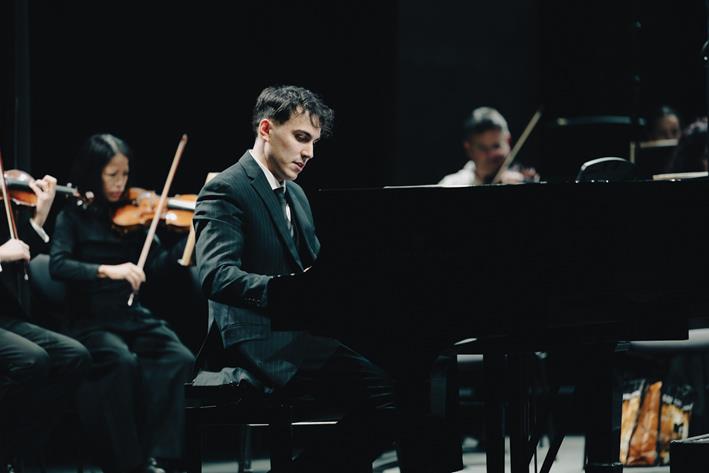
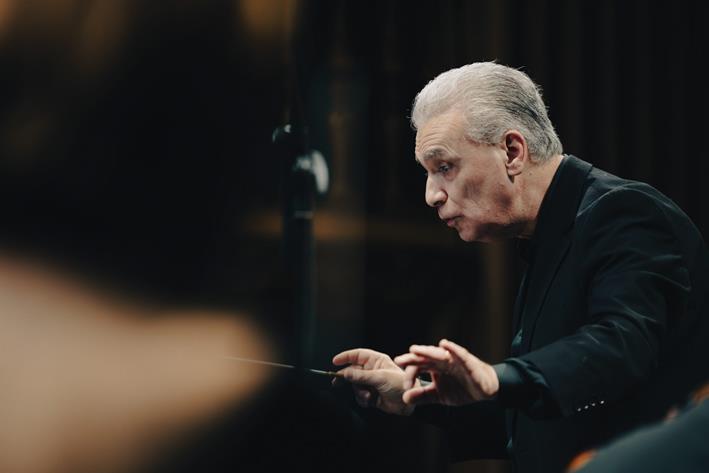
The orchestra opened with Beethoven's Leonore Overture No. 3, that great dramatic sweep of tension and release, a piece that always feels like a compressed opera - all the yearning, all the struggle, all the triumph, distilled into a single arc. The music announced itself unmistakably. The slow, searching introduction, the sudden blaze of light, the offstage trumpet call that always feels like a message from another realm. The players, under the firm baton of Maestro Michael Laus, seemed alert to the architecture of the work, shaping it with care, letting Beethoven's long lines unfold without hurry. It was a solid, dignified opening, the kind that steadies an audience and prepares it for whatever comes next. And what came next was pianist Francis Camilleri, walking onto the stage calmly, neither self-conscious nor theatrical, simply present. There is something quietly reassuring about his manner - a sense that he is there to serve the music rather than himself, and that he approaches the instrument with a mixture of discipline and affection. This was the first time I had the opportunity of listening to him. The work he performed was Joseph Vella's Piano Concerto, Op. 41, a substantial piece with its own internal logic and demands. Francis approached it with seriousness, maintaining a steady dialogue with the orchestra. Even when the material itself did not always rise to the level of his artistry, he remained committed, attentive, and fully in command of the keyboard. Let's face it. Playing classical composers who have stood the test of time is one thing; tackling a local composer quite another. I am not a critic but I know to which I would rather listen.
What struck me most was Francis's poise. There are pianists who rely on flamboyance, on exaggerated movements, on a kind of physical theatre that distracts from the music. Francis is the opposite. His playing is grounded, centred, and deeply musical. He listens. He breathes with the phrases. He gives each line its due without forcing it into something it is not. Even in passages that felt more dutiful than inspired, he maintained a sense of integrity that is increasingly rare. It is the mark of a true musician - someone who honours the score, the audience, and the moment, regardless of the repertoire placed before him.
The concerto unfolded with its contrasts and complexities, and Francis navigated them with admirable control. There were moments when the piano writing allowed him to reveal his natural lyricism, and in those passages his sound warmed, deepened, and took on a glow that showed me how beautifully he shapes classical repertoire. The orchestra supported him with sensitivity, and the overall performance, though uneven in its material, was executed with professionalism and care. I cannot say I felt much enthusiasm for this concerto.
But the evening's true revelation came after the applause, when Francis went off stage for a few minutes and cam back for an encore. It was Schubert's Impromptu in G-flat major, Op. 90 No. 3 - a piece that seems to float rather than unfold, as though it were made of breath and memory rather than notes. From the first phrase, the atmosphere in the theatre changed. The audience quietened in a different way, leaning inward, sensing that something more intimate was about to be offered. And Francis, freed from the weight of the concerto, allowed his natural musicality to bloom. He told me later that it was actually one of his favourite pieces to play, especially as an encore. Schubert is also a favourite composer of his alongside Beethoven. In fact, on 10th March he had played a recital with sonatas by Schubert (A minor D. 784) and Beethoven's Appassionata at the Manoel Theatre which was his debut there as a soloist playing a piano recital. How on earth did I miss that? He also teaches piano at the School of Music in Gozo.
I am looking forward to Sunday 14th June at the Malta Society of Arts in Valletta as part of the Malta International Arts Festival. One of the works which he will be playing is Beethoven's Moonlight sonata, which he will be also playing at the Corinthia on July 5th. There is another concert of completely Maltese composers with other pianists but they don't interest me. I like music which has been tried and tested the world over and over centuries.
His touch in the opening melody of the Schubert Impromptu was exquisite - tender without sentimentality, poised without rigidity. He made this well known and well loved piece feel personal, almost confessional. The balance between hands was perfectly judged, the accompaniment rippling like soft light behind the melody. It was as though he had stepped into his true voice, and the instrument responded with gratitude. The middle section, with its gentle surges and retreats, was played with a quiet nobility, and when the opening theme returned, it felt like a homecoming. In those few minutes, Francis revealed the depth of his artistry far more clearly than any concerto could have done. It was the highlight of the evening, and the audience knew it and the applause was enthusiastic. Francis then disappeared. I so wished he would come back and given us another encore but he didn't. Schubert didn't live long enough to fulfil his God-given talent. I disagree but no space for such arguments.
After the interval came Mendelssohn's Reformation Symphony, a work that carries its own sense of grandeur and uplift. The orchestra handled it with energy and conviction, giving the final movement its full, hymn-like radiance. But for me, the emotional centre of the night had already occurred. It was contained in those few minutes of Schubert - a moment of clarity, of beauty, of genuine musical communication.
As I left the Manoel, I found myself thinking about the strange alchemy of concerts: how a programme can be uneven, how certain works can feel distant or dutiful, and yet how a single performance, a single piece, even a single phrase, can redeem an entire evening. Francis Camilleri did that. His encore was not just an add-on; it was the true heart of the night, the place where music spoke directly and without complication. And that, in the end, is what lingers. Music that touches the heart.