Rather than existing as fixed or bounded, place is continually produced through repetition and the circulation of visual forms shaped by layered colonial histories, where meaning shifts as it moves across contexts. Identity follows a similar logic, emerging as relational and unstable, formed through movement, memory, and adaptation.
Jade Zammit (b. 1990) is a Maltese visual artist whose practice centres on intimate, everyday encounters, developed through private live drawing sessions establishing a space of shared vulnerability between artist and subject. Trained initially in architecture at the University of Malta, her work retains sensitivity to structure, spatial relation and inhabitation. Since 2020, she has participated in collective exhibitions and undertook her first residency at R.A.R.O. Barcelona in 2021, supported by Arts Council Malta. Works developed during this period was later presented as part of the Spring v2.3 programme at the Gabriel Caruana Foundation, which supports early-career artists.
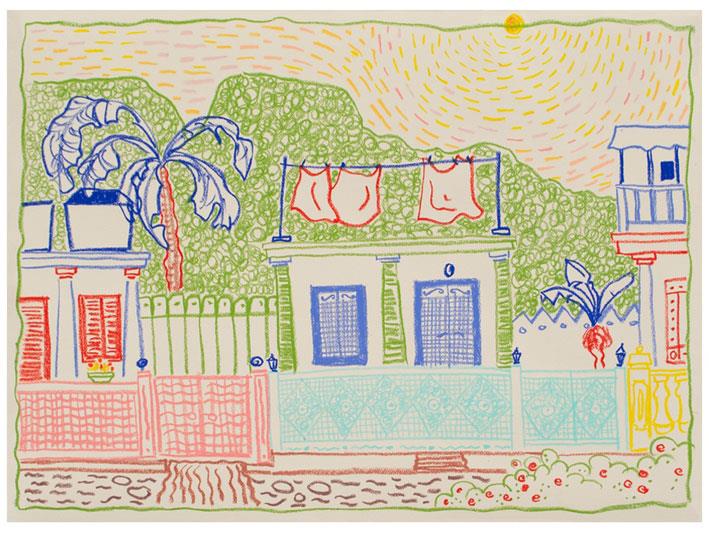
Borrowed Territories, produced by Marie Gallery 5, presents a new body of work in pastel, coloured pencil, and mixed media, developed from landscapes encountered during travels across Australia, India, Cuba, and Costa Rica. Although geographically distant, these sites are connected through layered colonial histories that continue to inform their visual and cultural character. Parallels emerge across these contexts as European architectural forms reappear within different local environments. The presence of Baroque architecture in Havana, alongside Victorian domestic styles in parts of Sydney and Melbourne, positions "borrowed territories" as a way of understanding how ideas of place are formed through movement and adaptation. This brings into focus questions of displacement and belonging.
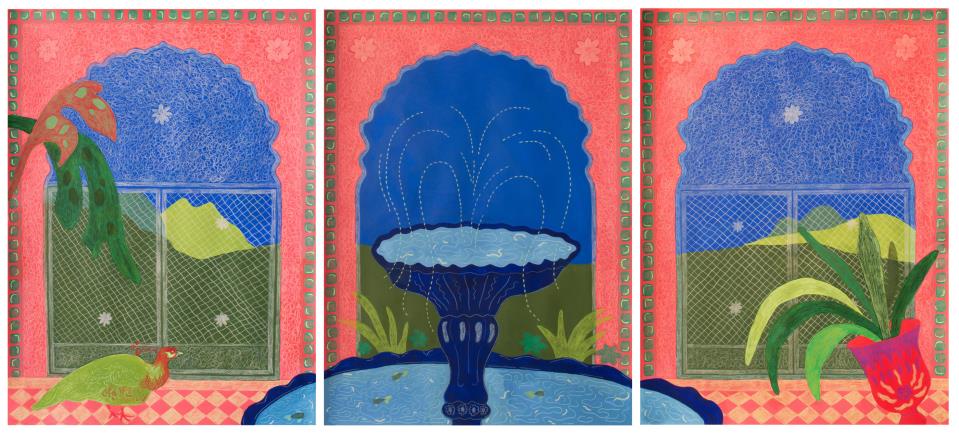
The works move between the personal interior, the community, and broader cultural symbolism, with boundaries between these registers collapsing most clearly within domestic ritual. As Zammit notes: "The 'interior' is rarely a closed box; it is a porous space where community life bleeds in." This permeability extends beyond the immediate context, where the circulation of forms across places reflects a desire to recreate familiarity elsewhere. Kate Grenville's The Secret River references colonial settlement as an act of material transplantation shaped by longing, where imported forms are used to reconstruct a sense of belonging in unfamiliar landscapes. Yet these spaces are not fully absorbed into such frameworks, maintaining a degree of independence that complicates how these borrowed forms settle and take hold. This dynamic resonates with Oswald de Andrade's concept of anthropophagy, where external influences are absorbed and reconfigured into something new.
Within this logic of circulation and reproduction, the fountain emerges as a recurring motif symbolising colonial "civility", wealth, and the attempted domestication of nature, as can be seen in Rajasthani Gardens. As Zammit notes: "Repetition reinforces the idea that these symbols are 'borrowed'; they are appropriated from another place and repeated often enough that they become part of a new landscape," framing this as a multiplicity of histories rather than a single linear narrative. This logic of repetition is extended through Zammit's reference to Salman Rushdie's Midnight's Children, where colonial architecture and imported spatial forms are used to reconstruct familiarity in unfamiliar environments, revealing how "home" is continually reproduced rather than simply relocated.
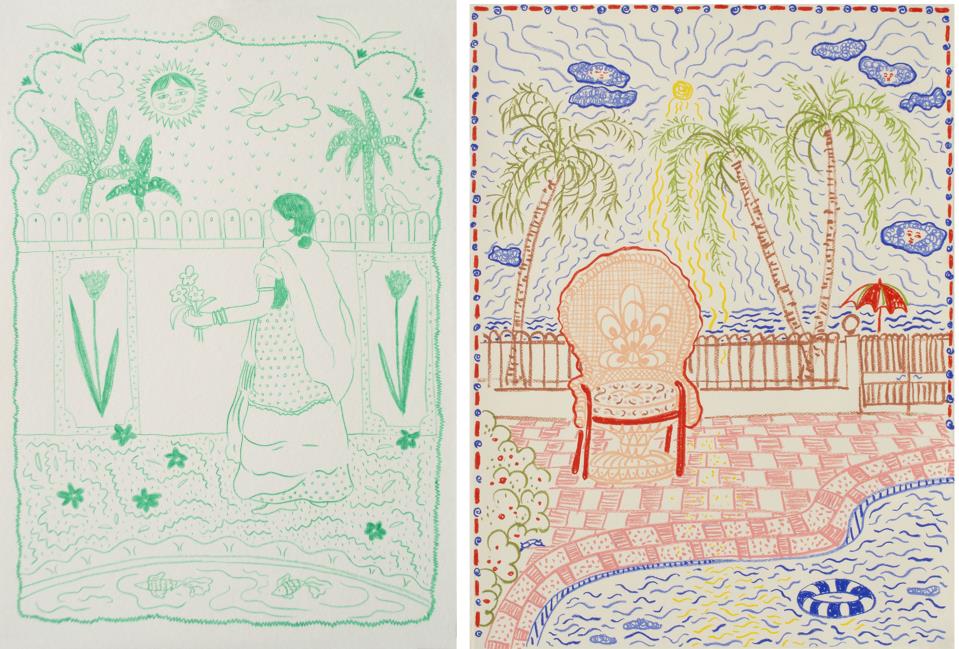
While these imported forms are imposed onto new landscapes, they do not fully overwrite existing visual languages, which remain structurally and symbolically active within the works. This is particularly evident in the visual language of personified celestial bodies, where sun, moon, and stars are transformed into active presences rather than passive background elements. Zammit draws on Rajasthani architectural interiors, miniature painting traditions, such as those found in Chitrashala, and Jain temple iconography, where celestial forms are frequently endowed with agency and character. In Private Offerings, this is reinforced through the removal of the human figure, with attention redirected toward the sun as the dominant point of perception, shifting the work's focus from human subjectivity to an animated environment. As she explains, these references engage a visual tradition in which celestial bodies are not treated as distant light sources, but as integral components of spatial and narrative structure.
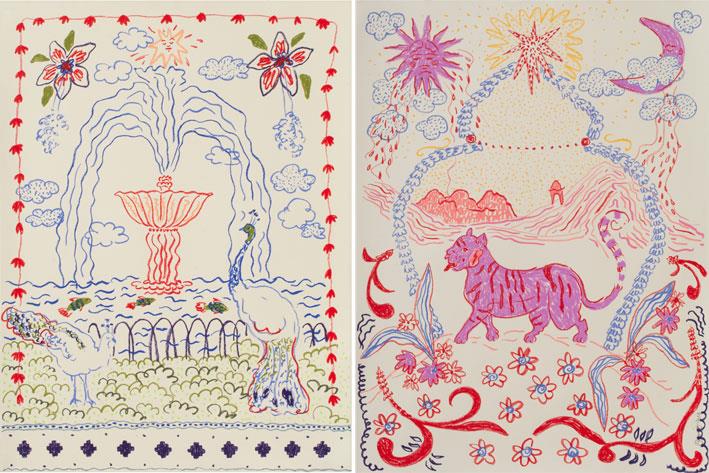
Beyond the subject matter, it is the manner of representation that is also a central focus. An architectural sensibility underpins Zammit's process, where forms are reduced to their essential structural properties. This reduction establishes a visual language grounded in simplicity of line and composition, while also revealing underlying similarities between geographically distant contexts when stripped of surface detail. Within this logic, notions of a "globalised identity" emerge, where shared histories of movement and occupation are understood as producing a kind of structural resonance across place.
Alongside this reduction, pattern operates as both a framing device and a counterpoint, functioning not as decoration but as a structural logic within the works. These patterns, often drawn from architectural and vernacular motifs encountered during her travels, are embedded into the composition and simultaneously define its edges, operating less as borders than as thresholds. Zammit describes them as "cultural shorthand", a means of marking presence while compressing cultural reference into visual form. At the same time, she frames them as revealing a "shared human instinct to find order in chaos", positioning repetition and pattern as fundamental to how meaning is constructed across different environments.
Alongside line, bold colour plays a dominant role in shaping how the work mediates its heavier historical and contemporary themes. Zammit describes colour as an initial point of attraction, noting that "colours invite the viewer in, mirroring the way 'exotic' lands are often sold to us as paradise". This visual seduction, however, is deliberately destabilised, as deeper concerns around colonialism, displacement, and blurred identity emerge through sustained engagement with the work. As she explains, the use of vivid colour is not intended to sanitise history, but to acknowledge the vibrancy of the cultures and people that persist within it, with colour functioning as a form of visual vitality that remains in tension with its historical weight.
This framing is particularly relevant within Zammit's context as a Maltese artist working from a small island shaped by colonial histories, where questions of origin and influence remain deeply embedded in everyday visual culture. As she reflects: "Locally, coming from a small island with a colonial past, I recognise that our 'authentic' identity is actually a beautiful, messy collage of outside influences. The boundary between 'mine' and 'theirs' disappears when a symbol, like a specific floral pattern or an architectural arch, becomes so ingrained in a local community that its foreign origin is forgotten. My work lives in that blurred space, celebrating the cultural and artistic 'digestion'."
Borrowed Territories is open to the public until 10 June at Marie Gallery 5.