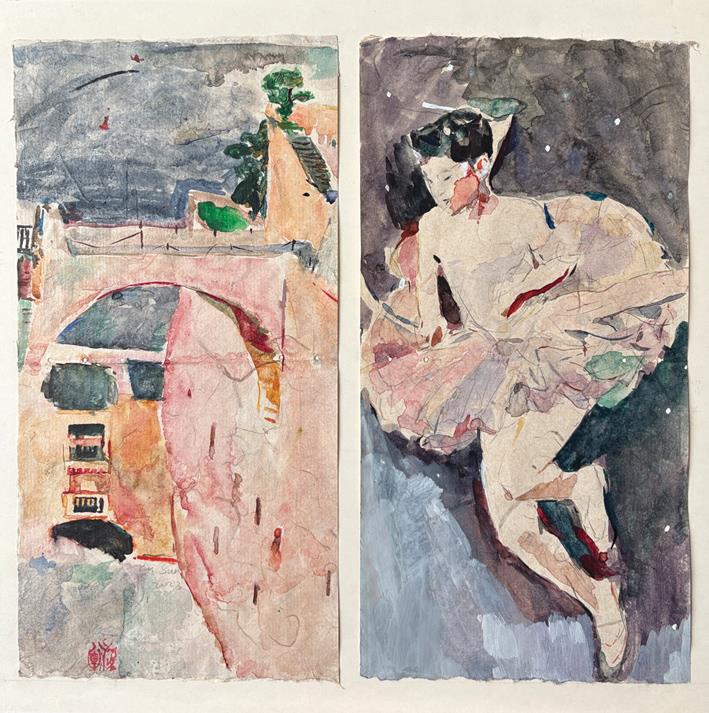
Il-Kamra ta' Fuq will be filled with open-ended stories, speculations, and shifting narratives from the 1st till the 17th of May, as we host the exhibition What Happens in Between by Hui Sun.
Since we started promoting the exhibition, we have received quite a number of questions, mainly about the artist, and of course, about the exhibition title. As usual, let us begin with a little background check.
Hui Sun is a Chinese artist who currently resides in Malta. He studied at Yunnan Art University, where his graduation work, History Wheel I, was acquired by the university's Art Museum, surely an achievement worth noting.
He has participated in numerous exhibitions in China and Malta, receiving recognition, including third prize at the Yunnan Young Artists Exhibition (2012) and third prize at the Yunnan Oil Painting Society Art Exhibition (2020). His practice weaves disparate themes into a single pictorial plane, creating visual tensions that reflect social and interpersonal dynamics. Engaging with the fragmented nature of contemporary urban life, his work draws from both historical and contemporary references, forming spaces that oscillate between the real and the imagined.
In this exhibition, we encounter something similar, but perhaps on another level altogether.
I met Hui Sun and his wife, Yuexin Kong (who is also an artist), during a mentoring session. Not on how to paint, of course, but rather on navigating the administrative side of things and understanding how the art sector functions in Malta. We immediately hit it off, perhaps helped by the excellent tea they always served during my various visits.
The quality of their work was outstanding, and following those mentoring sessions, I collaborated with both of them on a major collective exhibition titled Landscapes, Seascapes & Imaginary [E]scapes, held at the Grandmaster's Palace in Valletta in aid of the Malta Community Chest Fund. And now, here we are.
For me, what happens in between the curator's studio visit and the setting up of an exhibition is mostly a series of rather boring administrative tasks, aside from the occasional exchange of ideas with the artist. But what happens in between the artworks presented in What Happens in Between is anything but boring.
Here, visitors are invited to be creative with the narratives they may form while exploring the works, piecing together their own stories from the fragments placed before them.
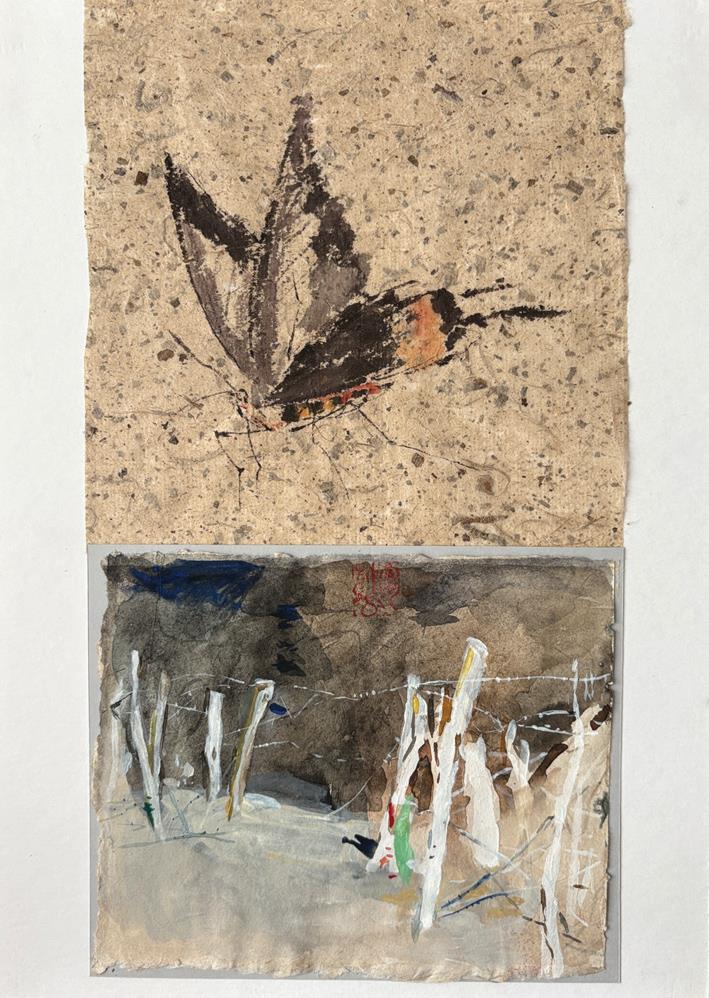
Let me explain. Each artwork in the exhibition is made up of at least two independent works by Hui Sun, sometimes even in different media. Although they were not originally created as a pair, they have not been brought together by coincidence, but through decisions known only to the artist.
In fact, during my first studio visit, when we decided to develop this idea of presenting two works in one, I began pairing a few fragments myself. Hui immediately stopped me and said, "No, that doesn't pair with that; it goes with this, and that."
The two fragments are positioned in deliberate proximity, like distant ends of a story that never fully reveals itself. Rather than forming a continuous narrative, these paired scenes resist resolution. They hover beside one another, suspended in a state of quiet tension.
In this presentation, Hui Sun's paintings do not depict singular moments, but simultaneous ones. What emerges is not a clear storyline, but a condition in which meaning remains unstable, constantly shifting between what is seen and what is inferred.
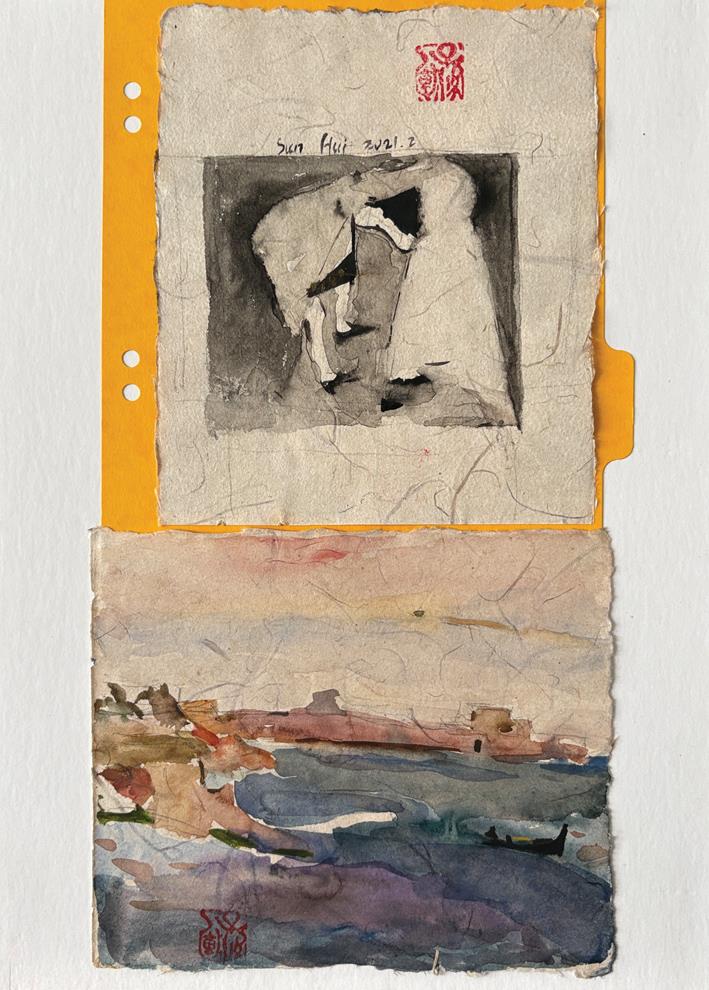
The relationship between these images is neither fixed nor explained. Instead, it is left open, fragmented, and incomplete, continuously reshaped with each viewer and each interpretation. The viewer is not guided toward a definitive reading but invited to navigate the distance between these elements, trace possible connections, or accept their dissonance. We are presented not with fixed narratives, but with propositions: open-ended structures in which multiple readings can coexist.
Hui Sun extends this approach further through his "polyptychs." In Reshape, a hexaptych, he brings together six works under a single title and display. Are these chapters of a longer, unfolding story? Once again, this remains open to interpretation. The grouping brings together insects, landscapes, seascapes, a fight scene, and a view of a broken gate. In fact, on closer inspection, one might even begin to construct a narrative that threads them together into a single, shifting story.
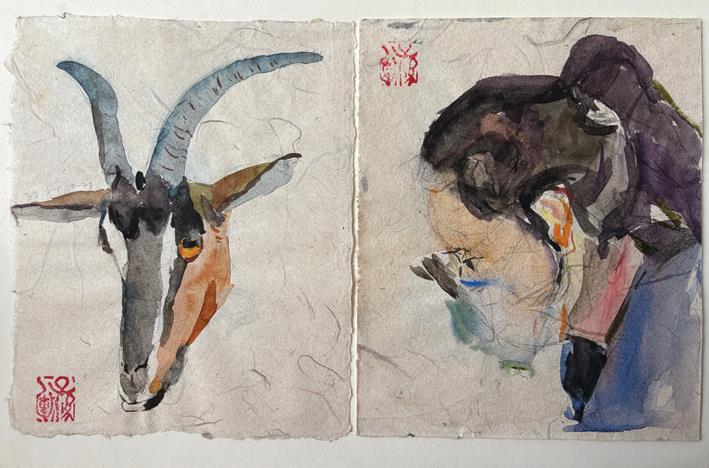
Next we have a pentaptych titled Relationships, combining four portraits, two goat faces, a pair of fish, a scene with police, a cityscape, and a landscape... I am very curious to see what stories will emerge from this one. In fact, when the title is brought into the equation, I can already start to see a very compelling narrative forming.
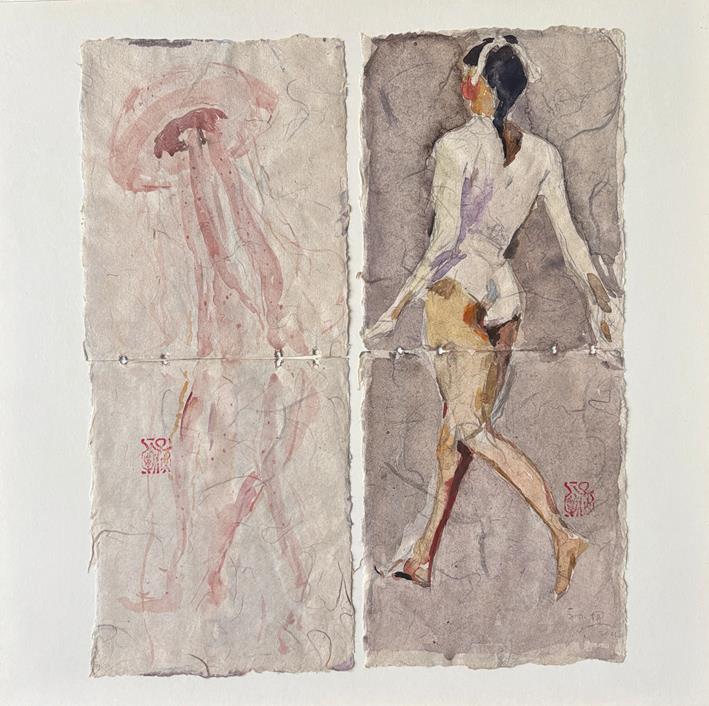
Another set of five works, titled Poetic Conception, shows a frog, a spider, a jellyfish, a ballerina in a tutu, perhaps a calligraphy set, along with a few land and seascapes. The central work features a jellyfish with its long tentacles, almost like pairs of delicate legs, paired with a female figure in a bodysuit, her own long legs left bare.
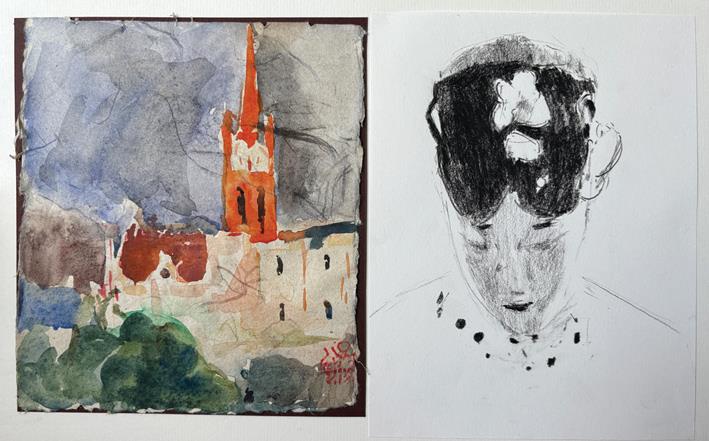
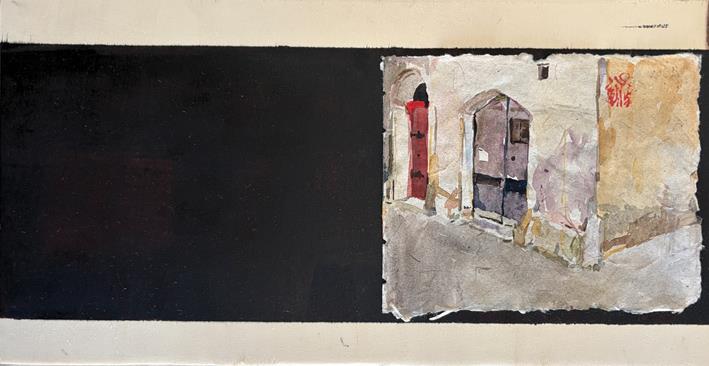
A Corner of Nature series is quite intriguing. The middle panel of the vertical triptych shows two scenes from nature, one in watercolour and the other in pencil on paper. The contrast is striking, yet there is a sense of harmony, perhaps suggesting that, in the end, nature always takes over. The upper work shows a street corner, while paired to it, we find a stark black square, with something concealed or deliberately hidden underneath it. In the bottom work, there is an abstract composition, paired with another dark square covering what appears to be the silhouette of a Victorian-style house.
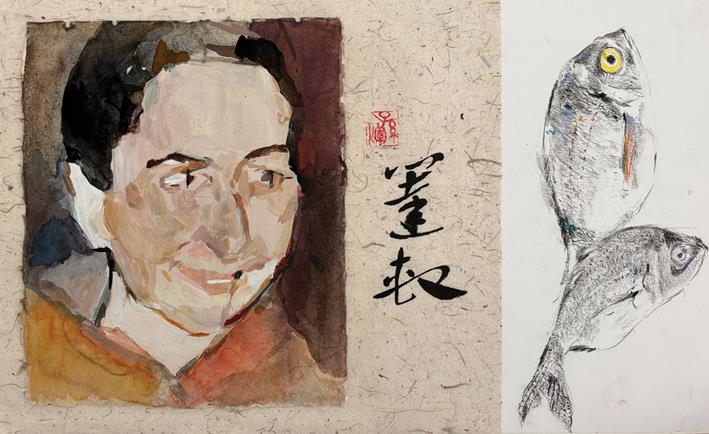
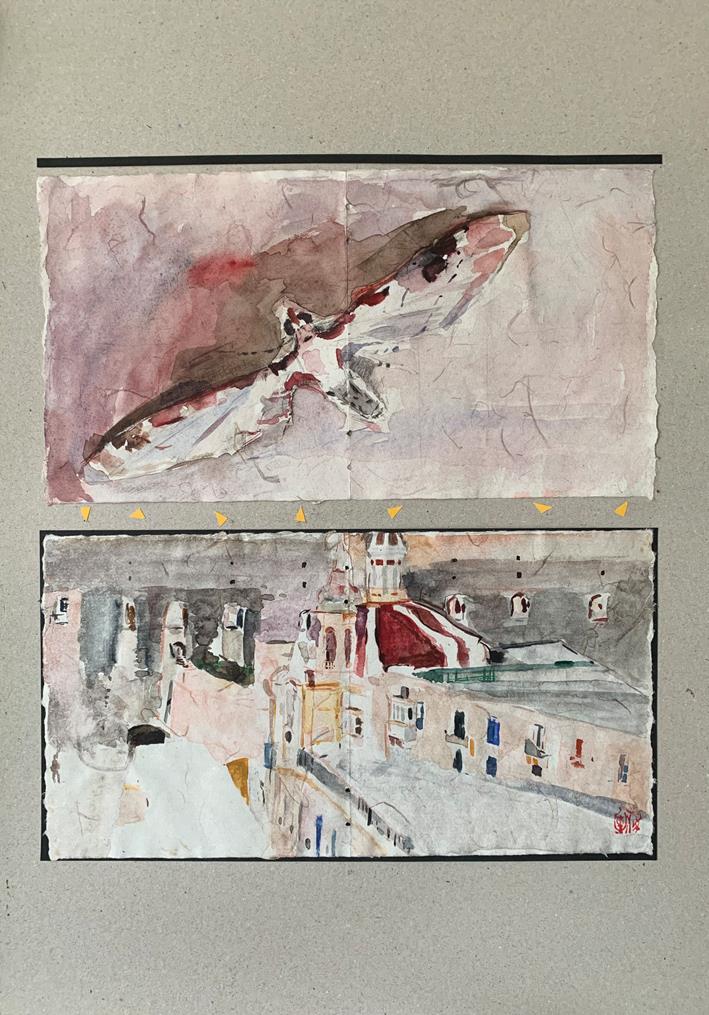
Next are some independent pairs, framed on their own. No chapters here. In Memory, there is a striking play on patterns and colours, where in the top painting, we see a dragonfly with a red ochre-like pattern on its wings. The connection becomes immediately noticeable in the work below, where we find a typical Maltese church dome, rendered in the exact same colours seen on the dragonfly's wings.
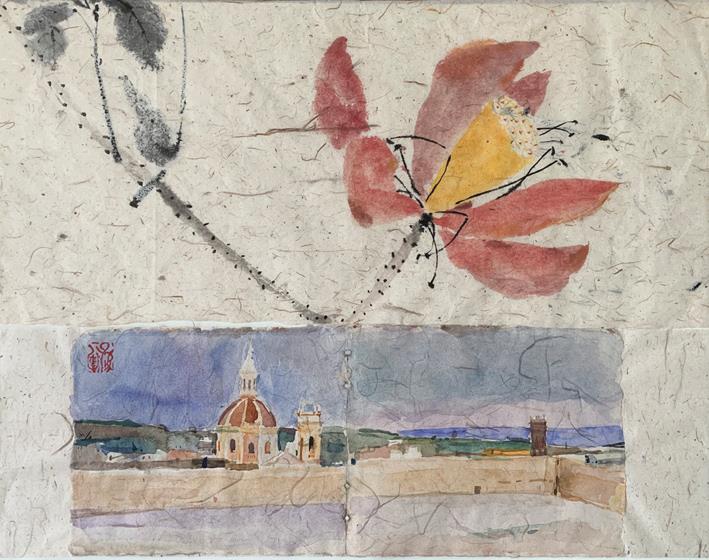
The work I find most intriguing is titled Stretched Shape. The two independent works appear to belong to the same sheet of beautiful paper (some of which is also a very special handmade paper). A classic Maltese village scene presents the almost mandatory view of the church and its majestic dome from a rooftop. So far, everything feels familiar. Then, quite suddenly, a giant flower emerges from the village's blue sky, almost turning the landscape into a decorative pot for this unexpected bloom.
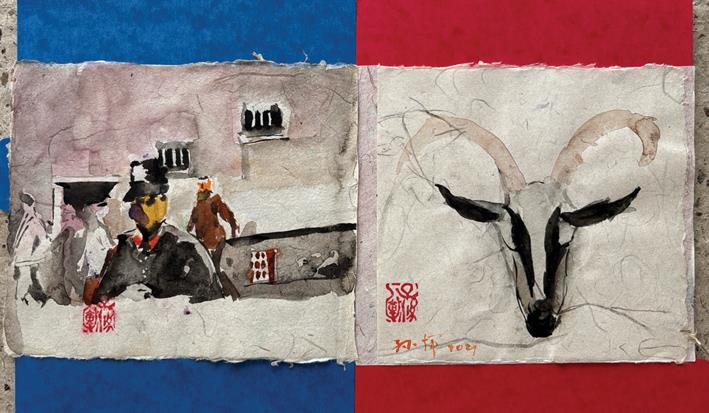
Light & Heavy is another intriguing one. At first glance, one might think it's just two landscapes, and yes, there are indeed two landscapes, but if one looks closer, one sees that the bottom work contains the contact details of an art gallery in Gozo, written upside down. One wonders what came first: the scribble or the painting? And one can't help but wonder whether we should revise our business plan or simply continue displaying the contact details of another gallery within our own gallery!
Needless to say, I am really curious to hear the stories that will unfold for visitors. It is within this space of uncertainty, the interval between one image and another, that the work fully unfolds. What is absent becomes just as significant as what is present. In these works, storytelling does not reside within the image itself, but in what happens in between.
The exhibition is on until the 17th of May at il-Kamra ta' Fuq. For more info, find us on social media, and when you find us... Follow us!