It was during May 1955, that W. A. Muller, CMG, inspector-general of Colonial Police, visited Malta to recommend changes to improve the organisation and efficiency of the Malta Police Force.
During the same month, members of the district constabulary submitted recommendations for the improvement of their lot. The following feature offers readers a brief look into the early days of the Malta Police Force union in July 1955.
A brief history of policing in Malta
According to vassallomalta.com, the Malta Police Force in its present form dates from a proclamation during the governorship of Sir Thomas Maitland (1813-1814). Other important dates extracted from this website are the following:
- The earliest records of policing in Malta date back to the Arab rule (AD 870-1091) when the sahib el-xurta was responsible for maintaining public order.
- During the Aragonese period, in 1283, this work was strengthened with the establishment of the office of the Head of Justice or the Capitano di Verga, who became responsible for criminal and civil offences.
- In 1530, Malta was offered to the Order of St John and policing fell under the control of the Gran Visconte.
- The criminal law was written down in the Code de Rohan, promulgated in 1784, and amended by subsequent notices known as bandi.
- When the French seized the island in 1798, the military and a civil commission of government became responsible for the maintenance of law and order.
According to the Malta Police Union website, The Malta Police Association (MPA) was set up on the 25 July 1955. The objectives behind its setup were mainly to protect young officers from any possible victimisation and to ensure full cooperation and better understanding between officers. The Malta Police Union celebrated its 70th anniversary in 2025.
Malta during the 1950s: A boiling pot of events
There was a growing urgency for unionisation, along with demands for better wages and working conditions within the police force, shaped by the wider political, economic, and religious climate that defined Malta in the 1950s. Some key aspects of this period involved the following:
- The Integration with Britain debate
- Church-State relations
- Economic collapse and strikes
- The direct rule by the Governor after Prime Minister Dom Mintoff resigned in April 1958
- Mass emigration of circa 30% of the population fuelled further the unrest
Visit by W. A. Muller
When W. A Muller, CMG, inspector-general of Colonial Police, visited Malta in 1955, one of the main themes of his recommendations was the separation of the Police Force from the general machinery of government civil service.
He reiterated that conditions such as pay, allowances, leave and other emoluments were to be treated separately. He suggested that police conditions, including pay, allowances and other emoluments and leave, be fixed independently of those of the civil service.
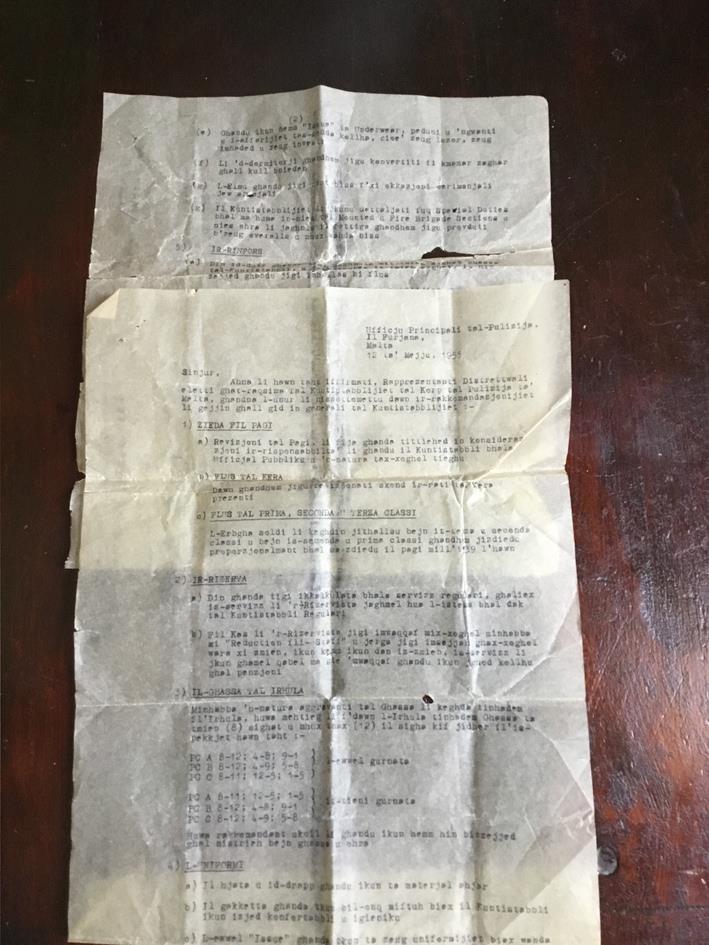
It is of no great surprise that claims were already in place and being put forward by the District Representatives elected by the Constabulary Section of the Malta Police Force (Taqsima tal-Kuntistabblijiet tal-Korp tal-Pulizija, Malta) during that same month as evidenced by a typed petition in the Maltese language, which is being translated into the English language, that present quite an idea of what constables were asking for as benefit. These recommendations were sent to the Principal Office of the Police at Floriana and the petition is dated 12 May 1955.
Recommendations by the first elected district police constables
The following are the claims/recommendations made by the representatives of the first elected Maltese constabulary representatives.
1. Increase in wages
(a) A revision of wages is needed to take into account the responsibilities carried out by a constable as a public official as well as the nature of his work;
(b) Rental money. These have to be revised according to the prevailing rates of rent;
(c) Money for Primary, Secondary and Tertiary Classes. The four pence difference paid between the Tertiary and Secondary Classes and between the Secondary and Primary Classes should increase proportionately in line with wage inceases since 1939 to date.
2. The Reservists
(a) Reservists' payment should be considered as regular service, because the work of reservists is the same as that performed by regular constables;
(b) In case of reservists being stopped from work due to reduction in staff and then asked to work again after some time, a time should be established whereby the work done before he was stopped from performing his duties is taken into account for his future pension.
3. The Police Station hours
Due to the aggravated state by which police station hours are computed in villages, it is important that police station hours should be eight hours and not 12 hours as shown below:
First Day
PC A 8-12; 4-8; 9-1
PC B 8-12; 4-9; 5-8
PC C 8-11; 12-5; 1-5
Second Day
PC A 8-11; 12-5; 1-5
PC B 8-12; 4-8; 9-1
PC C 8-12; 4-9; 5-8
It is recommended that between one shift and another, time is allocated for a rest break.
4. Uniforms
(a) The material and type of sewing should improve;
(b) The jacket should have an open neck so that the constable feels comfortable and hygienic;
(c) The first issue should consist of two uniforms so that one is kept for special ceremonies or occasions;
(d) The issue of new shoes should be every six months not every year;
(e) There should be an issue of undearwear, socks and gloves and bedding items (meaning, two sheets, two pillows and two pillowcases);
(f) The dormitories should be converted into small rooms for each indiviual;
(g) The helmet should only be used for ceremonial activities;
(h) The constables assigned special duties such as mounted section and fire brigade section and other duties such as fatigue duty should be provided with two overalls instead of one.
5. Overtime
(a) Duties performed after the eight-hour shift by a constable, and hours worked above the eighth hour should be paid in cash;
(b) When overtime ends, constables should be taken back to their destination by means of suitable transport (buses);
(c) Leave: When the exigencies of service do not allow using leave, the constable should be given money (one day of missed leave is equivalent to one day's wage) and should not be given as time in lieu. Where a constable attends court duties, his leave should be allotted on another day.
6. Discipline
(a) A constable should be given the right of appointing a Defence when served with any "charge" against him;
(b) Any monetary fines, where applicable, should be converted to extra duty hours equvalent to the fine in question.
7. Extra Duty on payment
Since the extra duty on payment is not being paid according to offical government rates, these rates should be revised.
8. Vacation Leave
The constable should be given all the entitled leave and not 14 days per annum only and in this regard account should be taken that constables do not have Public Holidays or half-days which are entitled to all other government employees;
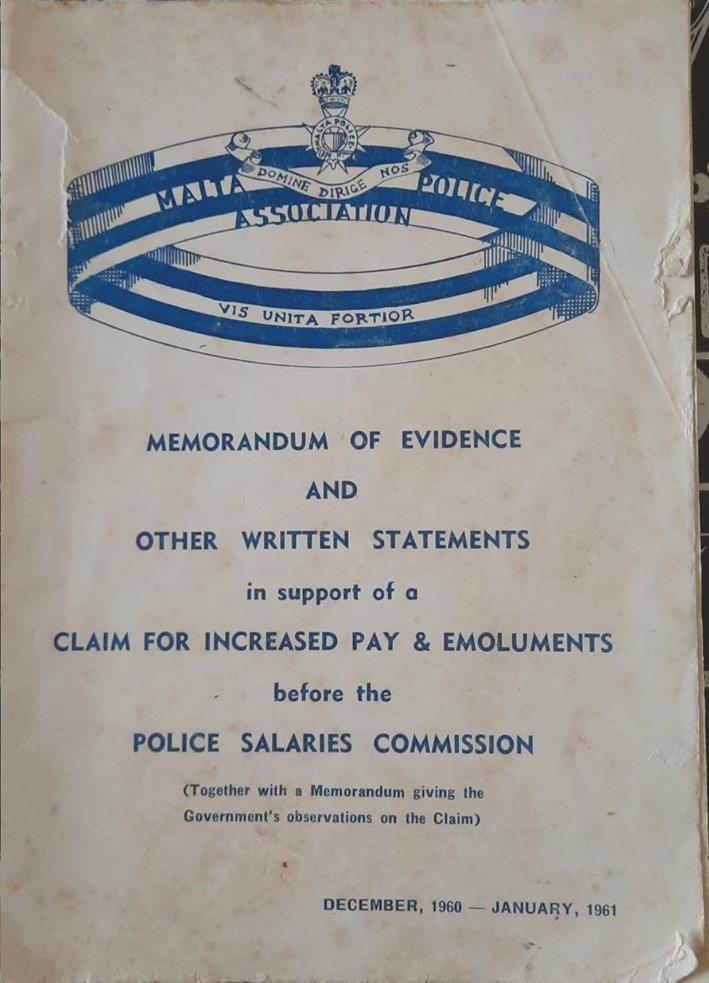
On 25 November 1960, The Malta Police Association submitted a 64-page memorandum regarding matters relating to the claim for the increase in police salaries and wages. This document was signed by Inspector Paul S. Grech for and on behalf of the Malta Police Association. This association was another significant step forward in enhancing police unionisation in Malta.
The author would like to thank Joseph Borda, national president IPA Malta Section and former police sergeant for providing images and information for this feature.