What does painting preserve when it represents heritage or landscape under conditions of change? Not stability, but a response to anticipated loss, where looking becomes a way of holding on and painting records what is already in flux.
Maris Zammit presents a series of thirty-three watercolour paintings in her debut exhibition Vanishing Vistas at The Phoenicia Malta, curated by Charlene Vella. Executed in watercolour and grounded in a realist sensibility, the works engage closely with the observation and rendering of Maltese heritage and its environment.

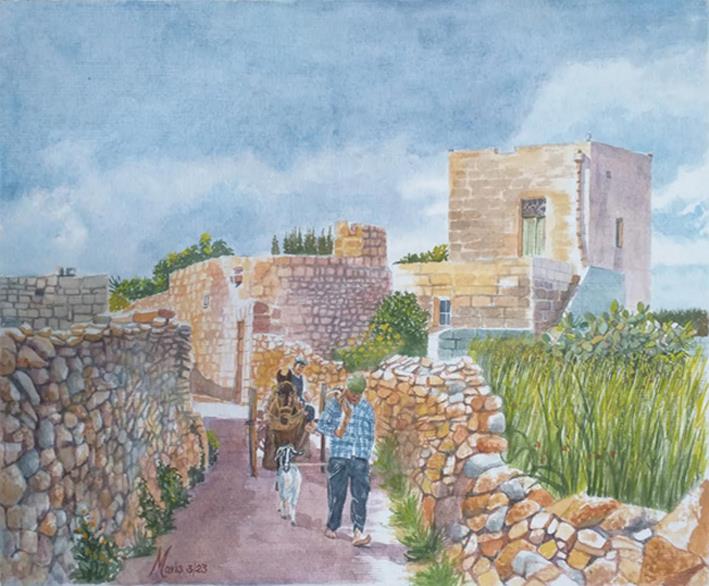
After a successful career in motorsport, she turned to painting in 2000, a shift that sharpened her engagement with the Maltese landscape and reframed how she saw it. Wanting to explore this passion further, Zammit trained for several years under Harry Alden and Anton Calleja, where technical discipline was closely tied to a sensitivity to place. This grounding is also evident in the influence of the Caruana Dingli family, particularly Debbie Caruana Dingli, whose approach to watercolour resonates in Zammit's own practice. Her continued involvement in The Wednesday Art Group, formed by artists who remained together after Calleja's sessions to paint en-plein-air, extends this commitment to direct observation into a collective framework. Against this background, she has participated in numerous collective exhibitions both locally and internationally, with her work receiving recognition across three consecutive editions of the Luxembourg Art Prize up to 2024, and being selected among the top 200 artists in the International Watercolour Masters Biennial in 2022 and 2024.

As the title Vanishing Vistas suggests, the paintings memorialise the Maltese landscapes, coastal environments and architectural history that are at risk of disappearing, whether through physical transformation or diminishing cultural visibility. Shaped by processes of urban expansion, overdevelopment, and the neglect of rural and vernacular sites, the paintings operate as a form of preemptive preservation, holding in tension the visual appeal of these places with an underlying awareness of fragility and potential loss.

Initially, the paintings present carefully rendered views executed with technical precision, offering viewers immediate recognition of familiar Maltese locations. However, they also function as visual archives, where representation becomes a method of recording rather than simply depicting. This archival impulse is reinforced through the titles, which can be broadly grouped into three categories: those that function primarily as records, such as Lunzjata Valley, Gozo; those that combine documentation with affective tone, such as Serenity at Ras il-Ħobż; and those that foreground emotional framing, such as Home Before the Storm. Across these frameworks, the paintings move between documentation and quiet lament, positioning the landscape as both a lived environment and a site marked by temporal instability.
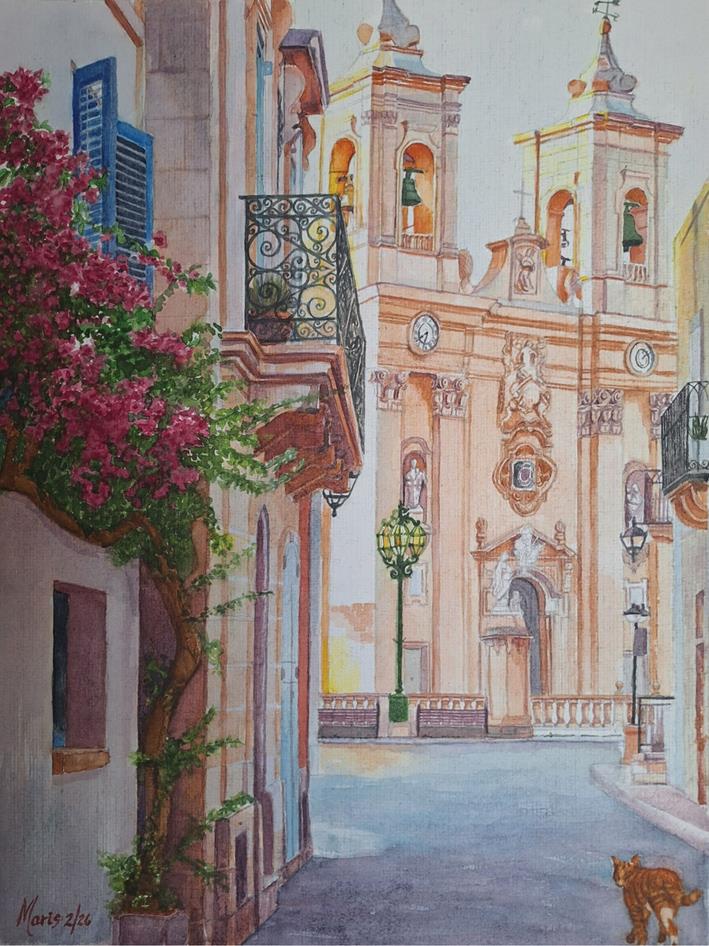
The atmosphere within the works is one of stillness, where figures inhabit places marked by quiet simplicity and an underlying sense of nostalgia. This is reinforced through geographical selectivity, where man-made structures tied to national identity are presented as harmoniously embedded within the natural environment, as can be seen in The Silent City from Tal-Virtù. These sites of Maltese cultural identity, such as Mdina and numerous churches, are so deeply embedded in everyday life that the built environment itself comes to appear as a secondary "natural" layer within the Maltese landscape.
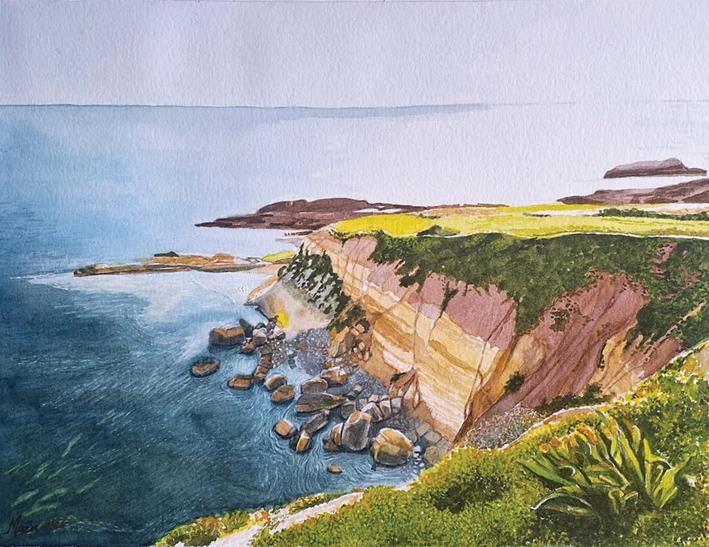
This sense of fragility is further reinforced by the properties of the watercolour medium. Its translucency and fluidity mirror the impermanence of the places depicted, while the palette and soft tonal gradations respond to Mediterranean luminosity. Together, these elements operate as a visual language of nostalgia, reinforcing a sense of temporal distance.
The exhibition constructs a rhythm between natural and man-made landscapes, interspersed with occasional figures, arranged within thematic continuity with moments of alternating sequences. These figures in the composition are dispersed throughout yet remain visible across multiple viewpoints, embedded within their surrounding environments. This curatorial structure foregrounds a sustained concern with connectivity between place, subject, and experience, guiding the viewer through shifting perspectives while maintaining an underlying coherence.
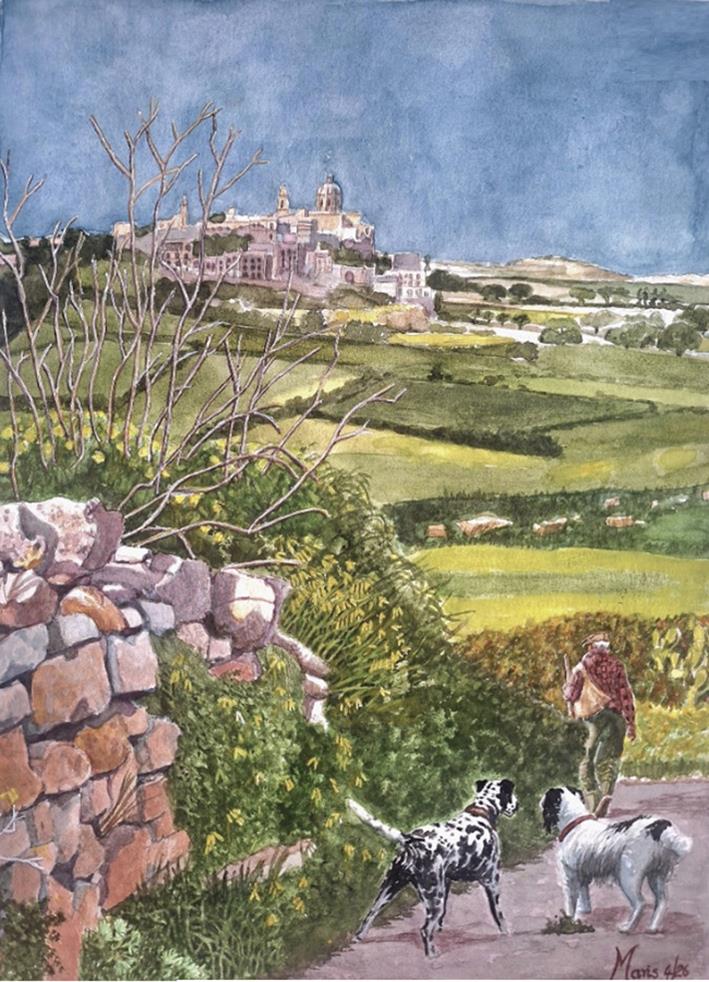
Vanishing Vistas extends beyond documentation of Maltese sites to raise broader questions about how landscape is visually preserved under conditions of rapid change. The works reflect wider tensions between heritage, development, and memory, where image-making becomes a form of cultural recording, tied to shifting lived experience within these environments.
Vanishing Vistas, curated by Charlene Vella, is open to the public throughout May 2026 at the Palm Court Lounge, The Phoenicia Malta