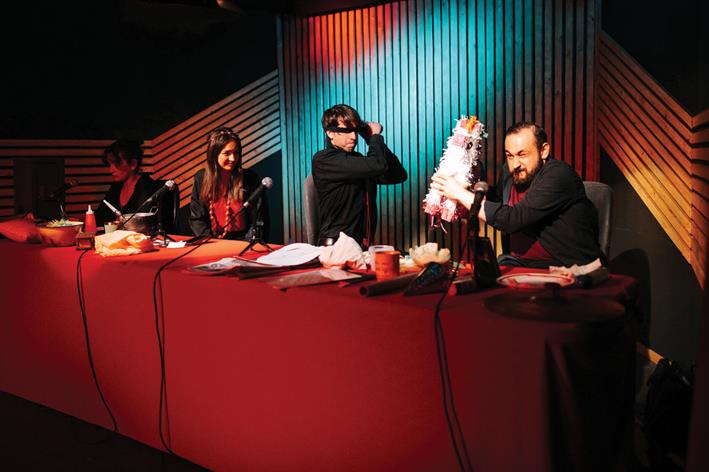
 Tom Fowler's Suspicious Minds, directed by Justin Kyle Camilleri, arrives on the Maltese stage as a daring and heartfelt dark romantic comedy that captures the chaos and tenderness of love in a way that feels intimately familiar. Presented in the unconventional form of radio theatre, the production offers an experience that feels both nostalgic and refreshingly original. It draws its audience into a world built not with elaborate sets or visual spectacle but with voices, sounds, and emotions - crafting an atmosphere that is deeply human and profoundly affecting from beginning to end.
The story follows Mark and Fran, a couple whose relationship has been battered by a particularly tough year. In one final attempt to salvage what's left between them, they book a commercial time-travel holiday that spans from the grandeur of ancient Rome to the glamour of an Elvis concert in Hawaii. What unfolds is not so much a science-fiction adventure as it is a reflection on the fragility of relationships and the futility of trying to rewrite the past. Fowler's writing cleverly uses the notion of time travel as a metaphor for emotional escapism, showing that while we might yearn to change history, the real challenge lies in confronting reality and choosing to grow from it rather than running away.
What makes this production truly memorable is its use of the radio-theatre style, a rarity on Maltese stages. Instead of relying on elaborate visuals, the play builds its world through sound alone, with the cast generating every effect live - footsteps echoing on stone, the hum of a time machine, the distant roars of crowds, or the croon of Elvis floating through the air. This immersive, handcrafted soundscape invites the audience to lean in, to listen closely, and to imagine vividly. It's a format that fosters intimacy between performers and audience, creating a shared imaginative space where every sound deepens the storytelling. This choice proves not only technically impressive but also thematically fitting, as the play's focus on memory, longing, and reconstruction resonates perfectly with the act of conjuring entire worlds from nothing but sound and voice.
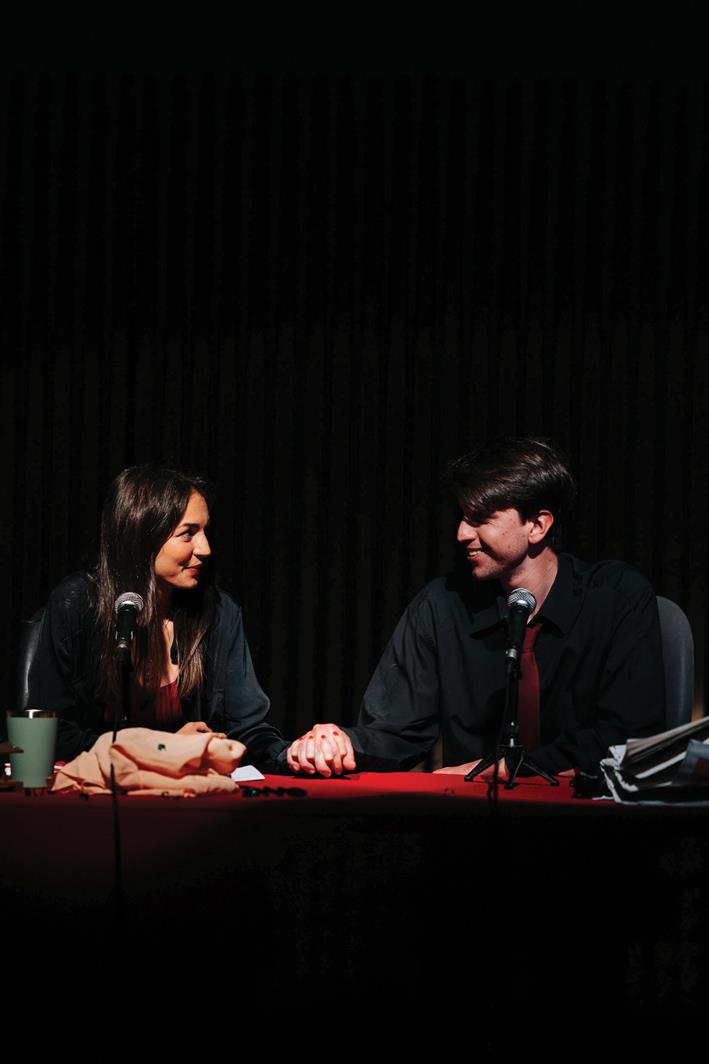
Despite its small cast of four, the performances radiate energy, precision, and depth. Shaun Rizzo as Mark gives a captivating performance, capturing the restless, anxious humour of a man desperately trying to keep his life from collapsing. His comic timing is impeccable - his awkwardness and wit draw laughter without ever detracting from the underlying sadness of his situation. Rizzo moves seamlessly between humour and heartache, drawing the audience into Mark's struggle to reconcile love with fear, and hope with disappointment. Opposite him, Thea Costa delivers an equally compelling portrayal of Fran. What begins as a familiar figure - the partner weary of the monotony and unresolved tension of a long-term relationship - quickly deepens into a heartbreakingly complex character. Costa's performance unveils Fran's vulnerability and suppressed frustration with remarkable emotional control, allowing the audience to feel the quiet strength and truth within her conflict. Their chemistry on stage feels genuine, marked by moments of intimacy, humour, and painful recognition that leave a lasting emotional imprint.
Myron Ellul and Maya Micallef Engerer deserve their own praise for their dexterous versatility, managing a range of different characters throughout the show while handling much of the play's sound design live. Their fluidity in moving from one role to another adds texture and rhythm to the story, while their sound work is so organic that it often blurs the line between performance and atmosphere. Whether voicing secondary characters or creating the sonic backdrop that carries Mark and Fran through time, both actors ground the play in a sense of momentum and cohesion. Their contributions subtly reinforce the narrative's emotional beats, allowing it to breathe and flow without interruption.
Fowler's writing remains one of the production's greatest strengths. His dialogue feels fresh and sharp but grounded in an emotional realism that anyone who has ever loved, lost, or tried to repair something broken can recognise. He invites the audience to laugh, cringe, and reflect all at once, offering moments that are both comforting and deeply uncomfortable - especially when they mirror the audience's own experiences of love and regret. Justin Kyle Camilleri's direction heightens these contrasts with sensitivity and restraint, allowing humour to emerge naturally and pain to linger just long enough to resonate. By embracing simplicity, Camilleri lets the words and performances do the heavy lifting, ensuring that each emotional shift feels earned and authentic.
In a theatre landscape often dominated by spectacle, Suspicious Minds stands out as a piece that trusts its audience's imagination and emotional intelligence. The radio-theatre format brings a welcome sense of vulnerability and creativity to the Maltese stage, inviting viewers to participate, to listen more deeply, and to connect in ways that transcend the visual. While the play runs for a relatively short time, it feels complete - its pacing is tight, and the ending lands with satisfying poignancy. One leaves the theatre feeling entertained, moved, and slightly exposed, as though the play has quietly peeled back some deeply personal layer.
Ultimately, Suspicious Minds is more than a clever concept; it is an emotionally intelligent and profoundly relatable exploration of the human condition. It reminds us that while we may fantasise about changing our past, growth and understanding can only come from facing what is. Fowler's words, paired with Camilleri's steady direction and a cast delivering outstanding performances, make for a production that is as humorous as it is heartfelt. This is theatre that entertains, challenges, and lingers - proof that even in its quietest form, storytelling can be both transformative and timeless.