In the history of modern art, certain figures resist easy placement within the established categories of European art movements. Maltese sculptor Josef Kalleya (1898-1998) is one such figure: a sculptor whose work, forged in relative isolation, constitutes one of the most radical and enigmatic departures from traditional art in the Maltese artistic scenario. Ambiguous and often resistant to narrative clarity, his sculptures refuse the comfort of easy legibility. His work does not merely participate in modernism. It carves out an autonomous artistic development that is at once prehistorically influenced and performative. While his artistic philosophy was deeply shaped by theological and literary sources such as Origen, Dante, Milton, and Papini, this article shifts attention away from the dominant focus on his spiritual dimension toward the performative logic that informed his sculptural practice.
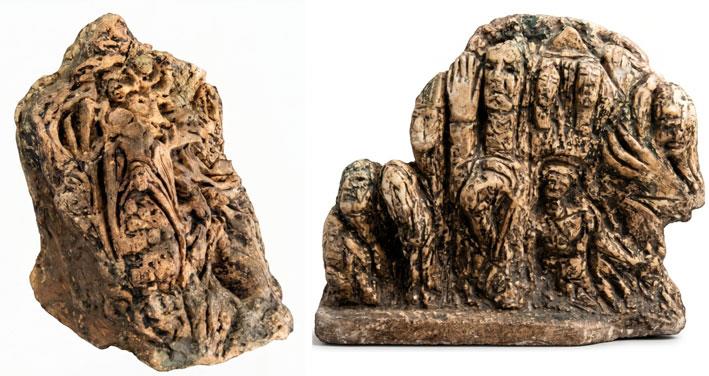
Kalleya's sculpture marked a decisive break from mimetic representation. Within the Maltese cultural context long shaped by academic naturalism and ecclesiastical commissions, his work emerged as a provocation. Although his artistic development unfolded largely independently of major European movements, it would be misleading to claim that he worked in complete isolation. As art historian Herbert Read argued, artistic influence may operate through a shared responsiveness to the spirit of the age - the zeitgeist - absorbed almost unconsciously. Kalleya's work can be thus understood as emerging from a tension between collective historical forces and an intensely personal philosophy, taking shape as a distinctive variation within a broader modern condition.
In the early 20th century, artists were increasingly embracing the arts of ancient and foreign cultures as a means to challenge and subvert the established norms of Western visual tradition. Prehistoric sculpture, in particular, exerted a strong stylistic impact on modern sculpture, as it privileged essential forms and expressive power over naturalistic representation. In one of his earliest works, L'Abbandono della Casa Materna, produced during his studies in Rome, Kalleya appears to align with this broader modernist tendency. Like figures such as Picasso or Brâncuși, he engages with the primitivist impulse as a formal resource. Yet Kalleya moved decisively beyond the modernist paradigm of formal appropriation. His engagement with prehistory shifted from the level of form to that of method. Rather than borrowing visual motifs, he appropriated the very creative process of prehistoric art. The incised, primitive line became foundational to his practice, ultimately producing a distinctive idiom in which the primitive is appropriated as a lived, material procedure rather than as a repertoire of forms.
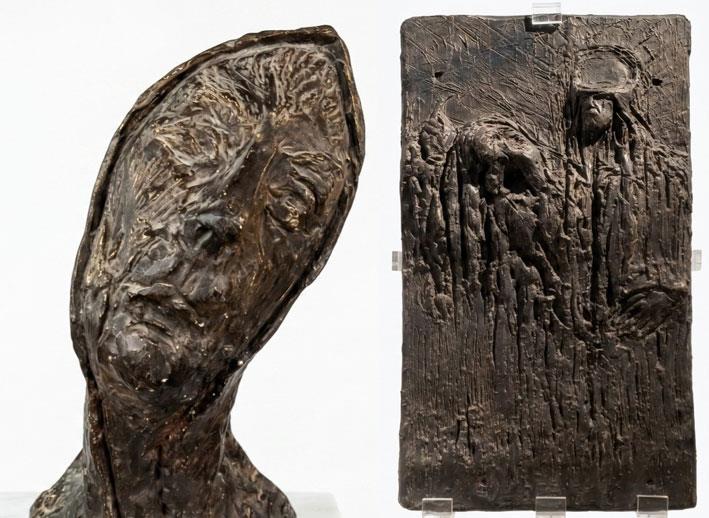
The key to this shift lies in his distinctive technique. Developed during his training at the Regia Scuola della Medaglia in Rome, where he specialised in relief design, Kalleya developed a method based on scratching the surface of clay. The surface of the sculpture was violently slashed and cut alla cieca - blindly, instinctively. In his hands, incision acquired an almost ritualistic significance, becoming central to his artistic philosophy.
It is at this point that a comparison with Swiss Italian sculptor Alberto Giacometti (1901-1966) becomes particularly illuminating. Although the two artists developed in markedly different contexts - Giacometti within the dense artistic networks of Paris, Kalleya within the mediterranean periphery of Malta - they converge in a strikingly similar rethinking of sculptural practice. Both artists engage with what might be described as a return to the primitive, yet this return is not merely stylistic. Rather, it manifests as a shared commitment to a sculptural language grounded in the visible trace of the creative process.
Unlike sculptors such as Brâncuși and the artists of Die Brücke, both Kalleya and Giacometti shifted away from the appeal of direct carving in favour of moulding. This enabled a more immediate and flexible engagement with material, allowing for continuous transformation. Their sculpture appears to have been shaped from within, with external surfaces retaining traces of the creative process. In this way, sculpture becomes an experimental and performative act rather than a resolved object, unfolding through cycles of construction and destruction.
Kalleya worked almost exclusively in clay and plastiline, whose malleability allowed for prolonged reflection and transformation. As he noted, plastiline enabled "a deep study that is authentic and serious, not superficial". Using the knife, he incised the material as if excavating hidden truths. His gestures, performed alla cieca, are instinctive and urgent, guided by an intense dialogue between artist and material. Through this persistent scratching at the surface, something deeper begins to emerge.
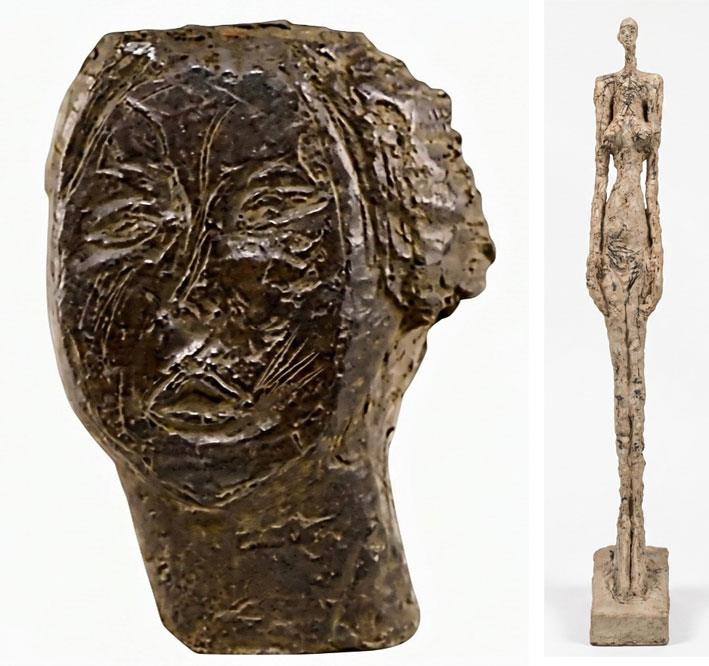
Giacometti's sculptural practice similarly relied on tactile, iterative engagement. Preferring plaster, he created highly textured works marked by gouges, scratches, and deformations. Working with his hands and tools, he reduced, elongated, and distorted forms, leaving an austere accumulation of marks. In his elongated figures, the surface becomes a site of continuous reworking. These gouged and scratched textures parallel Kalleya's insistence on the cut and the wound-like mark. In both cases, the surface becomes a field of inscription where the act of making is neither concealed nor resolved. What remains visible are residues of action - cuts, abrasions, accumulations - transforming the sculpture into a record of struggle.
This shared methodology serves a deeper ontological inquiry. Their concern is not representation in a conventional sense. They enter the realm of performative visual art, where meaning emerges through making itself. Sculpture becomes a site in which the problem of existence is staged. Through an avant-garde language rooted in process, both artists attempt to define man's existential presence.
Produced on the margins of dominant art historical narratives, Kalleya's oeuvre thus stands as one of the most significant contributions to Maltese modernism, precisely because it radicalises sculpture as process rather than object. His work does not aim at resolution but at the sustained exposure of making itself, where form becomes inseparable from action and meaning arises through material struggle rather than visual completion. In this sense, Kalleya pushes sculpture beyond object into a condition of perpetual becoming.
Today, his works can be viewed at Muża, which currently exhibits only two sculptures by the artist - a relief entitled The Last Judgement (1970s) and a sculpture entitled Assumption of Mary (1960s) - as well as at the Josef Kalleya Gallery situated at the University of Malta Valletta Campus. The latter is the result of a seven-year project by Maltese art scholar Giuseppe Schembri Bonaci, involving extensive archival research and sustained critical interpretation, further consolidated through his numerous studies on Kalleya, published by Horizons. His contribution has been instrumental in actively situating Kalleya within a broader philosophical art discourse.
Rowna Baldacchino is a Maltese art historian and cultural critic with postgraduate specialisation in art history, literature, and translation, focusing on modern and contemporary art in Malta