To what extent are unnoticed repetitions already structuring us? The everyday is full of gestures that don't announce themselves yet quietly organise how we move through time and presence. What follows is a gradual shift where the ordinary begins to behave like ritual, not through change, but through return.
Just Like a Prayer is a multidisciplinary installation by Liliana Fleri Soler, curated by Justine Balzan Demajo at Studio 87's secondary space in Valletta. The exhibition brings together three larger-than-life sculptural figures, painting, and video projection by Katrina Barthet, alongside a programme of live performances featuring Liliana Portelli, Sarah Vella, and Sandra Mifsud of Theatre Anon, with percussion by Banjo Rancho. In addition, the photography and videography was captured by Nigel Fleri Soler.
Within this interplay of forms, the exhibition consistently turns towards repetition and ritual. What emerges is not merely a sensory experience, but a rhythmic one that is felt before it is fully understood. The first rhythm we encounter, the steady beat of a mother's heart, resurfaces through sound and gesture. This extends into the most mundane actions: the sweep of a broom, the repetition of daily tasks, and the persistence of doing something again and again.
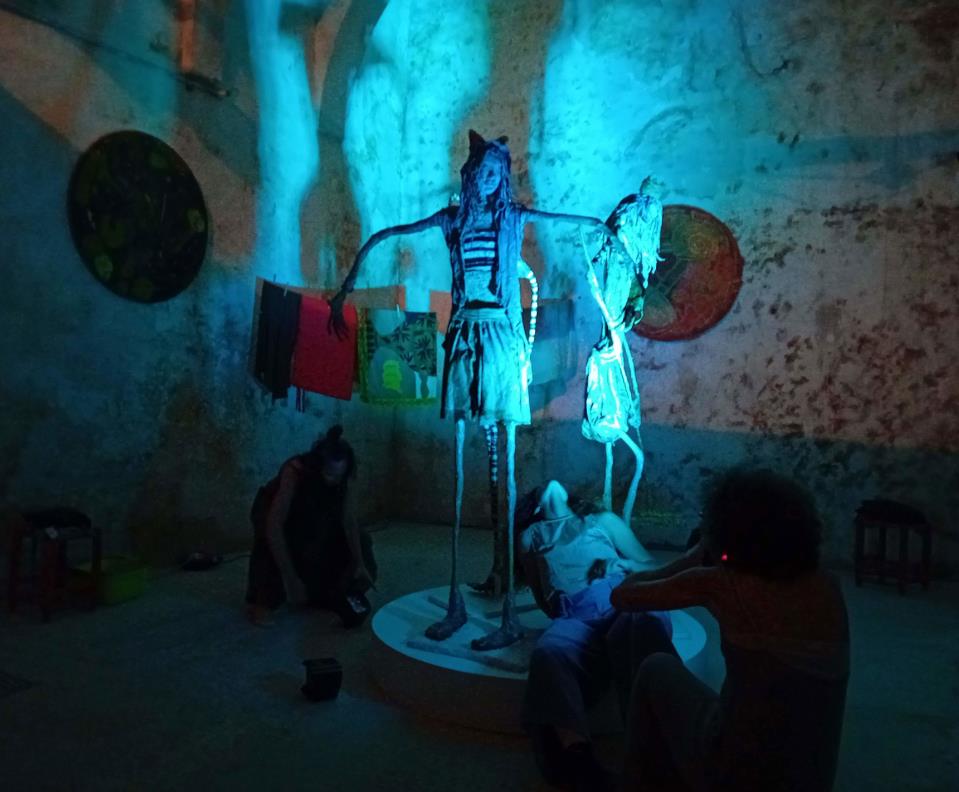
These gestures are taken for granted, absorbed into the rhythm of everyday life because of their reliability. Their constancy renders them almost invisible, a form of comfort enacted without thought. Yet it is within this overlooked persistence that repetition begins to shift, no longer read as monotony but as a quiet form of grounding, where movement settles into rhythm and rhythm, gradually, into ritual. In this accumulation, individual actions lose their singularity, becoming part of a larger process of change.
If repetition shapes experience, it also suggests centrality and resonance, which Fleri Soler interprets as a form of spirituality rooted in everyday action. This grounding extends into continuity with nature, where matter is understood as an ongoing cycle rather than fixed substance, leading to energy as relational and affective. In turn, this becomes intensified through synergy in shared spaces where collective presence heightens resonance. Within this logic, the overlap between religious and scientific thinking becomes apparent as ideas of resonance and presence converge.
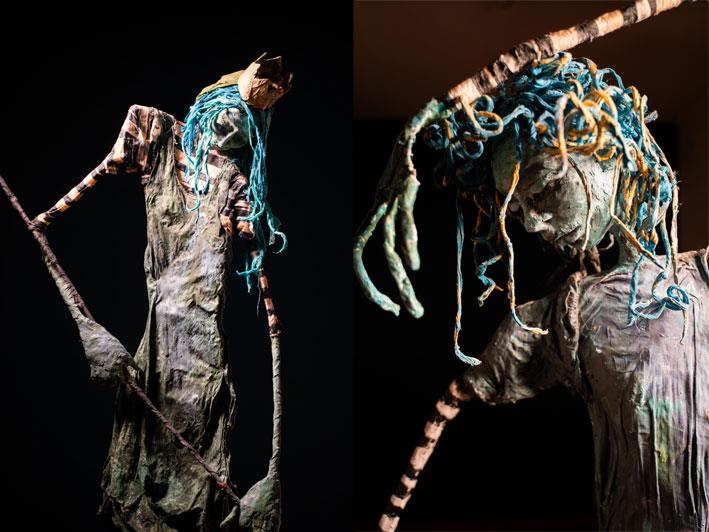
In describing her practice, Fleri Soler reflects on an internal shift: "When I start working, everything else falls away. The mind is very vast, and at times annoying, but without knowing, when I work I feel certain parts of my brain lock and unlock." What begins in hesitation and uncertainty does not resolve through rhythm alone, but through recognition, where the act gradually becomes familiar again and reflects the conditions and rituals of its making. As curator Justine Balzan Demajo observes, Fleri Soler's practice is deeply introspective and emotionally saturated, "very much digging deep within her soul... I have yet to see an artist who approaches it like Liliana".
Building on this process of creation, the sculptural figures echo mundane rhythms such as sweeping, spinning, and the repetitive motions of everyday movement. The early stage is mechanical and almost automatic, a process of building skeletal structures and establishing the foundations in an almost mundane and automatic procedure. Only once this stability is secured does the question of identity enter the work, seen as both the most difficult and the most revealing stage of the process.
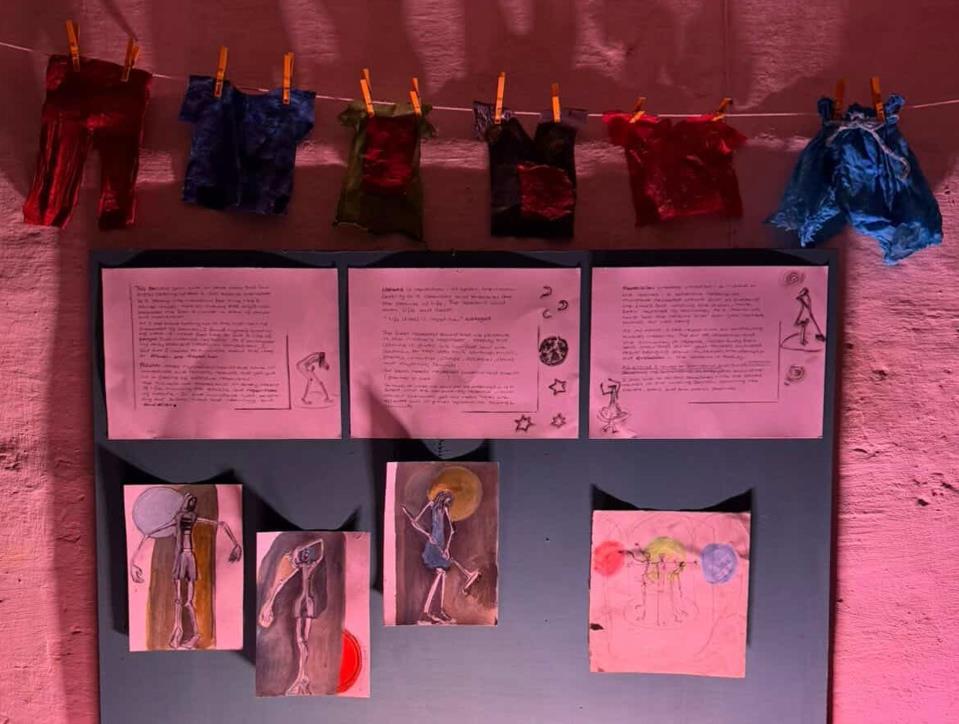
This importance of the material process extends into the logic of symbols incorporated, where structure and surface are shaped by patterns. The use of circular canvases reinforces this logic of return: cycles that are economical in their structure, reducing form to something continuous rather than linear. These echo broader systems of regeneration, such as moon and life cycles, where repetition is not excess but necessity. Together with their physicality, these three paintings surrounding the figures are constructed from fragmentation to reflect three levels of energy: red as energy and matter in constant transformation, green as a direct energetic exchange with nature, and blue as reflection and the immaterial, what is absorbed rather than seen.
While all these works are energetically imbued, their nature remains static. Their quietness echoes with the space, being created specifically for this location, while the performances, atmospheric sounds and moving imagery bringing them to life. Their quietness resonates with the space for which they were created, while performances, atmospheric sound, and moving image animate them. This need to bring them to life was integral to the work from the outset, bridging the different senses for an experience that is felt rather than simply seen.
The exhibition ultimately points towards experience rather than resolution, an internal revelation that is not contained within a single moment of making, but continues through repetition and return. This idea of repetition opens into a broader register, where as she notes, "so much of what we consider as meaningful is in actions which are compulsively repetitive with no obvious outcomes, yet our heart rates are affected and in groups synchronise aligning a community".
Just Like a Prayer is open to the public until 22 May at Studio 87's secondary space, 38, Triq Lvant, Valletta.