You are stepping into the shoes of Josef K, but also into those of seventeen other presences orbiting around him. How do you prepare your mind and body to move so quickly from one identity to another?
The preparation starts from a very simple principle: I do not consider those seventeen characters as "masks" separate from Josef K, but as fragments of the world besieging him. Each of them is a force, a pressure, a voice of the trial. Some seduce him, others humiliate him, others confuse him, while others seem to want to help him but end up tightening the knot even further.
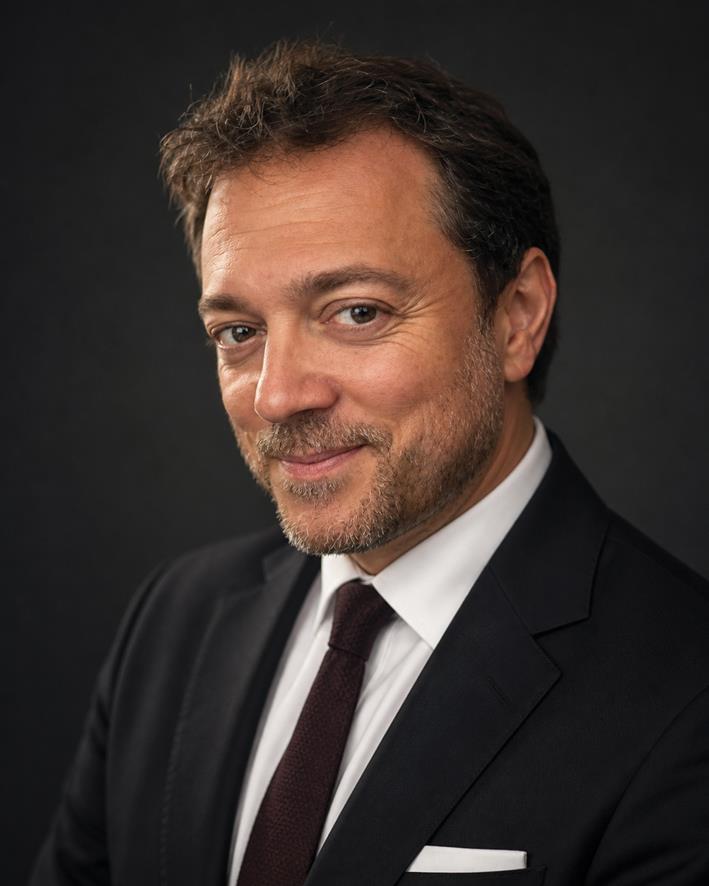
From a physical and vocal point of view, the work is almost musical. Each character has a rhythm, a breath, a different physical centre. Some live in the throat, some in the chest, some in the hands, some in the back, some in the gaze. The rapid shift from one identity to another cannot be merely psychological: it has to become a score. The body must know where to go before the mind does.
Mentally, however, I try never truly to "leave" K's nightmare. Even when I play the other characters, I remain inside his distorted perception of the world. It is as though all those figures were real and, at the same time, generated by his fear. This allows me to maintain a deep continuity, even within such an extreme multiplication.
Kafka's world is built on a sense of unease, opacity, and the feeling of being watched. Which aspect of this atmosphere strikes you most strongly as a performer?
What strikes me most is the impossibility of locating the centre of power. In Kafka there is no visible tyrant, no enemy with a precise face. There is something far more disturbing: a system that functions without needing to explain itself, that judges without revealing the accusation, that watches without ever truly showing itself.
For an actor, this is an extraordinarily powerful condition, because the anxiety does not arise from an obvious danger, but from an absence. Josef K does not know who he is fighting against. And when you do not know who you are fighting against, you end up fighting against yourself.
This, in my view, is Kafka's great modernity: the feeling of always being evaluated, classified, exposed to an invisible judgment. Today, we do not necessarily need a Kafkaesque court in order to feel on trial. Sometimes an algorithm is enough, a bureaucracy, a social gaze, a digital reputation. Kafka had intuited all this before it became our everyday landscape.
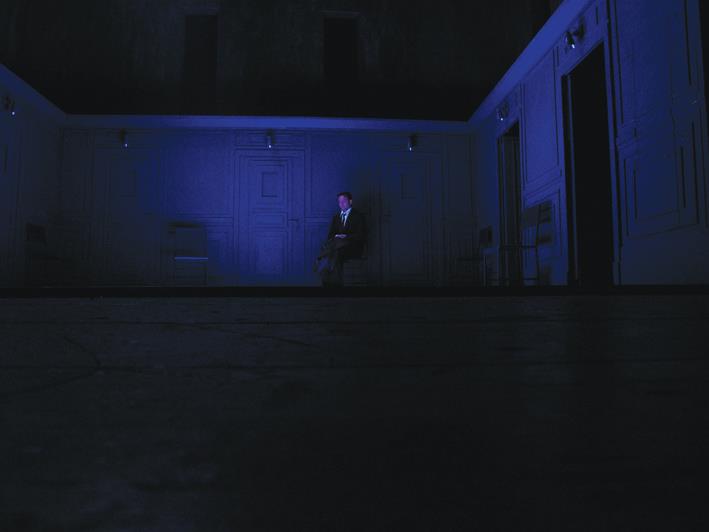
When you play K, do you see him as innocent, naïve, complicit, or something more ambiguous? How do you handle this ambiguity on stage?
Josef K is ambiguous because Kafka never grants us the comfort of a definitive answer. If he were simply innocent, the story would be a straightforward denunciation of injustice. If he were simply guilty, it would be a moral parable. Instead, K is something much more uncomfortable: a man who does not know his own guilt, but who is not necessarily pure because of that.
I see him as a modern man: intelligent, proud, convinced that he can rationally control what is happening to him. At first, he thinks the trial is a mistake, then an annoyance, then a problem to be managed. Only slowly does he understand that the trial is not outside him: it enters his life, his language, his body, his way of looking at himself.
On stage, I try never to decide once and for all whether K is innocent or guilty. Instead, I try to inhabit his resistance. K defends himself, becomes indignant, contradicts himself, deceives himself, exposes himself. His ambiguity lies precisely there: in the fact that he wants the truth, but is not always willing to truly look into the abyss that this truth may open.
Among the many characters you portray, is there one whose voice or physicality surprised you?
Definitely Block. He is the character who surprised me the most, also technically: in the exchange between Josef K. and Block, I think it is almost impossible to understand that both voices are mine, even if you know it.
Block is the lawyer's old client, but for me he is above all K. in his possible future: a man worn down by years of trial, shut away in a dark, dirty room, studying papers he does not understand and obeying a system before which he is now willing to kneel.
When K. meets him, he sees what he could become. That is where his surge of pride begins: he revokes the lawyer's mandate, tries to raise his head, attempts to rebel. But in the end, he understands that the system is not only invisible: for him, it is invincible.
Block is Josef K.'s Dorian Gray mirror: the degraded portrait of his possible future.
Which aspects of The Trial feel most relevant today?
I think it is impossible not to look at the present. The Trial begins with a simple and frightening image: a man is arrested without knowing why. He does not know the accusation, he never truly sees the centre of power, he does not understand the rules of the game.
Today, this dynamic returns every time a citizen is treated first as a suspect and only afterwards, perhaps, as a person. We see it in political, administrative, judicial or bureaucratic systems that stop explaining themselves and turn the individual into a file, a case, an anomaly to be managed.
But what is most frightening is the vocabulary of power: when those who govern speak as though their own morality were the only limit, when suspicion becomes almost a form of guilt, Kafka ceases to be literature and becomes current affairs.
He is prophetic because he describes the moment when a society stops asking for explanations.
Do you rely on voice, movement, or emotional cues to distinguish the characters?
First of all, it should be clarified that on stage I give body and voice to Josef K., while I give only the voice to the other seventeen characters, which are recorded. So on stage I interact with pre-recorded voices, all of them mine, but belonging to different presences.
During the recording phase, I naturally worked on the voice, but also on the body, breath and posture, because a voice always comes from an entire body. Each character has a rhythm, a weight, an intention.
The fundamental thing is that all these voices remain inside K.'s nightmare. They are not simple characterisations: they are cogs in the same mechanism. Each one tightens the screw of the proceedings in its own way, until the ending becomes not only tragic, but inevitable.
What do you hope the audience carries with them?
I would like the audience to leave the theatre feeling small. Small before power, before bureaucracy, before mechanisms we often accept without understanding them. But it should not be a sterile smallness: I would like it to generate an urgency for civic dignity.
The Trial could not come true in a society truly aware of the three pillars of democracy: doubt, dissent and the culture of limits. When these disappear, the citizen stops being a guardian of democracy and entrusts himself to the political or economic power that shows him the way.
At that point, the person who dissents dies and the person who obeys is born: the good official, the good employee, the good slave. The one who always says: "Yes, Mr Director."
I would like Kafka to leave a jolt: the awareness that democracy begins to die when we stop asking questions.
In a box
Kafka's The Trial - Il Processo with Italian actor Giovanni Costantino with director Andrea Battistini will be performed at Teatru Manoel on 6-7 June in Italian with English and Maltese subtitles. Booking Teatru Manoel Booking Office.