David Gill is pleased to announce We Are Where We Are the latest exhibition by Barnaby Barford. "What now? Each day seems to outdo the last. What felt unthinkable yesterday barely registers."
Spanning 35 ceramic sculptures and several large scale drawings, the exhibition brings together a body of work exploring how we are coping a quarter of the way through the 21st century overload, acceleration and a pervasive sense of inertia.
Barford uses found porcelain figurines which he decapitates and reconfigures, assembling sprawling scenes that echo the moral panoramas of artists such as Pieter Brueghel the Elder, Hieronymus Bosch and William Hogarth. Darkly comic, the works bring humour and absurdity to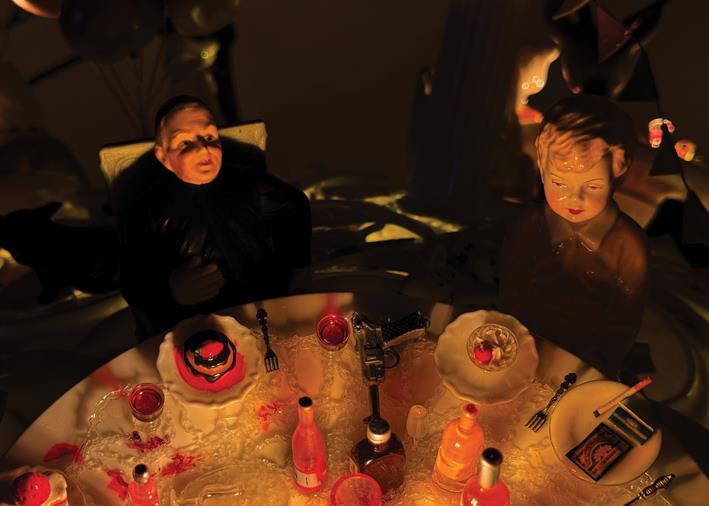 today's volatility.
A central work, Global Britain, is a 1.3m illuminated sphere that first unlocked Barford's thinking for the exhibition. Around its perimeter, animal/human hybrids stand in a queue, beneath a ring of flickering street lamps, while above them a pig-headed figure flies on a rocket. "I was interested in this dynamic of who queues, who doesn't, and the passive acceptance of that structure," says Barford.
A sense of instability and momentum continues in two further large-scale works. Shaped like a tornado, Scream to Go Faster is a two-metre-high sculpture in which figures cling on in varying states of distress or success as they are pushed outward from its spiralling core. "There's a force that's hard to step outside of," says Barford. "Things feel increasingly fast, increasingly out of our control. We're carried along whether we like it or not."
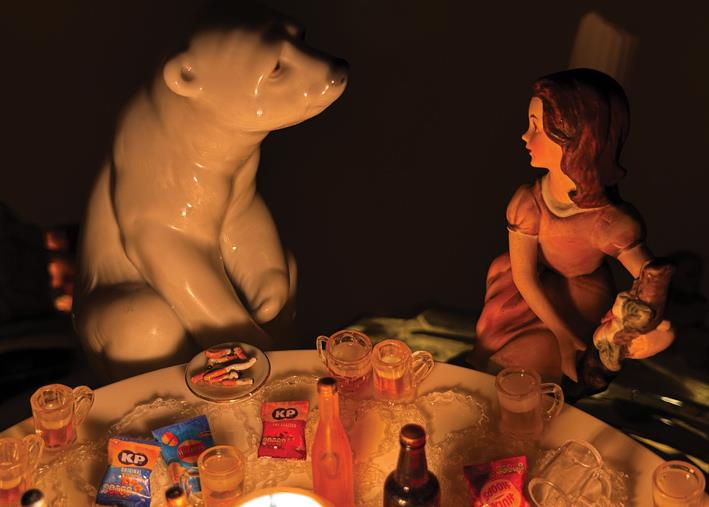
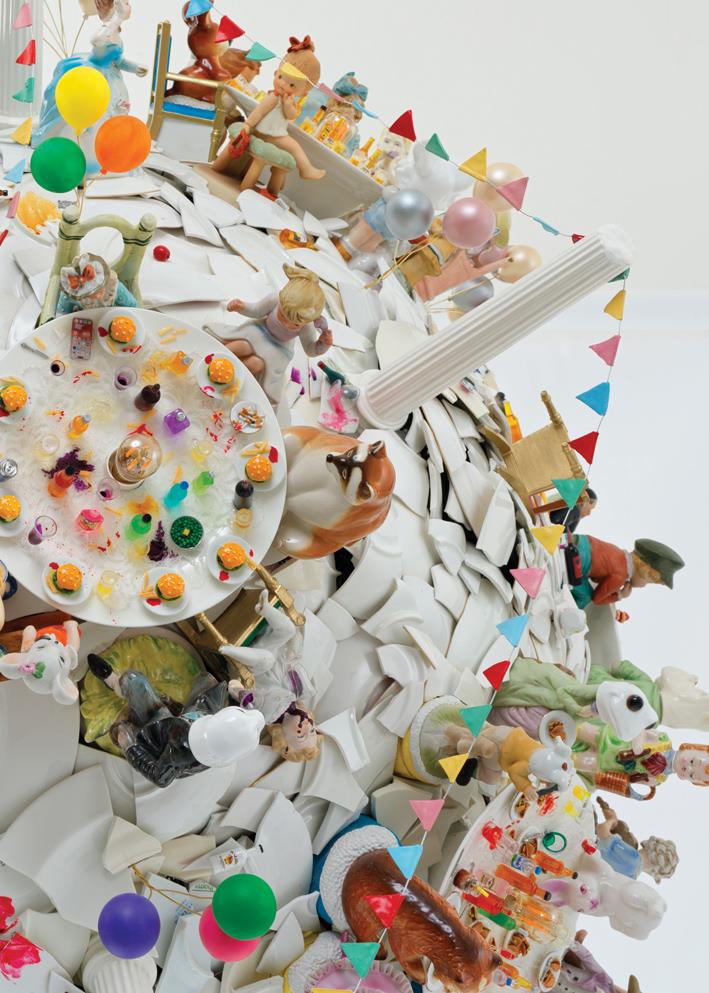
A second illuminated globe sculpture, Feast, presents a glowing celebration that quickly fractures into multiple, self-contained scenes, charged with excess and the sense that it could all unravel at any moment.
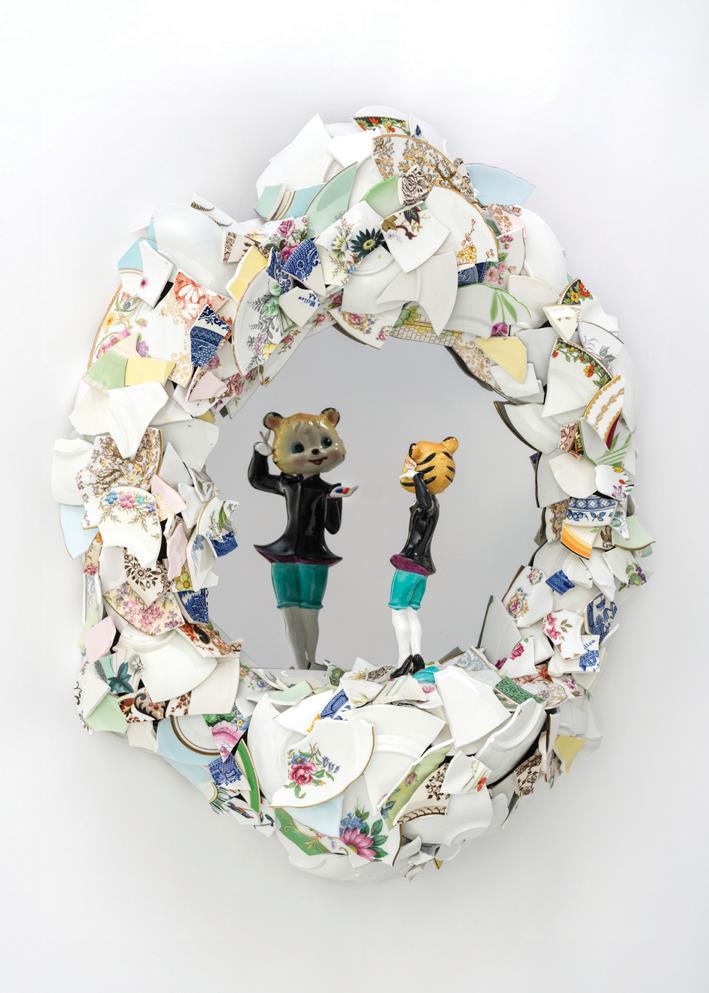
Smashed plates - often bearing a 'Made in Britain' insignia - are used throughout as surfaces onto which figurines are staged, and also form the frames of the exhibition's mirror sculptures. These recur across the exhibition. Seven concave mirrors distort and enlarge both viewer and figurine, each presenting a single character confronting their own reflection and literally upending the surrounding world. In one huge mirror, the animal/human hybrids give way to become human/machine cyborgs modelled on 1950s robots.
Language is a key concern for Barford, and this exhibition continues his Word Drawings. Starting as automatic writing, phrases are repeated ad nauseam in works such as Truth & Lies until they become chaotic and unreadable. "I'm interested in apathy and impotence in the face of chaos," says Barford, "and in the quiet nihilism of just carrying on, being swept along by forces larger than yourself."
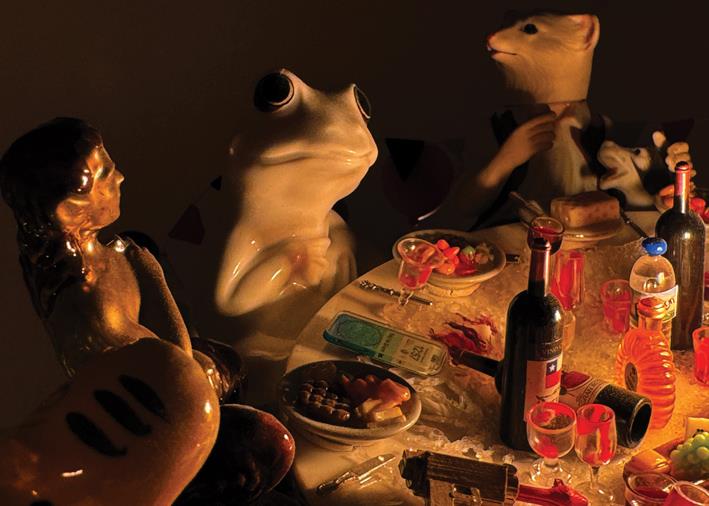
This exhibition marks a 20-year relationship between Barford and David Gill Gallery, who have represented the artist since 2004. Barford last worked extensively with porcelain figurines between 2002 and 2011, a body of work through which he first became widely known. Returning to the medium after a 14-year hiatus felt significant. "When I cut up and put figures together again, it feels like I am speaking a language I haven't used in a long time," he says. "In that sense, it feels like coming home."
Smaller tableau run throughout We Are Where We Are compressing and exaggerating snapshots of contemporary life. These works operate as fragments, glimpses of behaviours, pressures and ways of carrying on. References span pharmaceuticals, online masculinity, conspiracy thinking and consumer habits, with details from everyday life in miniature - disposable vapes, crisp packets and Greggs sausage rolls permeating the exhibition. Barford chose the title We Are Where We Are because he disliked the phrase and its undertones of resignation and complacency. In It's What It Is , figurines of protestors brandish similarly hollow slogans, reflecting a language saturated with statements that gesture towards action while often deflecting it. Language is a key concern for Barford, and this exhibition continues his Word Drawings. Starting as automatic writing, phrases are repeated ad nauseam in works such as Truth & Lies until they become chaotic and unreadable. "I'm interested in apathy and impotence in the face of chaos," says Barford, "and in the quiet nihilism of just carrying on, being swept along by forces larger than yourself."
ABOUT BARNABY BARFORD
BARNABY BARFORD (b. 1977) is a British artist working across sculpture, drawing, installation, film and ceramics. His work examines the values and behaviours embedded in everyday culture, transforming familiar forms into narrative devices that address consumerism, morality and desire. Repetition and accumulation are central to his work, from word large- based drawings to scale sculptural installations in which meaning shifts through scale and reiteration. Barford has realised major institutional projects including The Tower of Babel at the Victoria and Albert Museum, a solo exhibition at the Virginia Museum of Contemporary Art, and TOPIA, commissioned by Heritage Malta for MUŻA. His work is held in international public collections, and he is represented by David Gill Gallery, London.