In Rome, a rare opportunity awaits visitors at the Bernini e i Barberini exhibition at Palazzo Barberini. Running until 14 June 2026, the exhibition brings together more than 70 masterpieces, tracing the artistic vision that helped shape the Baroque transformation of Rome. Timed to coincide with the 400th anniversary of St Peter's Basilica, the exhibition offers a compelling journey into one of the most influential creative partnerships in art history: that between Gian Lorenzo Bernini and Pope Urban VIII, born Maffeo Barberini of the powerful Barberini family.
First impressions
I stepped into Palazzo Barberini expecting to see great works of art. I left feeling as though I had witnessed the birth of an entire era. The exhibition Bernini e i Barberini is not simply a display of masterpieces, but a vivid and immersive journey into the moment when the Baroque style emerged and transformed Rome forever.
From the very beginning of my visit, I was struck by the central idea of the exhibition: the extraordinary relationship between Gian Lorenzo Bernini and Maffeo Barberini, who later became Pope Urban VIII. This connection lies at the heart of the show and is presented as the driving force behind one of the most important artistic revolutions in European history. It becomes clear that the rise of Baroque art was not accidental, but the result of a powerful alliance between artistic genius and political ambition.
The first section focuses on Bernini's early years, when he was working in the workshop of his father, Pietro Bernini. It was here that Maffeo Barberini first recognised his talent. What impressed me most was that Barberini did not simply commission the young artist, but actively encouraged him to break away from his father's influence and develop his own distinct style. This moment of recognition marked the beginning of Bernini's transformation from a gifted apprentice into a revolutionary artist.
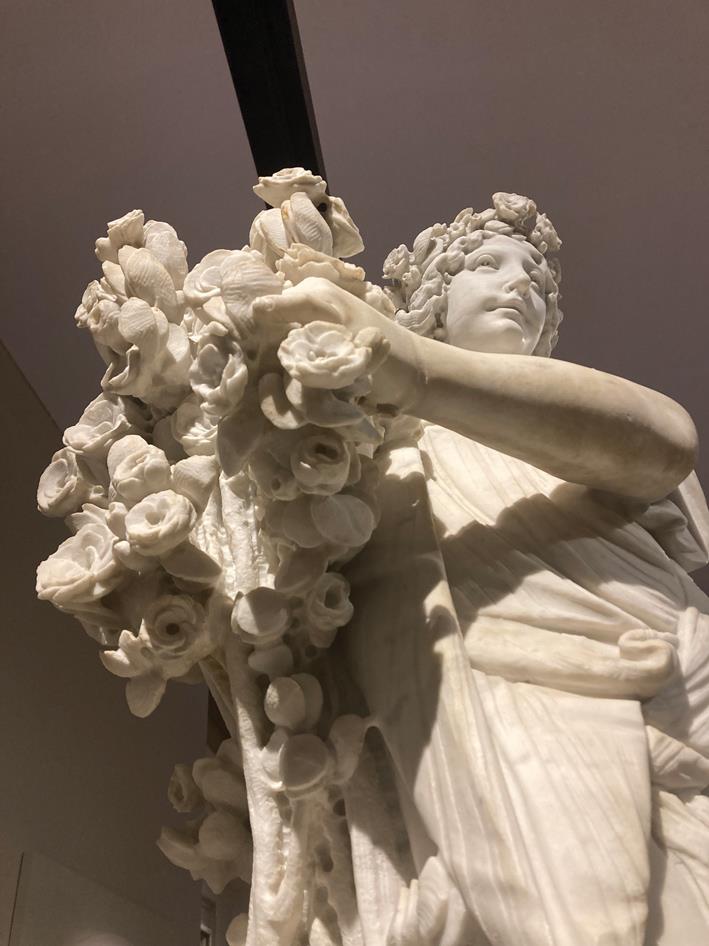
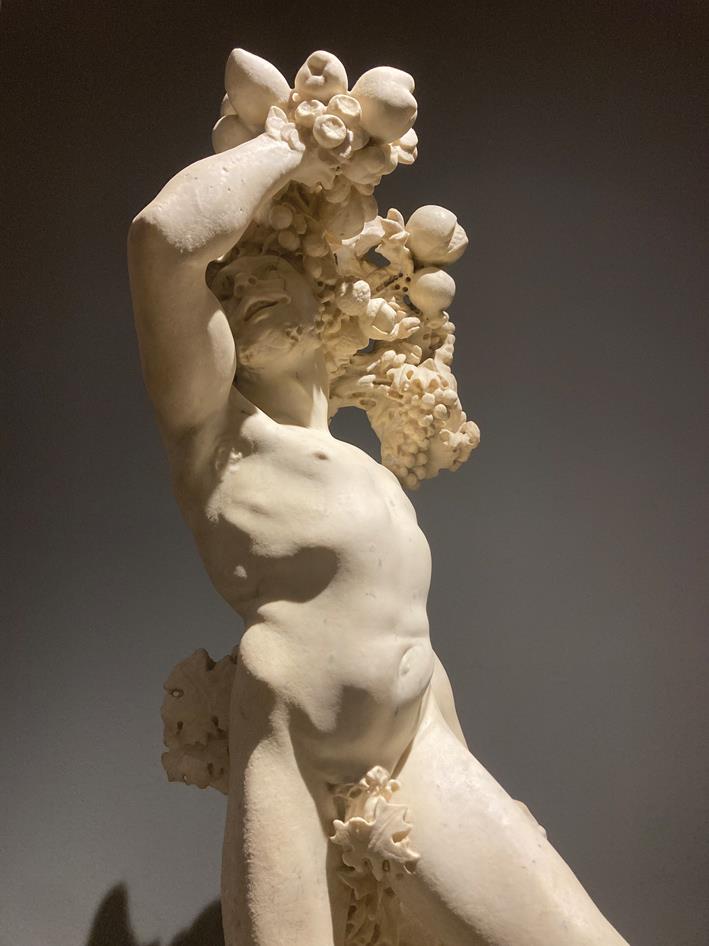
Adam and Eve by Pietro Bernini, who designed the famous Barcaccia Fountain in Piazza di Spagna, was one of the most impressive works. Putto with a Dragon and The Four Seasons show the transition from collaboration with his father to the emergence of a new artistic voice. Even at this early stage, Gian Lorenzo Bernini's work feels more alive and expressive, almost as though the marble itself is beginning to breathe.
The "new" St Peter's Basilica
The exhibition explains how the rebuilding of St Peter's Basilica transformed the original Constantinian church into a monumental Renaissance and later Baroque structure. Bernini's role becomes central after his appointment in 1629, when he reshaped its interior into a more theatrical and emotionally expressive space, completed under Pope Urban VIII.
A key focus is his work at the crossing, where he created the iconic Baldacchino above the tomb of St Peter. Its monumental bronze spiral columns mark the heart of the church, linking the dome, altar, and space below. Originally conceived as a ciborium, it evolved into a dramatic ceremonial canopy.
Bernini worked alongside Francesco Borromini and Carlo Maderno, whose extension of the nave helped define the basilica's monumental scale. Borromini also contributed technical expertise, and the project ultimately reflects a blend of competing artistic visions, where architecture, light, and sculpture combine to create a powerful sense of grandeur and unity.
Portraits of power
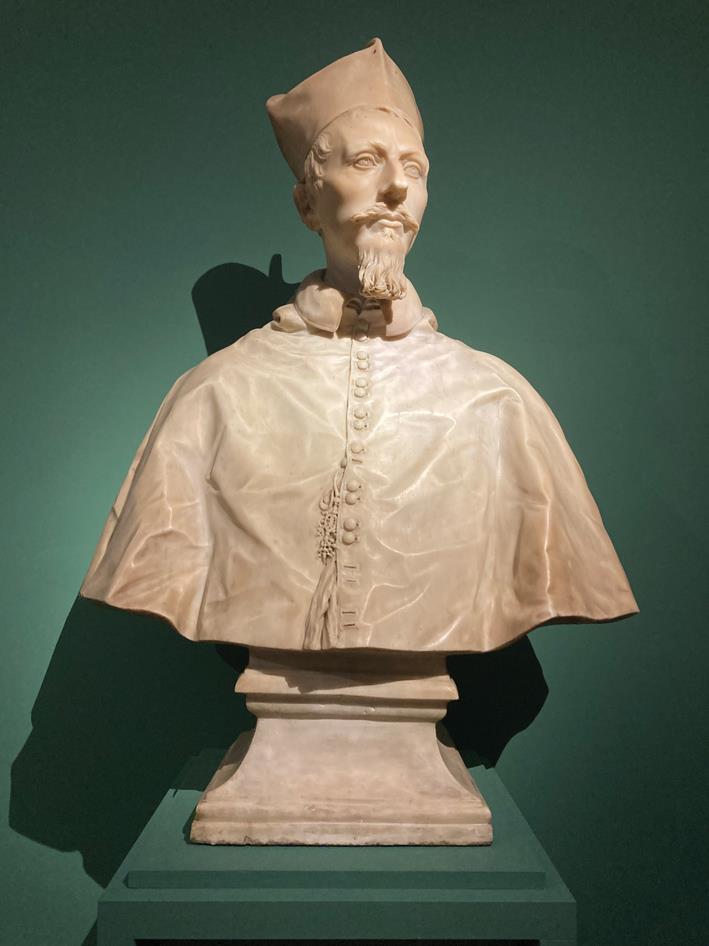
The exhibition then turns to Bernini's work as a portrait sculptor, and here I found some of its most compelling pieces. Before Urban VIII became pope, Bernini had already begun to redefine portraiture. His busts of Paul V and Gregory XV move beyond traditional representation, becoming intensely human presences charged with personality and emotion.
Standing before the busts of Urban VIII, I had the impression that they might speak at any moment. Bernini captures not only the physical features of his subjects but also their inner lives. Power, intelligence, pride, and even vulnerability seem to inhabit the marble.

The Barberini gallery
One of the highlights of the exhibition is the reconstruction of the Barberini family gallery. For the first time, these sculptures have been brought back together in Palazzo Barberini. Created by Bernini alongside artists such as Giuliano Finelli and Francesco Mochi, they form a striking statement of dynastic identity, reinforcing the authority and prestige of the Barberini family.
An obelisk-bearing elephant
I was mesmerised upon learning that the terracotta obelisk-bearing elephant by Bernini, in perfect condition and a spectacular masterpiece from the Barberini collection now in a private collection, was loaned to Bernini when he worked on the marble elephant in Piazza della Minerva, serving as his model for the design.
A hidden portrait
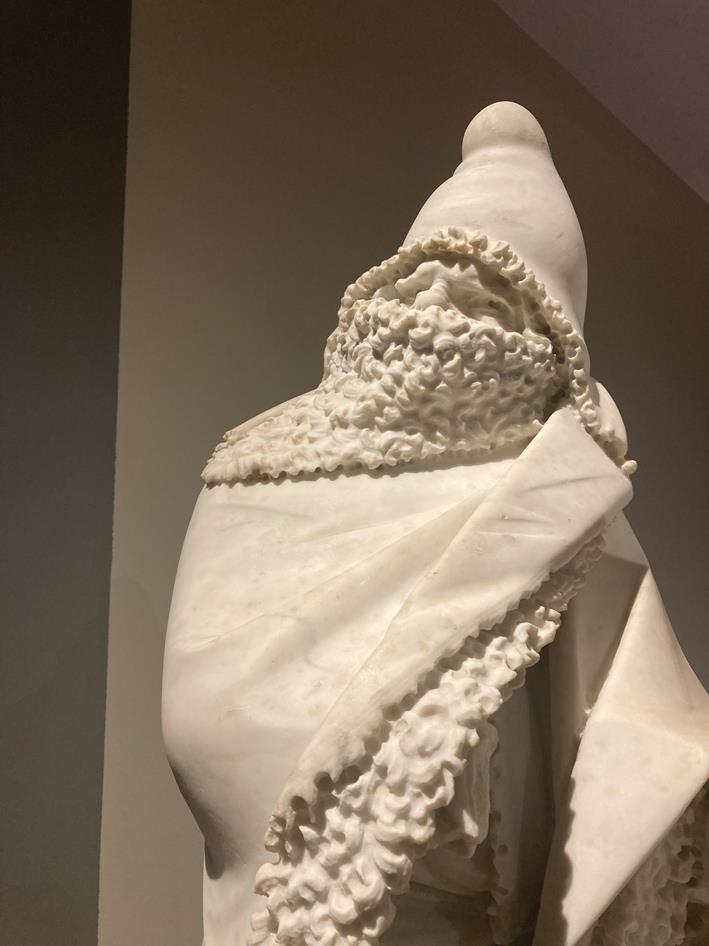
My favourite moment of the visit was encountering the bust of Sir Thomas Baker (on loan from the Victoria and Albert Museum, London), which I had not known existed. The pupils-less eyes and the hand emerging from beneath the cloak suggest a commemorative purpose. When Pope Urban VIII discovered that Bernini was carving this bust without permission, he ordered him to stop, though it was nonetheless completed.
Costanza Bonarelli
By contrast, the bust of Costanza Bonarelli felt more familiar but remains one of his most powerful works. Set against a deep red background, it is intimate and deeply emotional. In the late 1630s, Bernini's private life became the source of scandal after discovering his lover Costanza Piccolomini Bonarelli's involvement with his brother Luigi. In a rage, he attacked Luigi, who fled into the basilica of Santa Maria Maggiore, and later attempted to have Costanza disfigured. Despite this, he was protected by Pope Urban VIII and avoided severe punishment, revealing both a darker side of the artist and the extent of papal influence.
Bernini the painter
Then finally came the last section, where Bernini's paintings were shown. I was mesmerised, as I had no idea he was also a painter. Seeing them in person revealed a more intimate and experimental side of him beyond sculpture and architecture. My favourite was David with the Head of Goliath, one of the most important paintings attributed to him. It is recorded in a Chigi inventory and may have been given to Pope Alexander VII. I was drawn to the power of the composition and the intensity of David's expression, while the loose brushwork makes Goliath's head almost dissolve, giving the painting a striking sense of movement.
Art, power and legacy
When I left the exhibition, I kept wondering whether Bernini's genius alone would have been enough, or whether it was his close relationship with Urban VIII that allowed him to realise his full potential. Together, they reshaped Rome and defined the visual language of the Baroque.
This was not simply an exhibition about the past, but about how art, power, and personality combine to create something enduring. Bernini did not simply decorate Rome; he gave it a new identity that continues to resonate through time.