Your musical path has taken you from Enna to Boston, Milan, Barcelona and now Malta. How have these different geographies shaped your voice as a jazz musician?
Enna and Sicily are my roots. In the Netherlands - I lived there for a year too, and it was important - I discovered my love for arranging. In Boston I was exposed to great musicians from all around the world and I learned that talent is nothing without work ethic. Milan is teaching me to deal with compromises. Can I answer about Malta in a few months? Beyond that, I think it's not about where you are but who you meet. Music is about sharing with others, and for sure this exchange process shapes who you are and the way you play.
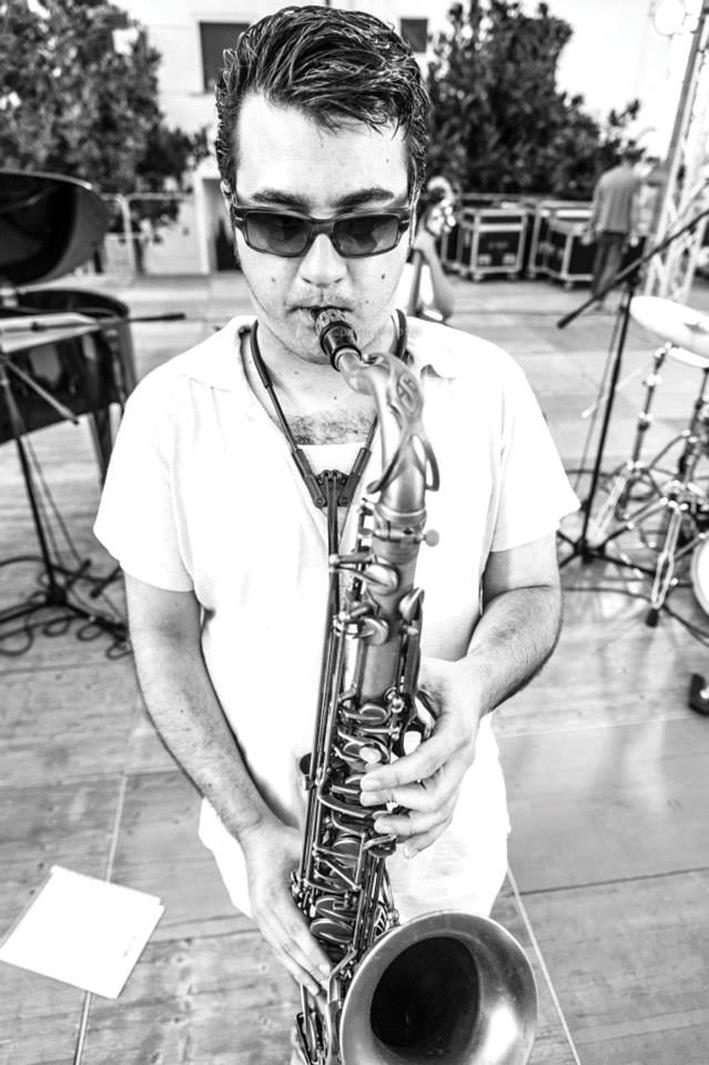
You trained with extraordinary teachers - George Garzone, Hal Crook, Tia Fuller, Maurizio Giammarco. Is there a lesson or moment from those years that still echoes in your playing today?
From all of them, the greatest common lesson I learned can be summed up as "trust the process." Music and art are a never-ending learning journey. During this journey there are going to be high points, but you also fall down - you have to be aware of that and learn to never stop striving for progress, even when it feels very little. I also want to mention another great mentor I had at Berklee: Jim Odgren. He fully believed in me and his words are still stuck in my head.
You move with ease between saxophone, clarinet, composition and arranging. Do these different roles feed each other, or do they require different parts of you?
Well, sometimes I write more than I play, or vice versa, but I always try to find a balance between all the aspects I need to take care of. I think they feed each other, as performing and writing are both part of my musical personality.
You've performed in festivals from Bergamo to Tel Aviv, Boston to Enschede. Is there a stage or encounter that marked a turning point in your artistic life?
The stage that I feel as a turning point is the Umbria Jazz Winter Festival. It was before Berklee - I was very young and I had to coordinate and take care of the arrangements and compositions of a band composed of some "young lions" chosen from the best musicians at Umbria Jazz Summer. There I understood that maybe I had something to say.
Your catalogue of original compositions is extensive. What usually sparks a new piece - a mood, a place, a rhythm, a story?
Well, it depends. I sing a lot during the day - fortunately for myself alone - so often it all starts with a melody. Then I try to enrich it with harmony and rhythm. Sometimes it's a sound my ears capture while walking, sometimes it's a groove - I wear this ring on my thumb mainly to play the objects around me. But I strongly believe that working, meaning writing music, even when you don't have a spark, is important. I try to write every day, even just a few bars. It's not unusual that I look back through my notebook and find ideas I didn't like at the time but now want to develop.
You lead several ensembles - trio, quintet, international quartet. What do you look for in the musicians who share the stage with you?
Love and respect for music. That has to be reflected in many aspects: being on time, being prepared at rehearsals, working constantly on your craft. Then I love playing with musicians who are open, who don't fear the unexpected - musically speaking - and are not afraid of contamination. I also love playing with musicians who are more experienced than me: I'm still hungry to learn new things.
"The Gathering", your debut album with Giuseppe Campisi was release last February. What does this project represent for you at this moment in your career?
It's important because before that I had done a lot of recordings that are sitting in a drawer, and this is my first album as a leader. It is truly a gathering of musicians with kindred ideas. The concept was to write original music for a group without any harmonic instruments and to play it in the most spontaneous way possible. It served as a catalyst to produce and release more music without overthinking it: I already have another album planned, this time for quintet, which I'll record in the fall.
You were selected for the AIR international residency and toured Poland with the Jaromir Rusnak Quartet. How did these experiences expand your musical horizons?
It all comes together - all these experiences feed my soul and it all gets reflected in my music.
You are also deeply committed to teaching. What do young musicians give back to you - what keeps you returning to the classroom?
The spark I see in my students' eyes when they discover something that truly moves them - and of course, that doesn't happen every day, but when it does, it stays with you. There is an energy they give back that is hard to describe: it reminds you why you started, it keeps you honest, and it pushes you to stay curious. Teaching forces you to articulate things you usually just feel, and that process ends up making you a better musician, too.
Jazz is often described as a conversation. When you play, who or what are you conversing with?
It's a conversation between you and the musicians you're on stage with, and with the audience as well. The magic thing about improvisation is that you have to stay in the present - you cannot think, you can only react. The moment you think "now I'll play this or that," the music has already moved somewhere else. It works practically like a language: when you talk to someone you just react. You learn the grammar and the rules, but then you don't think "okay, now I'll put the subject here, the verb there." Music works the same way.
For this Malta-Italy concert, what can audiences expect - a meeting of styles, a dialogue, a celebration?
All of these things. The idea of "Jazz Bridges" comes from a connection between Italy, Malta, Afro-American music, and Brazilian music - all influences carried not only by me but by the other members of the band as well. We are going to play arrangements of songs by Michael Jackson, The Beatles, Ornella Vanoni, jazz standards played in a contemporary way, and some of my originals too.
Finally, what is inspiring you right now - musically or personally - as you continue shaping your path?
These days I feel particularly inspired by stories - movies, books, and art. When I go to a museum I try to imagine stories connected to what I see, and sometimes that becomes music. But in general, I love being inspired by people.
Editorial note: Jossey Botte is currently undertaking an artist residency in Malta as part of the A.I.R. - Artists in Residence programme promoted by MIDJ, SIAE, the Italian Ministry of Foreign Affairs and International Cooperation, and the Europe Jazz Network. During his month-long residency in Valletta, he has been collaborating with Maltese musicians and engaging with the local jazz scene through a series of performances and artistic exchanges.
As part of this residency, Jossy Botte will perform in Jazz Bridges on 9 June at Teatru Manoel, alongside the Angela Vella Zarb Quartet, in a concert celebrating the musical dialogue between Italy and Malta through jazz standards and contemporary compositions.