Archive work is painstaking but rewarding, with rewards often exceeding expectations. The Malta Society of Arts' archives are in the process of being catalogued, and they are a treasure trove that keeps giving, yielding discoveries that are of interest to the general public, as well as to students, practitioners, and researchers interested in the arts and culture. They stand as a testament to Malta's longstanding cultural heritage.
One recent find sheds light on the origin and production journey of the bronze bust of Churchill, which can be seen in the Upper Barrakka Gardens in Valletta overlooking the Grand Harbour - its proximity to the Saluting Battery underlining its connection with military history.
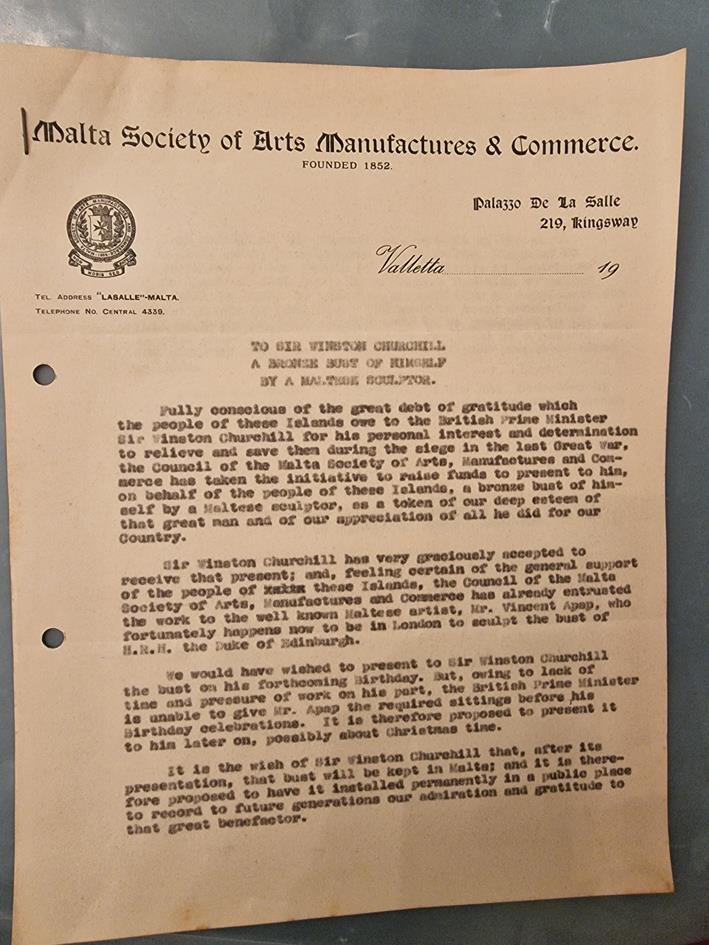
Among other things, the correspondence discovered by the volunteers working in the MSA archives includes communication between the Malta Society of Arts, Manufactures and Commerce and Churchill's staff, as well as communication with the sculptor. The series of letters, orders, receipts, and other documents offers intriguing insights into the interaction between art and politics. In the midst of these colonially-inflected diplomatic relations, there are some personal touches. The bust was intended to be a birthday gift on Churchill turning 80 (as it transpired, Churchill's schedule meant it was delayed and had to be presented later). In a letter to Churchill dated 10 November 1954, Judge Anthony J. Montanaro Gauci, the president of the Malta Society of Arts, Manufactures and Commerce is keen to stress the "personal" nature of the gift on both sides: the Maltese are "personally" in "debt" to Churchill for "the protection of Malta and its ultimate relief" in the war; the bust is deemed to be a "personal form" of gift, made for the "personal pleasure" of the sitter.
Fascinatingly, we also learn something about the Maltese sculptor Vincent Apap's craftsmanship, reputation, and method of working: "Mr Apap has the remarkable ability of being able to work at lightning speed." A bust of the Duke of Edinburgh took him "a couple of sittings of under an hour each". Judge Montanaro Gauci is quick to reassure the British Prime Minister Churchill that Apap's work will not take up much of the Prime Minister's time, and that Apap is able to work even while the sitter is going about his regular business.
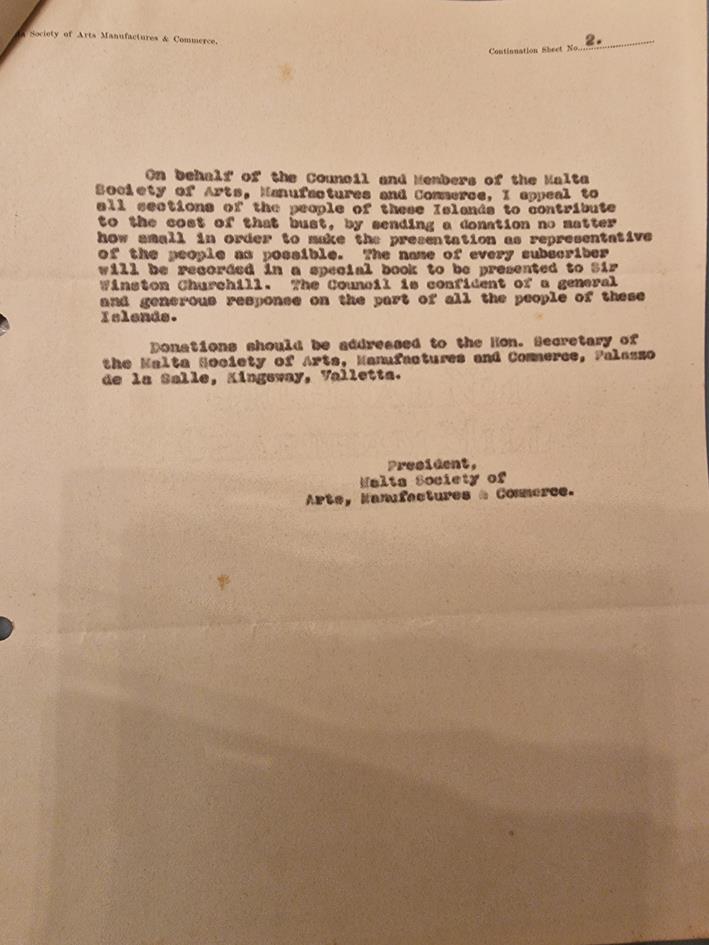
The documents found include a public appeal for contributions towards the cost of the bust, issued by the Society "in order to make the presentation as representative of the people as possible". With immense deference, the decision is made to have the bust "installed permanently in a public place to record to future generations our admiration and gratitude to the great benefactor", who desired the bust to remain in Malta. In contrast to the deference of the official communications with colonial power, the tone becomes terser and less formal when we see the back-and-forth within the local team working on the production of the piece; Apap admonishes the foundry for its delays with the pointed comment: "I hope you understand that this gift is not intended for Sir Winston's 81st birthday."
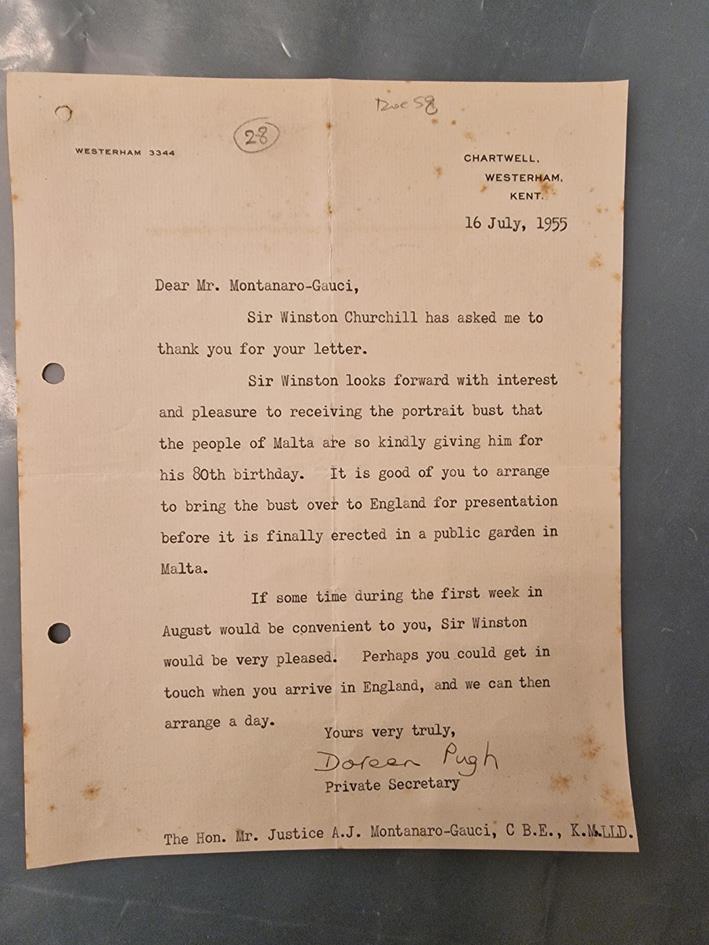
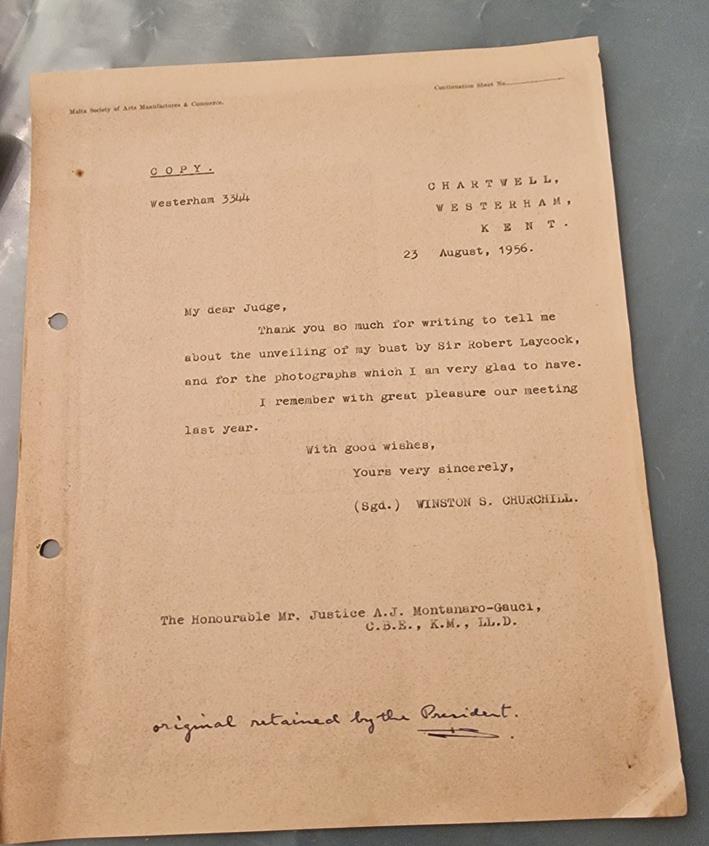
Documentation extends to the official presentation of the bust to Churchill in his Hyde Park residence (including press clippings) on 3 August 1955; its transportation to and delayed arrival in Malta; right up to the eventual unveiling of the bust on 5 May 1956.
These documents, collected as a series, tell a story: they fill in many factual details, while also illuminating some aspects of relations between the parties involved through their interactions and navigation of power dynamics. The archived letters give us a glimpse into brewing anxieties as delays inevitably crop up and plans change - parts of the picture that are often missing from the history books.
The archival cataloguing work at the MSA is ongoing, and there will no doubt be many other surprising and exciting discoveries to come. The MSA would like to thank the National Archives of Malta for their support in supervising this project and to the volunteers, who dedicate their time and attention to this project.
The National Archives of Malta had this to say, placing the find in conversation with related documentation from other archives: "The identification of a file from the Office of the Prime Minister at the National Archives of Malta (MT NAM OPM-01-876/1955), documenting correspondence on the return of the bust of Sir Winston Churchill from London to Malta, adds a crucial governmental perspective to the story. When read alongside the correspondence preserved at the Malta Society of Arts, these records allow us to reconstruct the same events from different vantage points - artistic, administrative, and institutional - tracing discussions on approval, placement, and practical arrangements such as the waiver of Customs' duty. These discoveries remind us that history rarely resides in a single archive and demonstrate how ongoing cataloguing work continues to uncover connections across archival collections, opening new avenues for research and public engagement.
"The National Archives of Malta also wishes to acknowledge the invaluable contribution of the volunteers, whose commitment to attending meetings and training sessions has enabled them to carry out these archival tasks on a weekly basis under the supervision of National Archives of Malta archivists."
Dr Joe Borg, the president of the MSA, comments: "The MSA is a place where heritage and contemporary art meet. The archives of the Malta Society of Arts continue to be a fascinating source of insights into local cultural history, as well as rounding out our picture of the role played by the MSA itself at a national level."