 For this month, il-Kamra ta' Fuq will be hosting Architopia: Echoes of elsewhere, the second solo exhibition by Glenn Ellul, where the level of intricate detail is guaranteed to leave visitors in awe.
Speaking of detail, this is the kind of exhibition that should come with a BYOMG policy: Bring your own magnifying glass. (Don't worry, we'll be providing some too.) The images accompanying this article are impressive, but trust me, (and I am rarely wrong), these works need to be experienced in person.
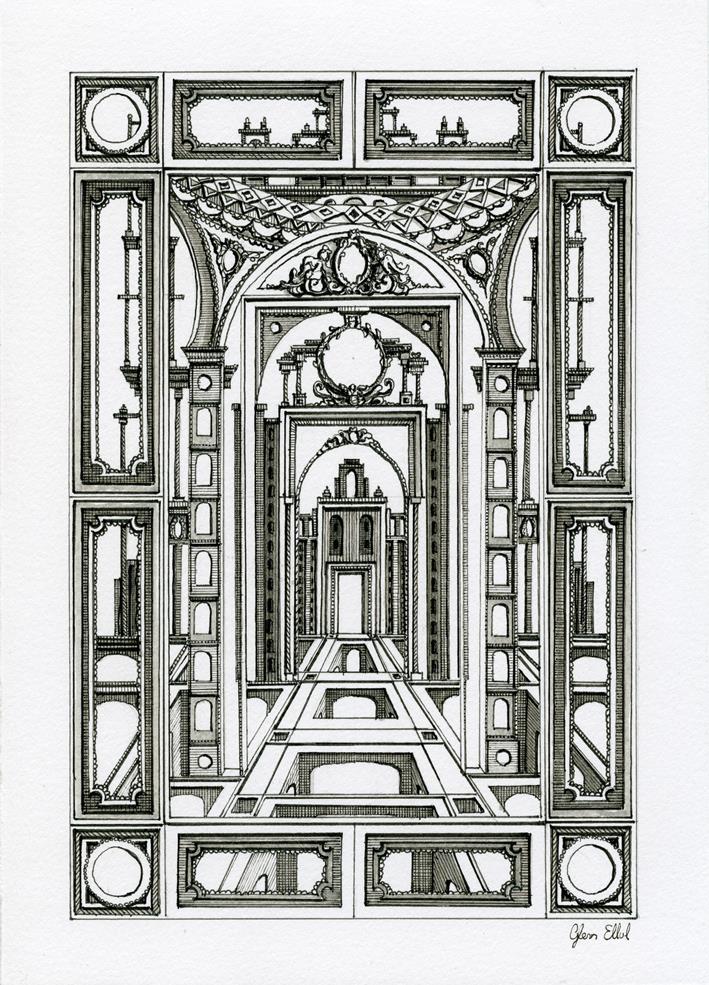
I still get shivers when I think back to my first studio visit with Glenn and my initial encounter with these drawings. The sheer precision, patience, and imagination on display, were astounding. Every inch of the surface rewards attention, revealing layer upon layer of architectural complexity. It is a remarkable demonstration of both technical bravura and creative vision.
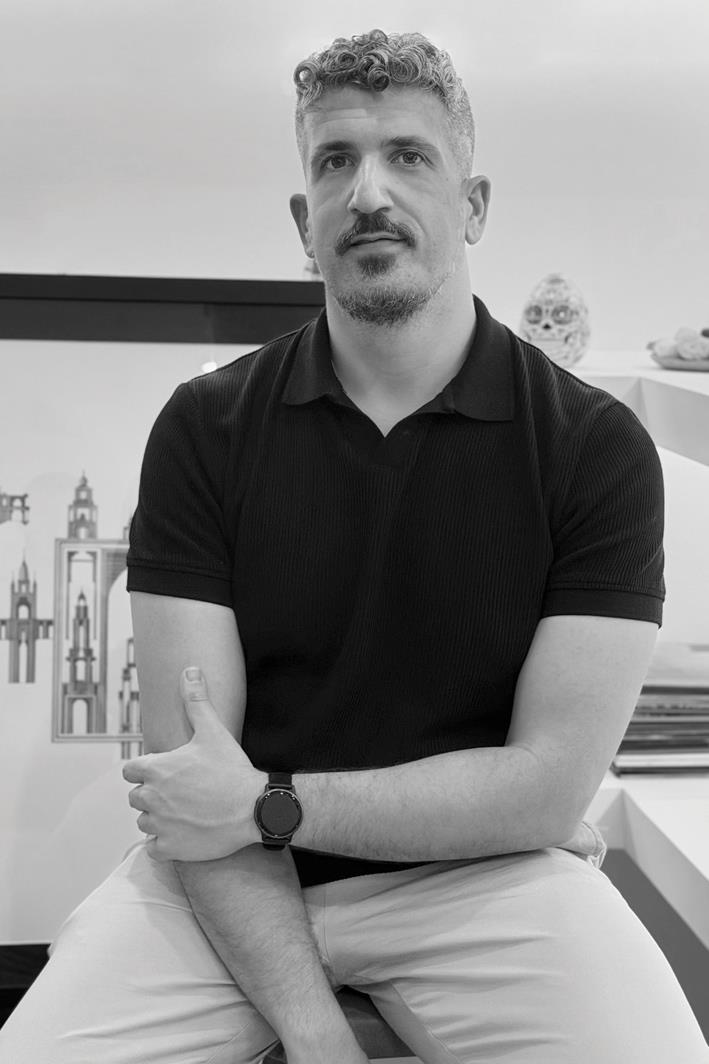
But first things first: the usual background check. Ellul is a self-taught artist whose fascination with the intricacies of local architecture, particularly monumental and Baroque structures, began at a very young age. He graduated with a B.A. (Hons) in Graphic Design & Interactive Media (and this says a lot).
His first solo exhibition, Structures of the mind, curated by Roderick Camilleri, introduced audiences to his distinctive architectural visual language, which can now be seen as a prelude to what visitors will encounter at il-Kamra ta' Fuq. Over the years, Ellul has developed a signature artistic style that combines architectural motifs with an intricate ornamental vocabulary, articulated through an imaginative and painstakingly meticulous approach using ink on paper. The result is a body of work that is immediately recognisable as his own.
The exhibition presents a series of intricate ink drawings that exist at the threshold between memory, imagination, and architecture. The title itself, Architopia, suggests an invented architectural ideal: a constructed "place" suspended somewhere between utopia, fantasy, and psychological space, while Echoes of elsewhere introduces a sense of distance, nostalgia, and reverberation; spaces that are not entirely fictional, but rather fragments of memories from another lifetime.
Drawing from a deeply personal archive of visual memories shaped by local architecture and travels across Europe, Asia, and South America, Ellul constructs impossible cities, suspended ruins, sacred interiors, and speculative monuments that appear both ancient and futuristic. Much like the imagined urban landscapes found in Italo Calvino's Invisible cities, these works are not depictions of actual places but meditations on how space can hold thought, memory, emotion, and desire. Such intangible notions are translated into beautifully balanced compositions and meticulously constructed architectural worlds.
Echoes of Giovanni Battista Piranesi emerge in the monumental complexity and labyrinthine nature of these spaces, while the intricate spatial paradoxes recall the impossible architectures of M. C. Escher. Closer to home, one may also find affinities with Richard England's Mythopoeia series, where architecture transcends function and enters the realm of poetry, mythology, and imagination.
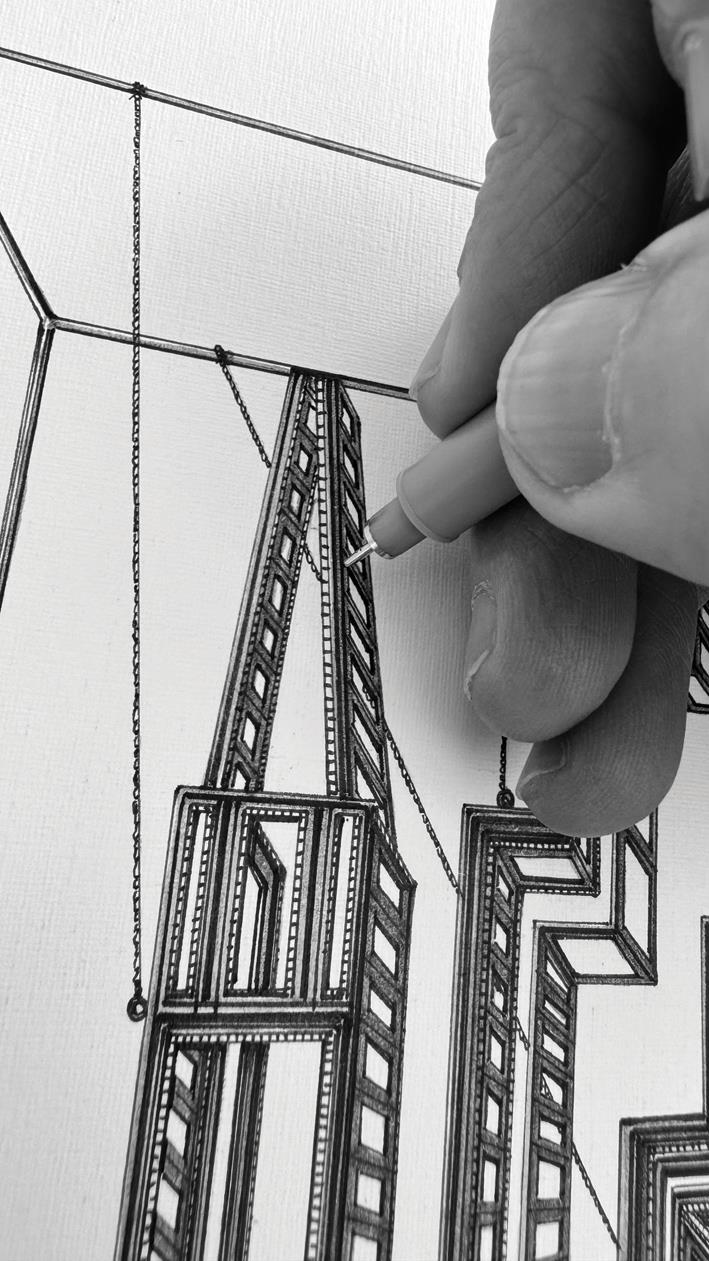
The level of detail and complexity is astounding. Executed painstakingly by hand in ink, line by line, the drawings emerge through repetition, accumulation, and intense concentration. The longer one observes them, the more they reveal themselves. New details emerge from every corner; embellishments, hidden passages, architectural flourishes, and unexpected twists and turns gradually come into focus - (seriously, do use the magnifying glasses.)
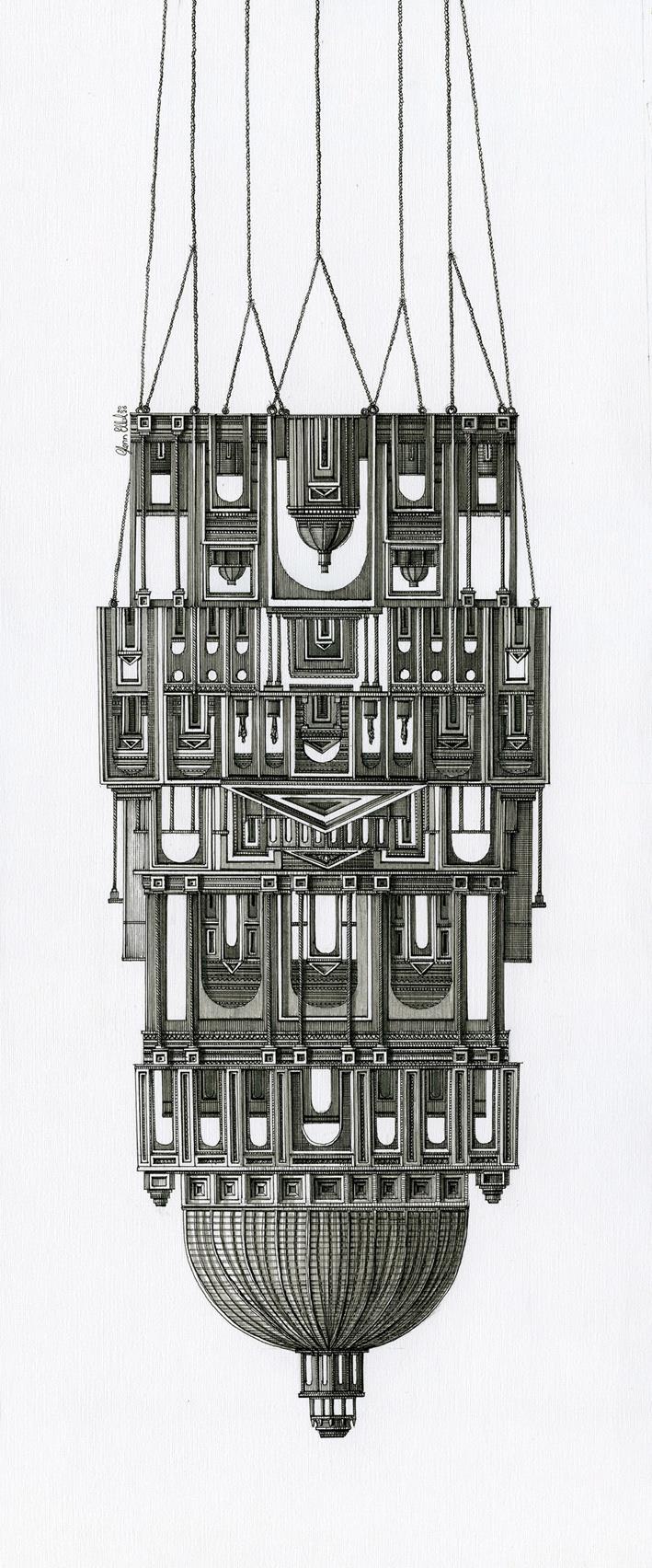
What is perhaps even more remarkable is Ellul's ability to imbue these fully-fledged architectural structures, complete with columns, domes, porticos, staircases, and facades, with a surprising sense of weightlessness. They appear to float effortlessly, as though constructed from some unknown, almost extraterrestrial material. Equally striking is the immaculate whiteness of the paper itself. It feels almost surreal to comprehend the countless hours invested in each drawing, yet there is scarcely any trace of the artist's physical presence upon the surface. The works possess a precision and cleanliness that seem to defy the very process of their making.
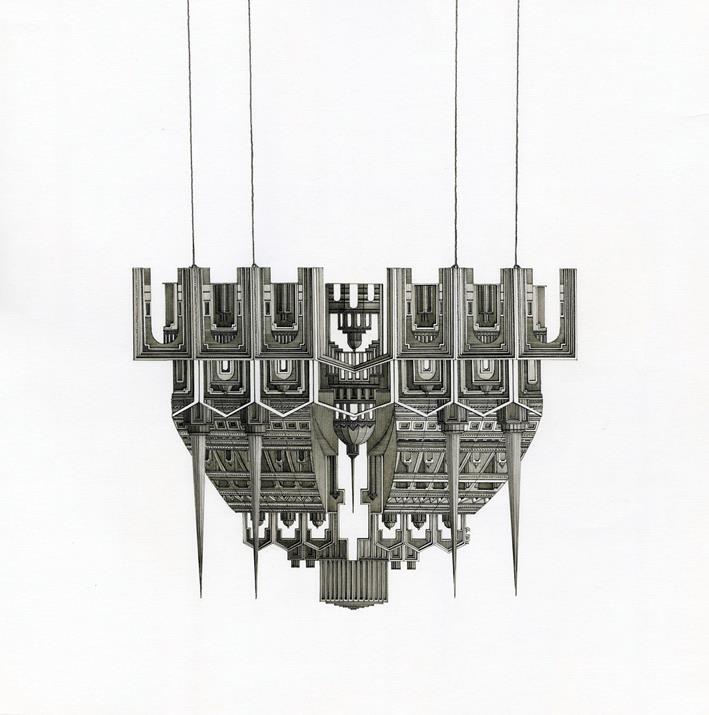
For the sake of discussion, I am grouping the works into four recurring visual typologies: those that appear to be constructed within intricate metallic frameworks; others that are suspended by ropes and hover freely in space, sometimes even upside down; a series focused on extraordinary architectural facades; and a number of works that invite viewers to peer through elaborate outer frames, revealing layer upon layer of an entire city concealed within.
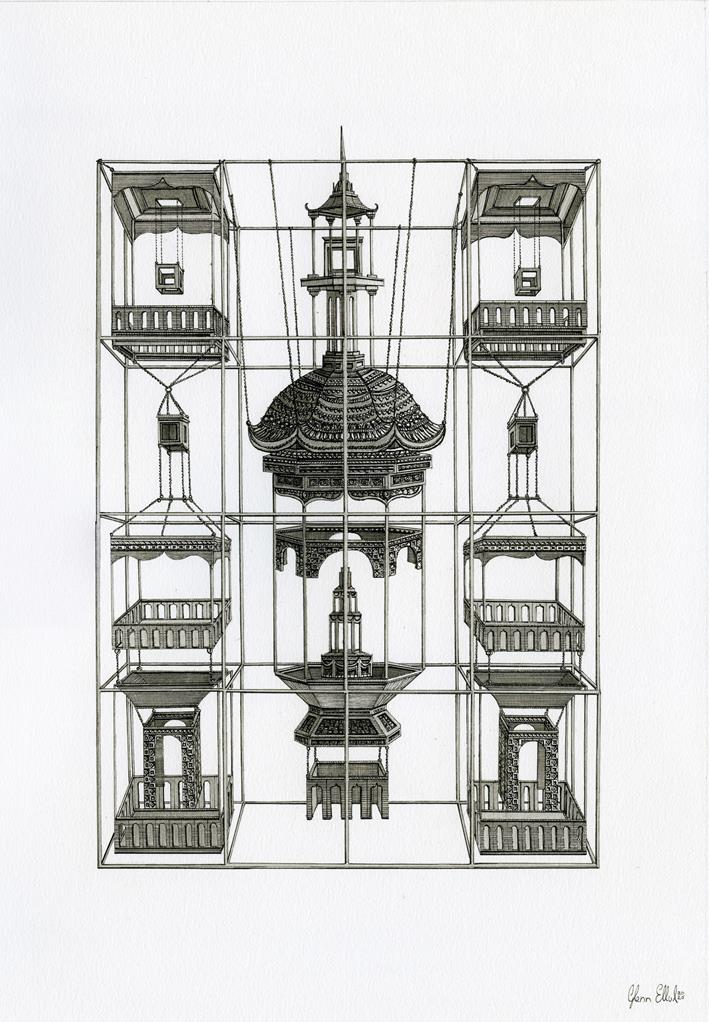
From the series of structures contained within metallic frameworks, I wish to highlight Sanctum frame. Along each side edge, three suspended "terraces" hang from one another. One supports a swing-like element, while the lowest appears to display an intricately embellished arch. At the centre of the composition stands a structure reminiscent of a pagoda. Suspended from its roof is yet another architectural form housing a smaller structure that resembles a wedding cake, or perhaps, closer to home, the Neo-Classical folly of the Belvedere in Lija.
Another work from this series is Void aperture. Here, the metallic cage becomes even more pronounced, almost taking on the appearance of scaffolding. A recurring pointed diamond motif is present throughout the composition, and two structures resemble oversized glass hourglasses. At the bottom, what appear to be two cannons guard the entrance to this imagined space, and there is something distinctly Futurist about their form and presence.
The suspended works are simply mind-blowing. Not only because of their technical execution, but because Ellul pushes the illusion one step further. The ropes supporting these structures appear to extend beyond the confines of the paper and into the viewer's own space, creating a subtle yet beautiful uneasiness. One instinctively searches for the safe point where these ropes might eventually be anchored. Suspended reliquary captures what appears to be an upside-down church, elongated and suspended in mid-air. Within it are smaller churches, arches, niches, and perhaps even saintly figures. At its very base hangs another belvedere, suspended from somewhere known only to Ellul.
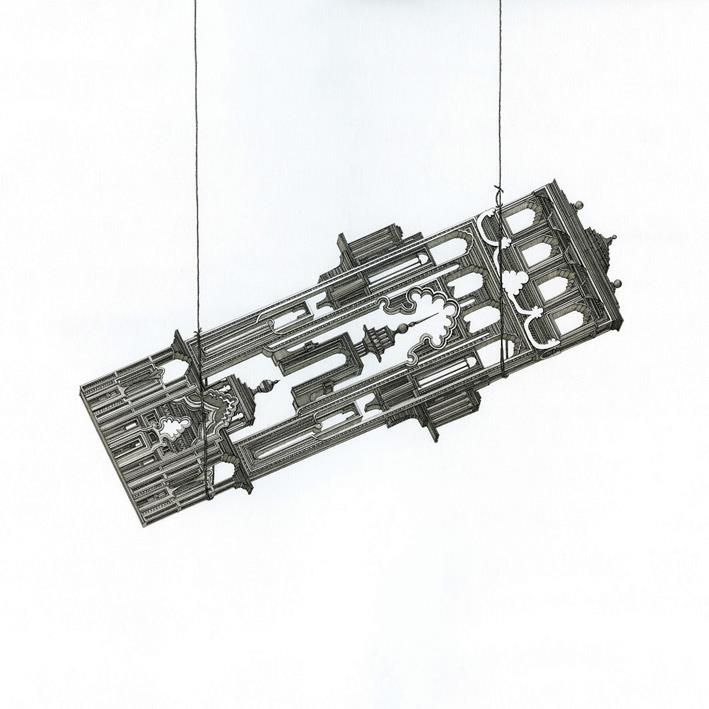
Tilted monument feels as though the Leaning Tower of Pisa decided to lean just a little further. Two ropes emerge from nowhere, seemingly preventing its inevitable collapse. The structure remains frozen in time, suspended between falling and standing.
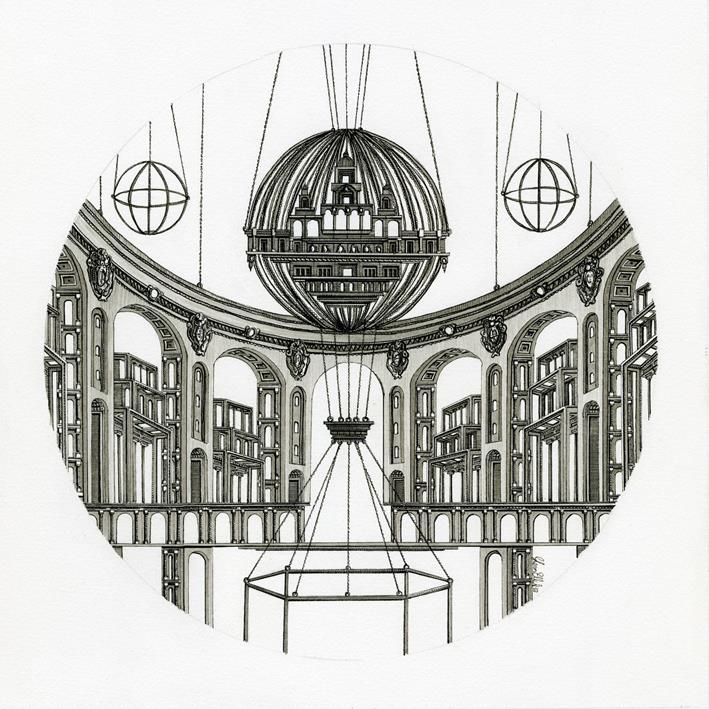
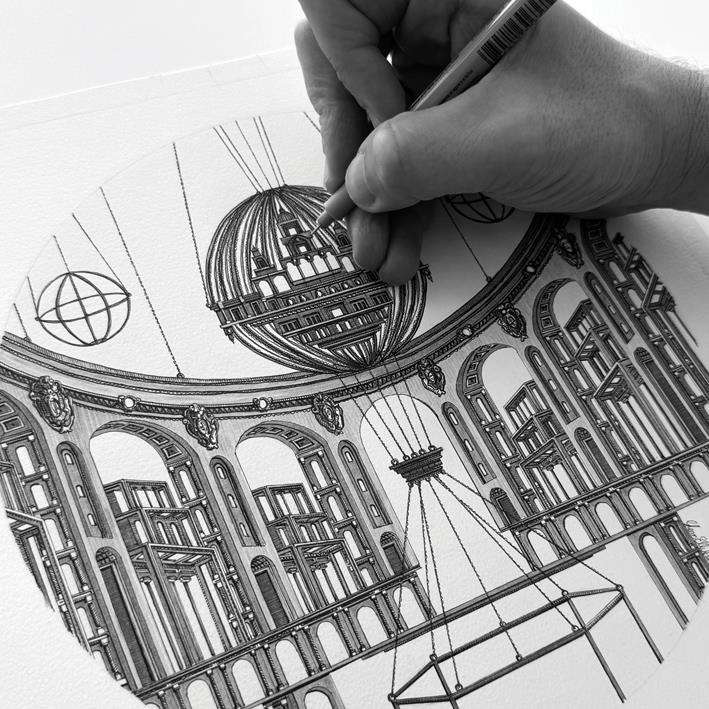
Sphere of observation is one of my absolute favourites. I hardly know where to begin describing it. The entire composition is contained within a circle. A series of arches and balconies, rendered in the round - a perspective challenge that the artist himself described as a nightmare to execute - surround three suspended spheres. Two are skeletal frameworks, while the central sphere is so extraordinarily complex that it deserves an article of its own.
The series of facades, titled Monuments of elsewhere, comprises three works that appear almost like cross-sections of these imagined architectural worlds. Entire facades stand isolated and suspended on their own. There are no ropes here, no visible means of support. There is no depth beyond the doors, porticos, and windows. They become portals leading nowhere and coming from nowhere, existing solely as monuments to an unknown place.
These works lead naturally to what I consider the magnum opus of the exhibition, Ethereal grandeur, a most fitting title. Here we are confronted by a sequence of extraordinarily complex facades. Although the apertures reveal nothing beyond, the composition itself possesses a remarkable sense of depth, created through an endless layering of arches, porticos, spheres, domes, and architectural embellishments. At its centre hangs the skeletal frame of a sphere, suspended upon a series of buttresses, themselves balanced upon delicate pointed structures. The result is a composition that feels simultaneously monumental and impossibly fragile.
The two works that appear to be enclosed within elaborate decorative frames form another fascinating group. In Cathedral skeleton, the composition is contained within richly ornamented panels that evoke the remnants of a cabinet or reliquary. Through this architectural threshold, the viewer is invited to delve deep into a succession of spatial planes executed with impeccable perspective.
The second work, Vertical chamber, employs a comparatively simpler frame, though one constructed from recurring triangular motifs that generate a striking visual rhythm. Beyond this threshold, suspended structures emerge in the distance, seemingly supported by an internal framework rather than ropes, as though governed by their own architectural logic.
Ultimately, for Ellul, architecture becomes a means of translating internal complexity into structured spatial systems. His works invite viewers not to search for fixed meanings, but to enter dense visual environments that gradually reveal themselves the longer one lingers within them. In doing so, they transform drawing into a journey through worlds that exist somewhere between memory, imagination, and possibility.
The exhibition is being held at il-Kamra ta' Fuq in Mqabba until 28 June, curated by Melanie Erixon