History is ever changing, never static, and the moral lens through which societies view past events and the individuals involved can shift dramatically with time. Heroes of one century may be judged differently in another, as generations reinterpret the past according to their own values. During the Victorian epoch, however, soldiers and officers were widely revered as figures of courage and honour, especially in the great wars of the Empire. In 1857, Queen Victoria established a medal that embodied this admiration for uncommon valour, the Victoria Cross. This decoration carried no social distinction or class privilege, recognising instead sheer bravery in the face of the enemy, whether performed by officer or private soldier alike. Though modest in design, bearing only the words "For Valour", its worth lay not in its metal but in the courage it symbolised. Tradition holds that the bronze was cast from captured cannon taken during the Crimean War.
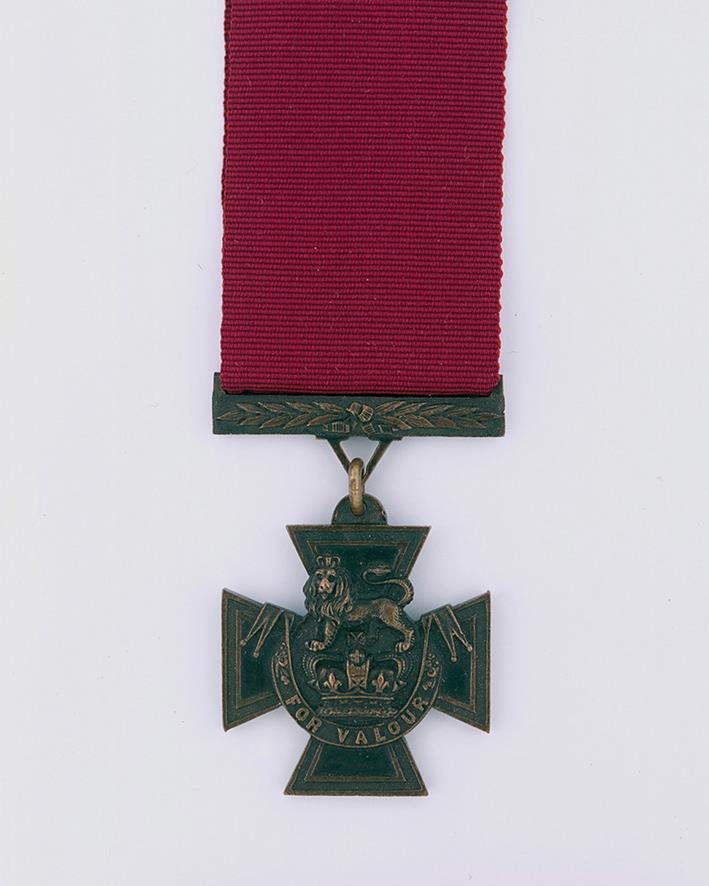
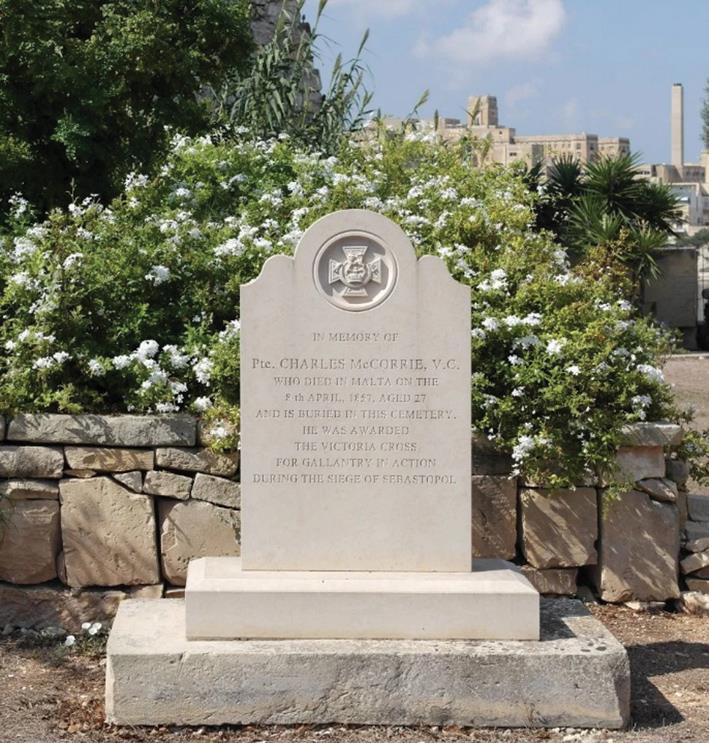
Malta's historic connection to the Victoria Cross is embodied in three distinguished recipients: General Sir Walter Norris Congreve, Boer War hero and former Governor of Malta, uniquely commemorated as the only VC holder buried at sea off the island; Private Charles McCorrie, decorated for exceptional bravery during the Siege of Sebastopol in 1855 and Captain Andrew Moynihan, another Crimean War veteran laid to rest in Malta's historic cemeteries.
Since 1856, only 1,358 Victoria Crosses have been awarded, making it the highest and rarest decoration for gallantry in the British military tradition.
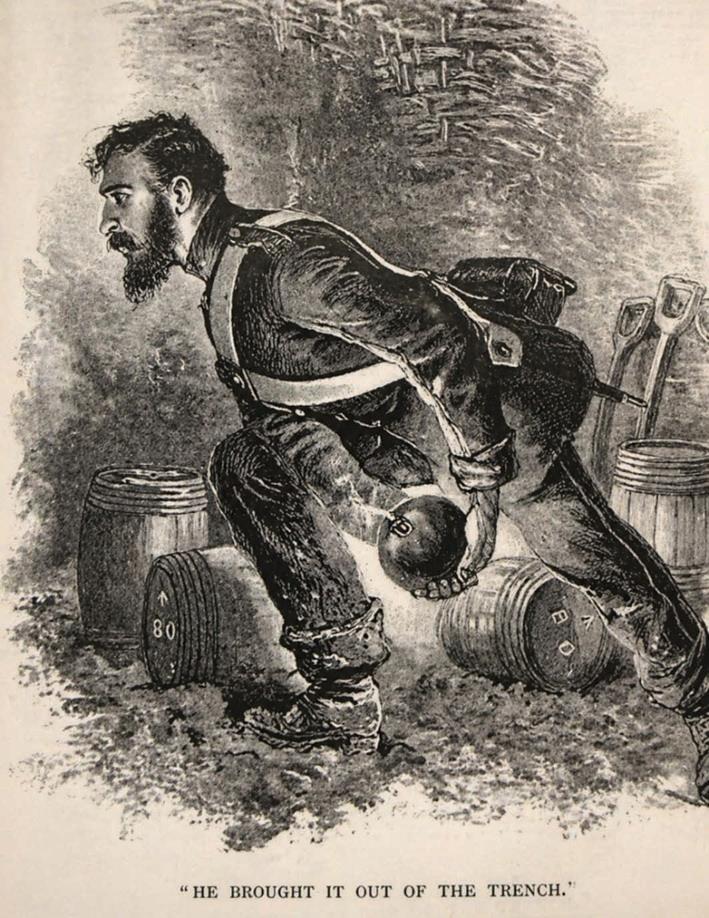
Private Charles McCorrie, VC. Courage in the trenches of Sebastopol
Charles McCorrie was born in 1830 in Ireland, County Antrim, his birth registered at St Catherine's Parish Church, Killead. He was the son of a mixed marriage, his mother Protestant and his father Catholic, reflecting the complex religious fabric of 19th century Ireland. Like many young men of humble background, McCorrie entered military service seeking opportunity, steady income, and adventure, unaware that his path would lead him into one of the most brutal conflicts of the 19th century - the Crimean War.
McCorrie enlisted in the 57th (West Middlesex) Regiment of Foot, a regiment heavily engaged in the Crimean campaign. The war, particularly during the prolonged Siege of Sebastopol, became notorious for its relentless artillery bombardments, disease, and trench warfare that transformed the battlefield into a relentless ordeal of endurance. It was within these dangerous trenches that McCorrie performed the act of courage that secured his place in history. On 23 June 1855, during heavy Russian bombardment, a live enemy shell fell directly into the trench occupied by his comrades. Without hesitation and with full awareness of the danger, McCorrie seized the burning shell and threw it over the parapet before it exploded. His prompt reaction saved the lives of fellow soldiers and demonstrated the calm bravery expected only of the most resolute men under fire.
Tragically, McCorrie would never live to witness the honour bestowed upon him. The Victoria Cross, instituted in 1856, was awarded retroactively to recognise acts of exceptional bravery performed during the Crimean War. By the time his award was confirmed, McCorrie had already died at the young age of only 26. He passed away on 8 April 1857 while stationed in Malta, most likely because of illness, possibly cholera or another disease common among soldiers stationed far from home, though the precise cause of death remains uncertain. Because of his early death, he never physically received his medal, which was returned to Britain, where its later fate became uncertain and is believed to have been lost.
McCorrie was laid to rest within the historic grounds of the Msida Bastion Cemetery, one of Malta's most significant military burial sites and a distinguished non-Catholic neo-classical cemetery established to serve Protestant and other non-Catholic servicemen of the British garrison and Empire. However, the exact location of his grave within the cemetery remains unknown today. Like many soldiers of modest rank, he is believed to have been buried in an unmarked grave, a common occurrence during periods of illness and high mortality. Over time, burial records were lost and many early markers disappeared, while the ravages of the Second World War air raids on Malta caused further destruction, making precise identification impossible.
It was only in April 2012 that a commemorative monument was erected in his honour during a royal visit by Prince Richard, Duke of Gloucester, marking the celebrations of the Diamond Jubilee of Queen Elizabeth II. This memorial does not indicate his exact resting place but stands as a symbolic tribute to a young Irish soldier whose courage saved the lives of his comrades, while his final resting place remains hidden beneath Maltese soil.
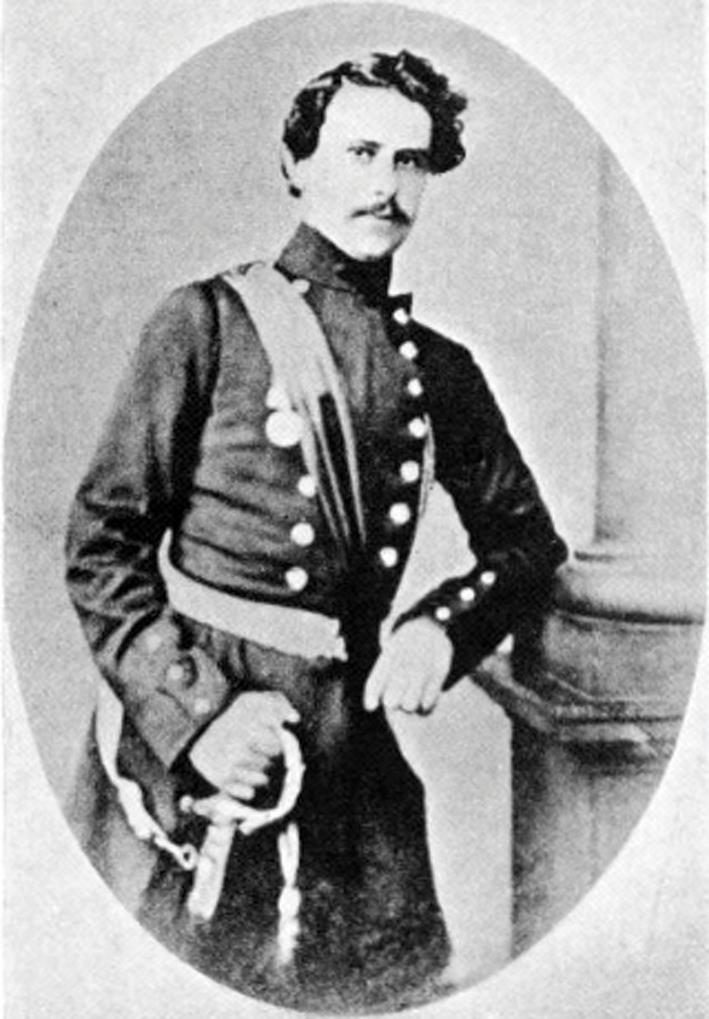
Captain Andrew Moynihan VC. Storming the Redan Fortress
Captain Andrew Moynihan (1830-1867) was born on 1 January 1830 at Wakefield in Yorkshire, and in his early youth moved with his family to Dukinfield near Ashton-under-Lyne, where he was schooled among the mills and industry of the north of England. There, amid the discipline of labour and the hard schooling of modest beginnings, he was shaped into the steady and obedient character of his age. He received his education at the Wesleyan Methodist School and in due course worked in the textile mills and tailoring trade, proving himself an excellent worker, diligent, fast learner, and steadfast in duty.
Yet from his boyhood he nursed the soldier's calling. At the age of 17, in 1847, he enlisted in the 90th Regiment of Foot (Perthshire Volunteers), exchanging the loom for the drill square. In time he rose through the ranks to Sergeant, and his physical strength, discipline, and aptitude for instruction soon marked him out. By his early service he was appointed a drill instructor, shaping other recruits with the same exactness he had once shown as a worker, and by May 1851 he had attained the rank of full Sergeant.
His baptism of fire came with the Crimean War, where his regiment formed part of the Second Brigade before Sevastopol. There, in the grim grinding warfare of siege and earthworks, men were tested beyond ordinary endurance. Moynihan's unit was posted against the formidable Redan fortress, a place of stone and death under constant Russian fire. On 8 September 1855, during the Assault on the Redan, he and his comrades were ordered forward under what was surely a suicide mission.
Under relentless fire, Moynihan went forward repeatedly to aid the wounded, returning through shot and shell to drag comrades from the storm of battle. He rescued a fallen officer and continued to assist others, though grievously wounded himself. In the confusion of the assault, he was bayoneted and for a time taken prisoner, only for the shifting tide of battle to return him to his own lines. When at last he was recovered, it was found he bore 12 separate wounds upon his body, yet he lived.
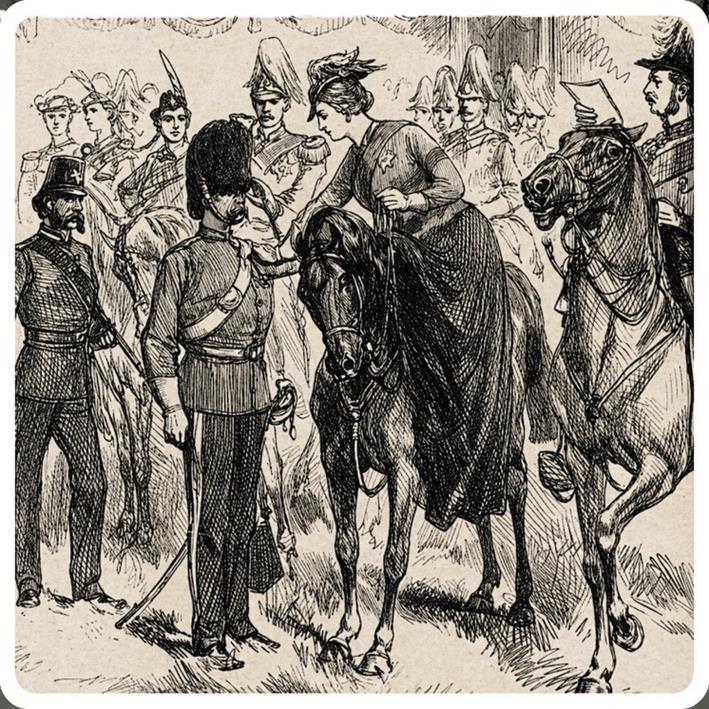
For these deeds he stood among the first soldiers honoured at the inauguration of the Victoria Cross in Hyde Park in 1857. Commissioned thereafter, he rose to the rank of Captain, continuing a soldier's life of duty and movement serving in India during the Mutiny, and later in Ireland and Gibraltar, ever faithful to the demands of his profession.
In the early 1860s he was posted to Malta, where he served as musketry instructor in one of Britain's foremost Mediterranean garrisons, teaching steadiness of hand and eye to younger soldiers. Yet fate, which had spared him under shot and shell, dealt him a quieter enemy. There he contracted Malta Fever, believed to be caused by unsterilised goat's milk. He died at Floriana on 19 May 1867, aged but 36 years, and was laid to rest the following day in Ta' Braxia Cemetery, leaving behind the memory of a soldier of humble origin, shrewd discipline, and proved courage under fire.
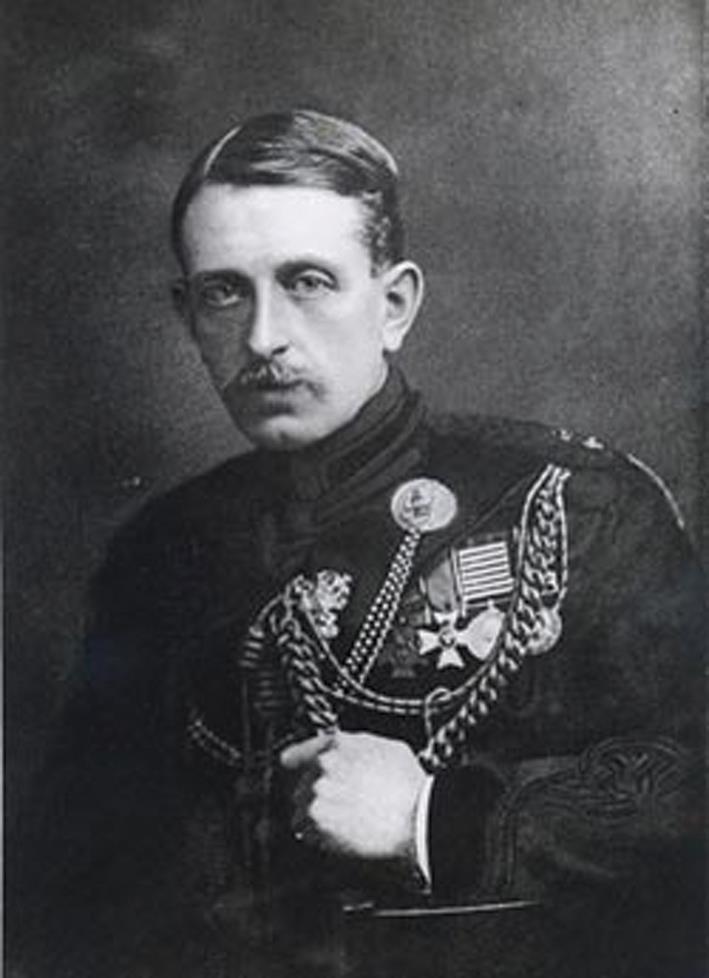
Sir Walter Norris Congreve VC (1862-1927) was a Royal Engineer whose career embodied the disciplined violence and administrative reach of late British imperial warfare. He was awarded the Victoria Cross for gallantry during the Second Boer War at the Battle of Colenso on 15 December 1899, where he took part in the attempt to recover British artillery under withering fire. In the confusion of the action, Congreve showed decisive leadership and personal courage, helping organise the withdrawal of the guns until he was severely wounded. The injury led to the amputation of his right arm, after which he wore a prosthetic hook, an unmistakable mark that followed him into public life.
He continued in service and was appointed Governor of Malta in 1924, where he became a familiar imperial figure on the island. Maltese memory sometimes referred to him as "the Governor with the hook", a blunt recognition of both authority and wound soldier and administrator fused in one visible history. Congreve died in 1927 while returning by sea from Malta and was buried at sea in accordance with naval tradition, a rare end for a Victoria Cross recipient and a final gesture consistent with a life lived across empire and ocean.
In Malta's memory, three soldiers remain, Charles McCorrie VC, Andrew Moynihan VC, and Walter Norris Congreve VC. Different regiments, different wars, different ends, yet each awarded the same supreme distinction for valour in the presence of the enemy.
They did not meet in life, nor in formation, but in remembrance they stand together beyond rank and time, where courage is the only measure that survives the fog of war.
All three are buried in Malta, within its earth, its walls, and its enduring silence.