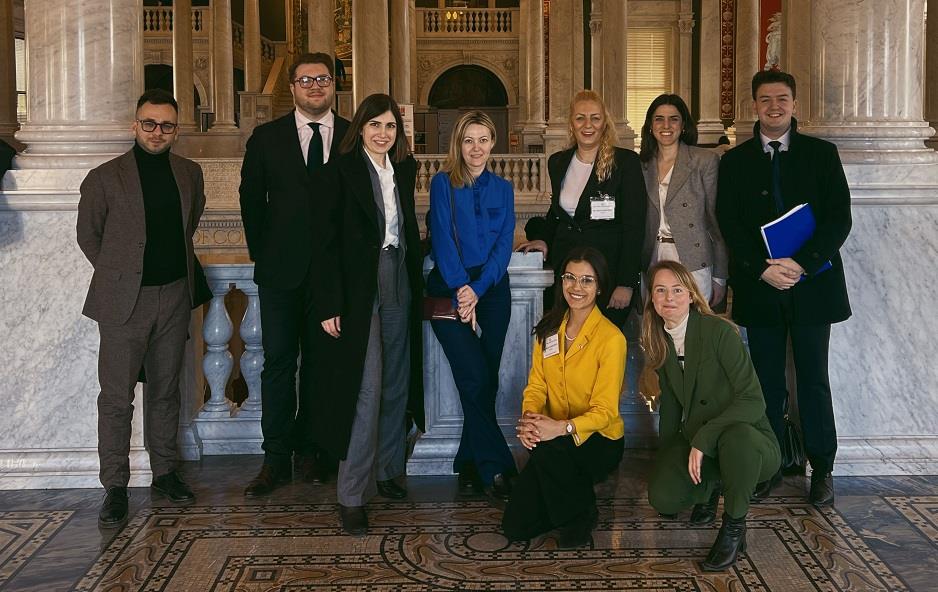
In January 2025, I had the privilege of representing Malta in the International Visitor Leadership Program through the project "Current U.S. Social, Political, and Economic Issues for Young European Leaders." The programme took place between 27 January and 14 February 2025, at a defining moment in American political life: the beginning of the Trump administration.
That timing made the experience far more than a conventional exchange programme. We were not observing American politics from a distance. We were in the United States at a moment of transition, when priorities were shifting, institutions were adjusting, and the national conversation was changing almost by the hour. For someone involved in Malta's political and policy environment, this was a rare opportunity to understand not only what America says about itself, but how it functions when tested by change.
Through visits to Washington, Cleveland, Tulsa and Orlando, the IVLP offered a serious look at the United States across different levels of government and society. We explored federalism, local government, civic engagement, political parties, volunteerism, economic development, migration, social policy, energy, security and the role of civil society.
What made the programme particularly interesting was that it did not present a single, polished version of the United States. It exposed us to a country in debate. We saw institutions, communities and individuals responding to difficult questions: how to manage political division, protect security while preserving freedoms, support vulnerable communities, encourage economic growth, and maintain civic engagement in an increasingly polarised environment.
These are not only American questions. They are European questions, as much as they are Maltese questions too.
As a small island state, Malta often experiences global issues directly, whether they relate to migration, security, energy or economic resilience. The IVLP allowed me to reflect on these issues through a wider lens.
Washington gave us insight into national institutions and policy formation at a time of political recalibration. Cleveland, Tulsa and Orlando offered a different perspective: one rooted in communities, local leadership and the everyday realities of governance. That balance mattered. It showed that politics is not only shaped in capitals. It is also shaped in cities, counties, neighbourhoods, NGOs, universities, media organisations and voluntary groups.
One of the strongest impressions I took from the programme was the role of civic responsibility in American life. Whether through volunteerism, local initiatives or community organisations, there was a clear emphasis on people taking ownership of the challenges around them.
One moment in Tulsa captured this in a very personal way. A taxi driver I met, who had served in the Marines, was working additional hours to contribute what he earned to a fund supporting fellow Marines affected by their service. It was a brief encounter, but it stayed with me. Beyond the formal meetings and policy discussions, it reflected a quiet sense of service and solidarity. It reminded me that public service is not only found in institutions. Sometimes it is found in ordinary people who continue to carry responsibility for others long after their formal duty has ended.
The IVLP was not only about the United States. It opened doors beyond the programme itself. It created relationships with people from across Europe engaged in public life, policy, civil society and leadership. In an increasingly uncertain international environment, these networks far from symbolic. They are practical, useful and essential.
For me, the programme also strengthened an important conviction: leadership today requires exposure. It requires the ability to understand different systems, speak across divides, recognise complexity and remain grounded in one's own conviction. The IVLP offered precisely that kind of exposure.
I returned to Malta with a deeper understanding of the United States, but also with a clearer sense of the importance of transatlantic dialogue. The United States and Europe will not always see every issue through the same lens. That is normal. What matters is that the channels of conversation remain open, serious and honest.
At a time when politics is becoming faster, louder and more fragmented, programmes like the IVLP remind us that relationships still matter. Dialogue still matters.
Rachel Powell took part in the United States's International Visitor Leadership Program (IVLP), the leading short-term professional exchange program of the United States government and Department of State