What does it mean for an exhibition to behave like a cosmology in formation rather than a system already given? In Firmament, image, text, and space are arranged as sequential thresholds, each reconfiguring how the viewer reads ascent, matter, and visibility itself.
Working across image and text, Ryan Falzon (b. 1988) moves between visual art, writing, and education. Since the late 2000s, he has exhibited in Malta and abroad, including participation in Absolut Vodka's Transform Today global art project in 2014. Alongside his visual practice, he has developed a parallel literary output that includes short publications and the novel SAJF (2022), shortlisted for the NBC 2023 National Book Prize. A graduate of the University of Malta (MA Fine Arts, 2023), he was named Best Emergent Author in 2024 and took part in the European residency programme Ulysses' Shelter the same year.
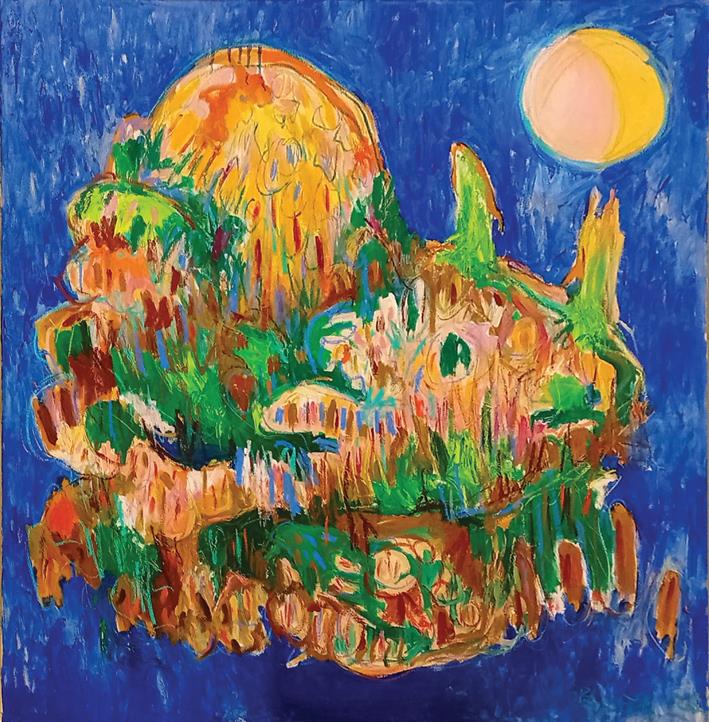
His latest solo exhibition Firmament, co-curated by Veruschka Götz and François Zammit at Spazju Kreattiv, brings together a new series of paintings, text-based works, and spatial installations. It unfolds across a sequence of rooms in which each room marks a gradual ascent through shifting materials and atmospheres. These elements are arranged to guide the viewer upward through the space, establishing a structured progression that culminates in a final spatial and conceptual shift.
The term firmament has historically been used to describe the sky as a solid dome enclosing the earth, a concept rooted in early cosmological thought and later echoed in biblical accounts. Falzon draws on this layered history of cosmology, alongside visual references from ancient Mesopotamian, Egyptian cultures and medieval esoteric illustration. A key visual point of departure is also the Flammarion engraving, in which a figure breaches the edge of the visible world in search of what lies beyond the celestial sphere. Through these references, Falzon reconsiders the firmament not as a fixed or hierarchical structure, but as something permeable and open to rupture.
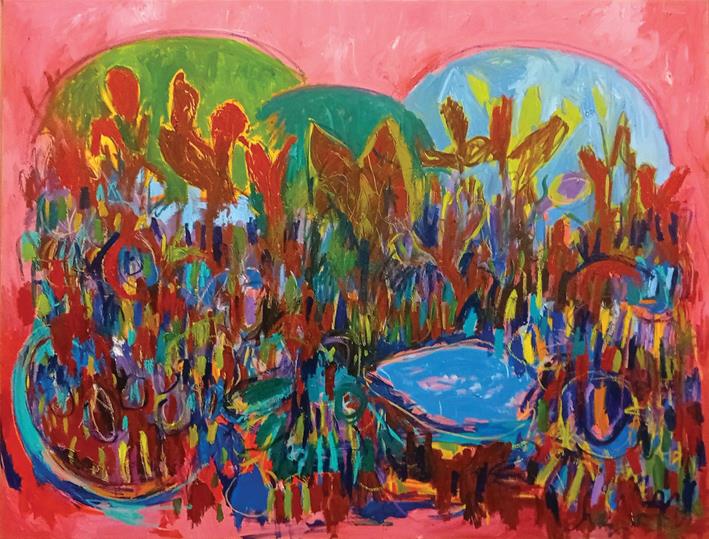
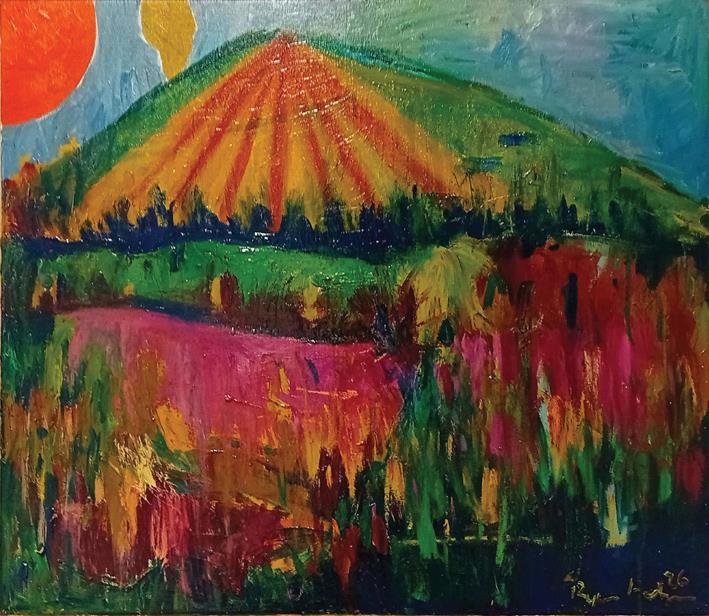
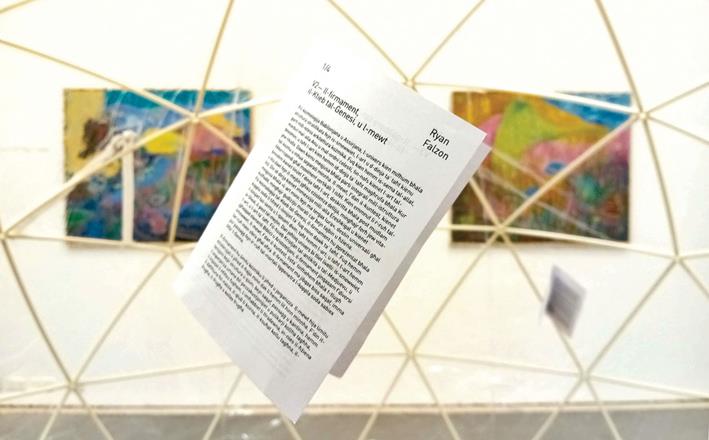
The initial room functions as a grounding point for the exhibition's progression. The paintings draw on abstraction of Maltese terrain, presenting the landscape as both historical and unspoiled, with recurring gestures of dissolution, descent, and upward perception. Their vibrant palette leans toward a more metaphysical register, as Zammit observes "the Landscape is material but its suspension is psychological". In this space, painting, text, and installation remain distinct, only fully converging when the viewer enters the makeshift cupola, reads Falzon's suspended texts, and encounters the distortion of the paintings mediated by this physical threshold.
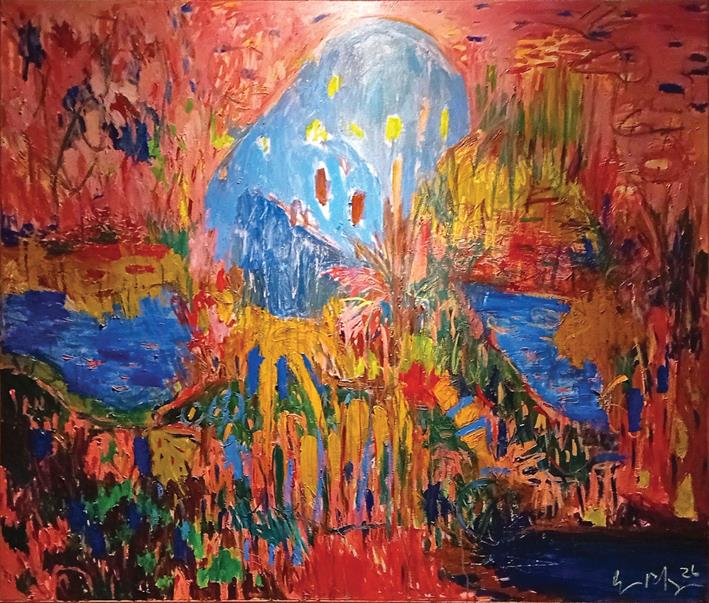
The second room draws on two etchings from the Mutus Liber, centred on alchemical imagery of union and transformation, where cyclical processes of bodily and cosmic convergence are linked to the pursuit of renewal through the philosopher's stone. This is echoed in the emphasis on sunlight, whose shifting rays act as a visible link between the material world and something beyond it. Water operates alongside this as both a symbolic and physical agent of purity and transformation, further represented through an installation that suggests the collection of dew, evoking its role as a distilled and essential element towards purity.
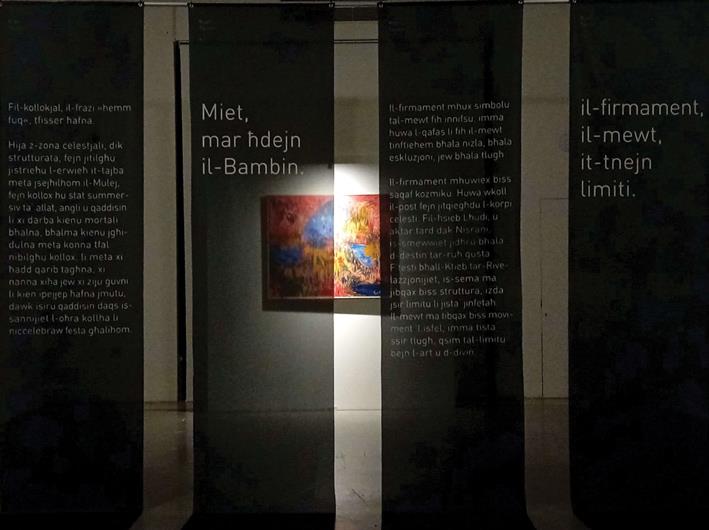
This logic of transformation and boundary-crossing becomes most pronounced in the subsequent section. Set in darkness, the viewer encounters suspended veils of text that partially obscure a single painting, which must be physically passed through to access the work. The act of passing through these barriers frames perception itself as a form of encounter, echoing the logic of the Flammarion engraving as it is enacted spatially. In this manner, the viewer is positioned as an active participant in an experience in which, as Falzon notes, "the written and the visual are intertwined, each supporting the other to produce a unified experience".
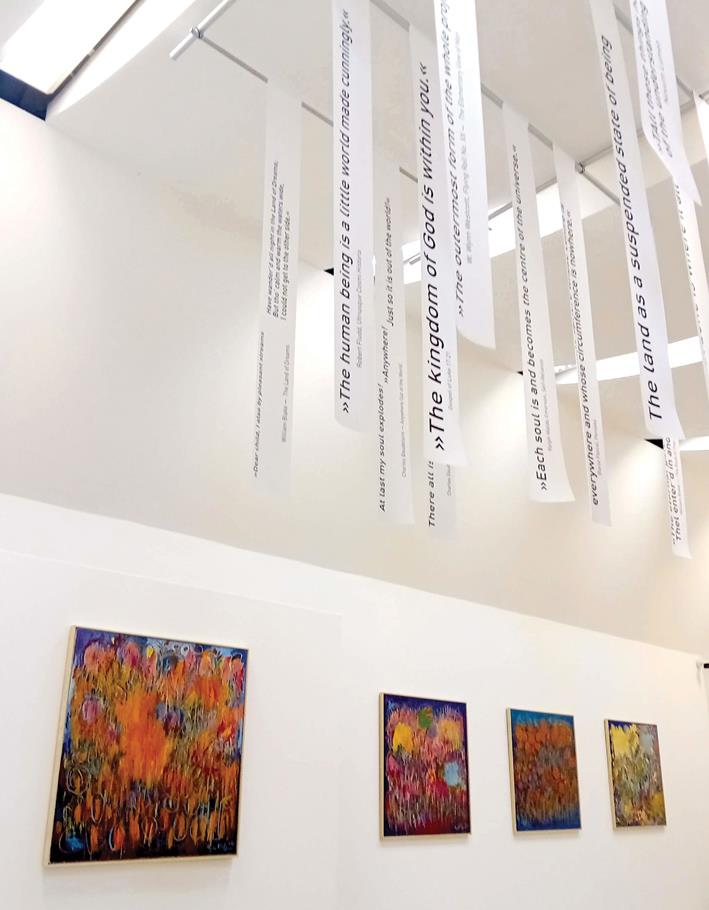
In contrast, the final room, titled Jacob's Ladder, presents a vast, illuminated space structured around ideas of movement, ascendance, and self-renewal. The room is divided into three sections: an initial empty area containing five small texts by Falzon reflecting on these transitional stages, set between fiction and fact; a suspended configuration texts incorporating quotations from Virgil, William Blake, and others, together with a painting below them; and a final grouping of paintings. As Falzon states: "Socially, morally and otherwise, one reaches a point of culmination where exploration seems to pause. You discovered who you are as a person."
A sense of internal tension underpins the exhibition's movement toward transcendence, framing it less as escape than as a persistent pressure against the limits of the material world. The idea of a firmament is therefore treated not as a stable structure but as something conceptually broken open, reshaped through the exhibition's own unfolding logic. As Zammit notes: "The exhibition itself is creating a cosmology," suggesting a system that is generated in real time rather than presented as complete. Within this framework, Firmament occupies a liminal field where established orders begin to loosen, allowing material and psychological registers to overlap and shift.