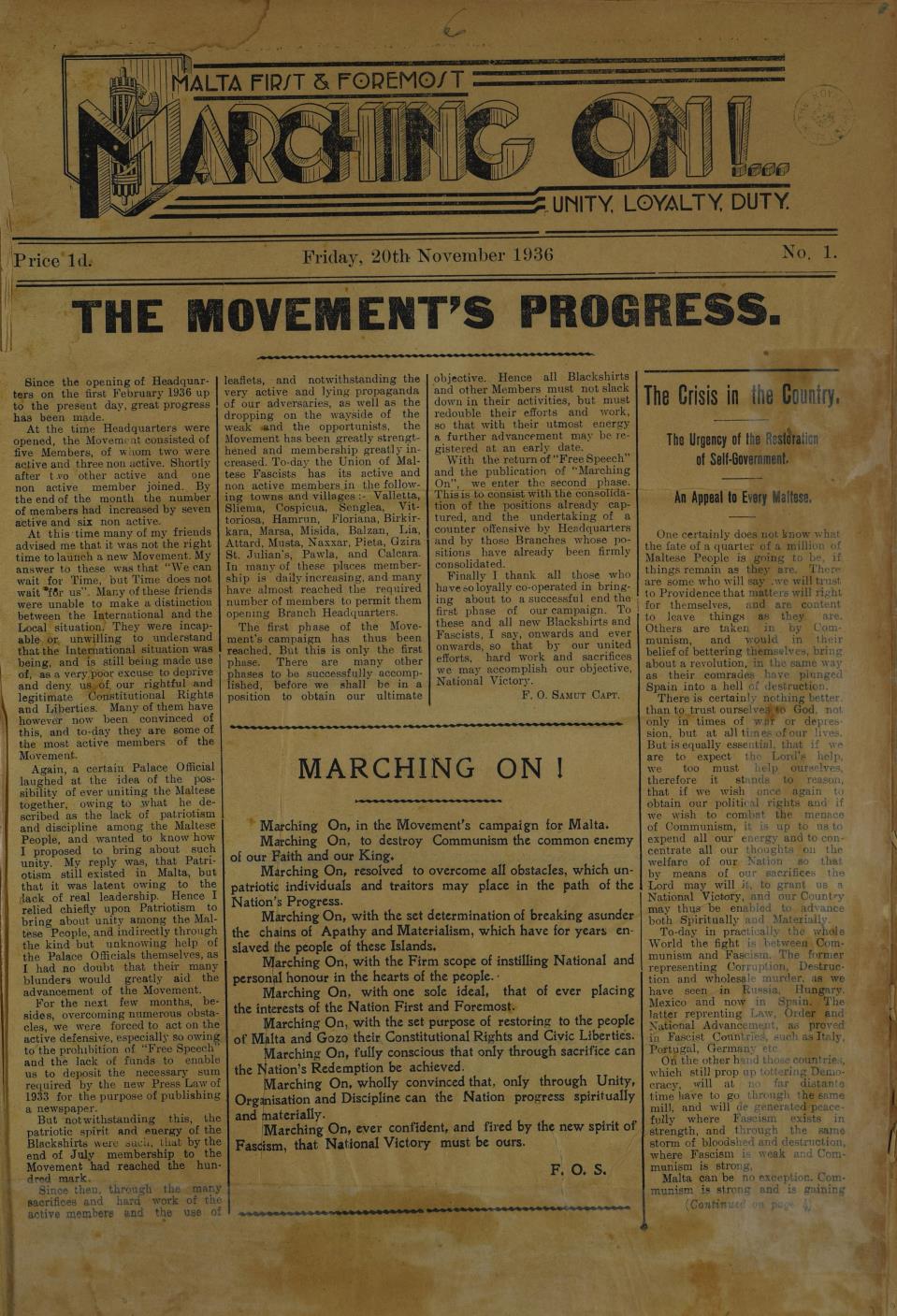
If the emergence of fascism in Malta reflected the anxieties of a society in transition, its rapid decline revealed the limits of radical political experimentation in a small, tightly contested colony. As detailed in Marching On... the story of the Union of Maltese Fascists (UMF) is as much about ambition as it is about constraint.
At the centre of this experiment stood Captain Frederick Oloff Samut and the Union of Maltese Fascists (UMF)-a movement that promised renewal but ultimately faded before it could take root.
Building a Fascist Alternative
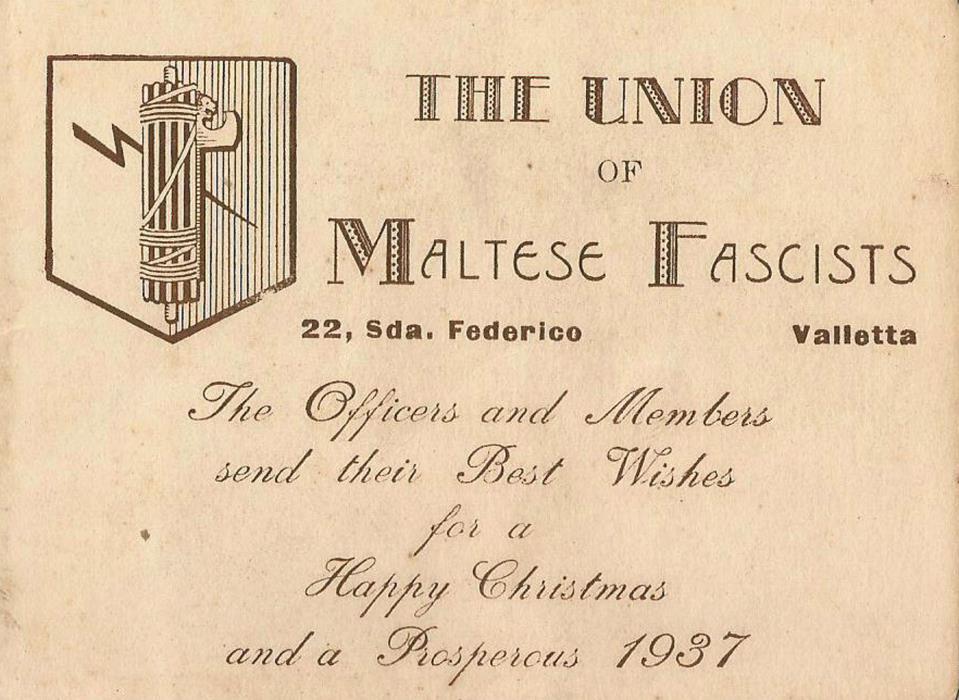
By 1936, the Maltese branch of the British Union of Fascists had evolved into a distinctly local organisation under Samut's leadership: the Union of Maltese Fascists. Unlike its predecessor, the UMF sought to articulate a vision tailored specifically to Malta's political, economic, and social realities.
At its core was the idea of the Corporate State-a system that would replace parliamentary democracy with representation based on professions and sectors. Workers, employers, and professionals would all be integrated into a unified governing structure, theoretically eliminating class conflict and ensuring efficiency.
For Samut and his followers, Malta's existing political system had failed. The 1921 constitution, once celebrated as a milestone of self-government, was now seen as inadequate and ill-suited to the island's needs. The UMF argued that incremental reform was no longer enough-only a complete restructuring of governance could address Malta's challenges.
Economic Anxiety and Opportunity
The UMF's appeal was not purely political. It was also deeply rooted in economic concerns.
During the interwar period, Malta's economy remained heavily dependent on British military spending. While this provided a degree of stability, it also limited diversification and left the island vulnerable to external shocks. The Great Depression only worsened the situation, increasing unemployment while reducing opportunities for emigration-a traditional outlet for economic pressure.
To many, the success of Fascist Italy appeared to offer a compelling alternative. State-driven industrialisation, infrastructure projects, and economic planning suggested that a more interventionist approach could transform Malta's fortunes.
The UMF embraced this model, proposing policies aimed at economic revitalisation and self-sufficiency. Their vision promised not only growth, but also dignity-a Malta less dependent on imperial structures and more in control of its own future.
Loyalty to King and Empire
One of the most intriguing aspects of the UMF was its relationship with the British Empire.
Unlike many nationalist movements of the time, the UMF did not seek independence. Instead, it promoted a form of loyal reformism. Samut and his followers believed that Malta could remain within the Empire while adopting a fascist system of governance.
This position created a delicate balancing act. On one hand, the movement criticised British policies, particularly the suspension of self-government and the island's economic dependence. On the other, it emphasised loyalty to the Crown and sought closer integration within a reformed imperial structure.
This duality reflected Samut himself-a man shaped by British military service, yet convinced that Malta needed a radically different political model.
Resistance from All Sides
Despite its ambitious vision, the UMF struggled to gain widespread support.
Established political parties viewed the movement with suspicion and hostility. The Nationalist Party dismissed its members as opportunists and traitors, while the Constitutionalists largely ignored it, focusing instead on their own rivalry with the Nationalists.
Even within Maltese society, fascism faced significant resistance. The Catholic Church, a powerful institution on the island, remained cautious. While the UMF presented itself as aligned with Christian values and strongly anti-communist, its authoritarian tendencies raised concerns.
At the same time, British authorities monitored the movement closely. Although they initially tolerated fascist organisations-as long as they operated within legal boundaries-they remained wary of any group that could threaten stability in a strategically vital colony.
A Movement Without Momentum
Perhaps the UMF's greatest challenge was its inability to translate ideas into political success.
Unlike larger fascist movements in Europe, the UMF never had the opportunity to test its popularity at the ballot box. By the time Malta began moving toward a limited restoration of representative government in 1939, the movement had already begun to decline.
Several factors contributed to this.
First, Samut's own health and personal struggles limited his ability to build and sustain a strong political organisation. His earlier military injuries and ongoing health issues had already disrupted his political career in the early 1930s.
Second, the movement lacked a broad social base. While it attracted some members of the elite and ex-servicemen, it failed to mobilise the wider population in the way that fascist movements had done elsewhere.
Finally, the international context was shifting rapidly. As tensions in Europe escalated toward the Second World War, fascism became increasingly associated with aggression and conflict. What had once seemed like a viable alternative began to lose its appeal.
The End of an Era
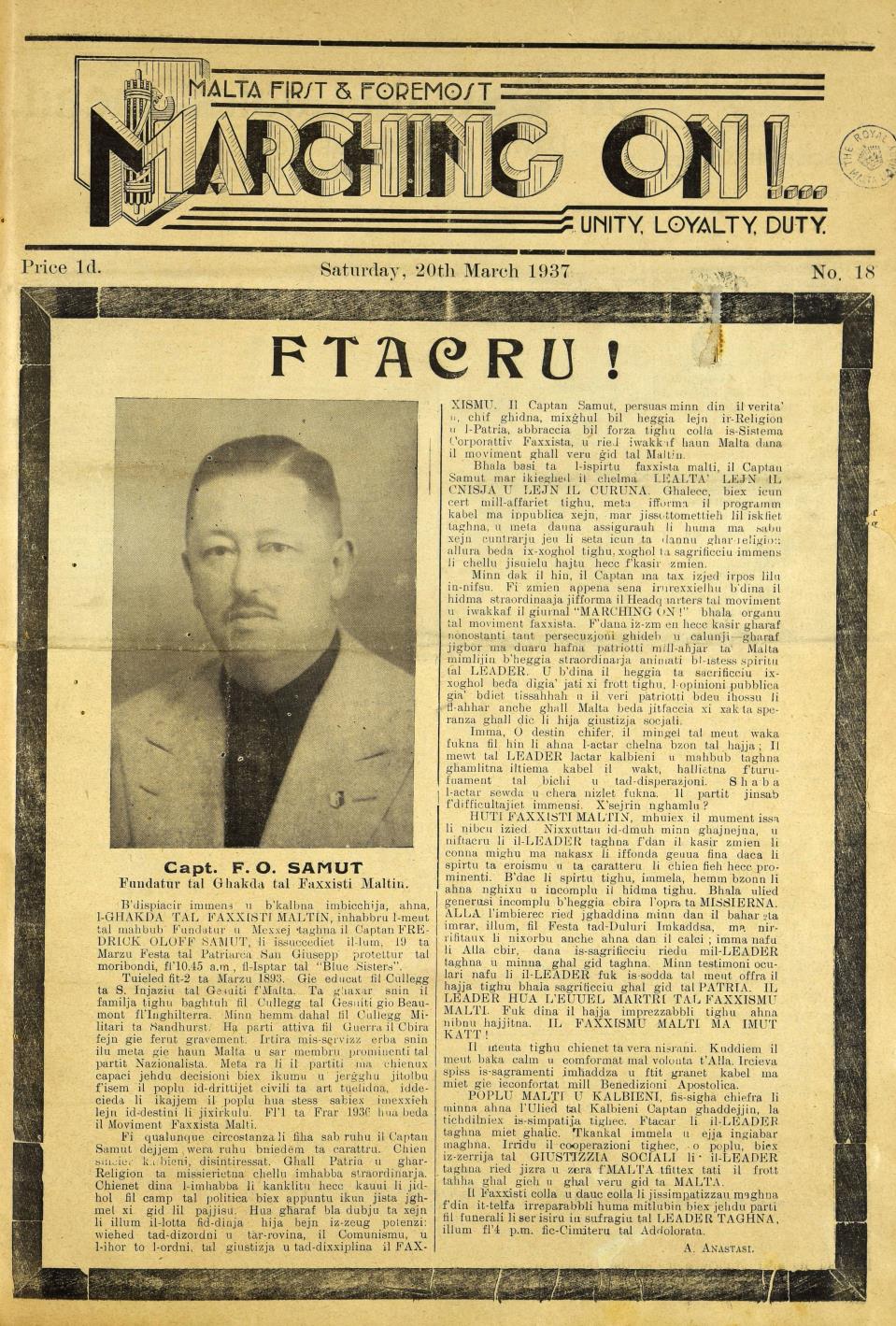
The death of Frederick Oloff Samut marked a defining moment for the UMF.
Without its central figure, the movement struggled to maintain cohesion and direction. Although successors attempted to continue his work, they lacked his charisma and vision. The organisation quickly faded into obscurity, becoming little more than a historical footnote.
By the time war broke out in 1939, the UMF had effectively disappeared.
Rethinking Malta's Past
Today, the story of Maltese fascism remains largely overlooked. When fascism in Malta is discussed, it is usually framed in terms of Italian influence and irredentism. The existence of a pro-British fascist movement complicates this narrative.
The UMF challenges simplistic interpretations of Malta's colonial experience. It reveals a society grappling with competing identities-British, Mediterranean, and Maltese-and searching for solutions in an uncertain world.
Rather than fitting neatly into categories of loyalty or resistance, figures like Samut occupied a more ambiguous space. They were both products of empire and critics of its limitations, seeking to reshape it rather than reject it outright.
In the end, the Union of Maltese Fascists was a short-lived experiment. It never achieved political power, nor did it leave a lasting institutional legacy.
Yet its significance lies elsewhere.
It serves as a reminder that Malta's history, like that of many colonial societies, is more complex than often assumed. The island was not merely a passive recipient of external influences, but an active participant in the ideological currents of its time-an argument explored in detail in Marching On, Captain Frederick Oloff Samut and the Union of Maltese Fascists.