You speak beautifully about a "shift in the way of looking". When did you first realise that your way of seeing had changed not just in the work, but in yourself as an artist living in Malta?
When I first learned to paint, I was taught how to simplify, organise a composition, and develop a personal style. Even without painting from life, I could make an image.
In 2022, I reached a point where I felt stuck. I began to ask myself: if art is about expressing the self, then what exactly is this "self"? So I stopped painting and started reading.
After moving to Malta, I joined an oil painting course at the Malta Society of Arts. My teacher Matthew asked us to paint still lifes from observation. I instinctively relied on theory and technique. One day Matthew said: "Paint what you see, not what you know."
It sounds simple, but it was not easy. I had to learn how to look again, slow down, and set aside what I thought I knew. This directly influenced the wild flower project. Instead of rushing to organise or simplify them, I spent long periods simply looking.
During my exhibition A Place of Return, I realised that painting wild flowers had taught me more than a way of painting. That was when I began to understand that this shift in seeing had changed not only my work, but also myself.
The peach blossoms were painted in a concentrated burst, while the wild flowers unfolded slowly over months. How did these two different rhythms affect your inner state, your patience, your sense of time?
I painted the peach blossoms in the spring of 2021. It was my first time painting outdoors after the long restrictions of 2020, and there was a strong sense of freedom. I stayed in a small mountain village for ten days and completed eighteen paintings. But towards the end, my thoughts ran ahead of my hands. I gradually became lost, and went home early.
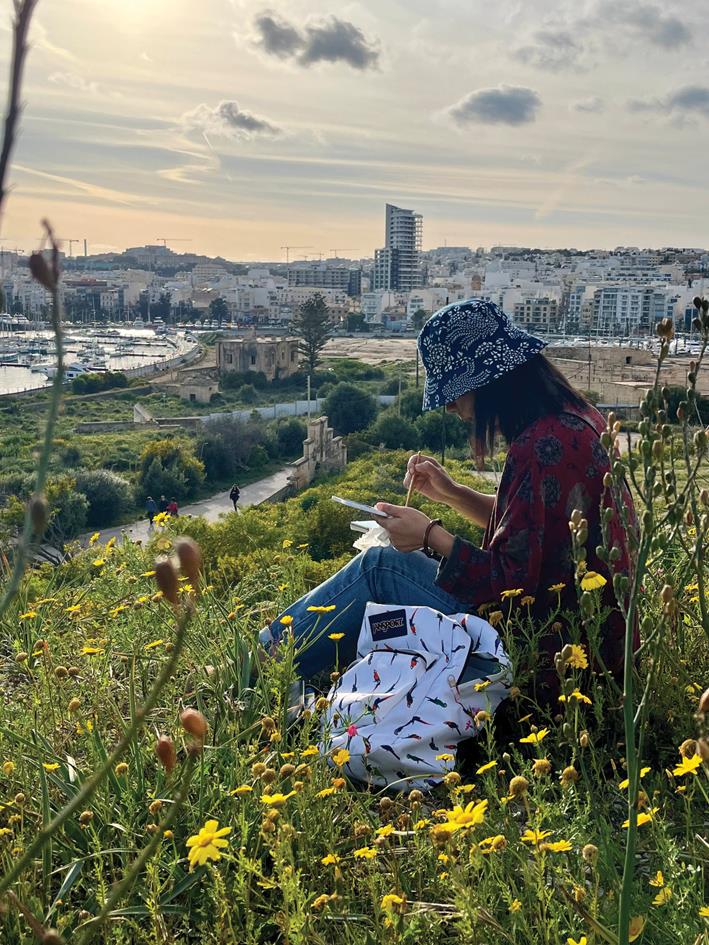
The wild flowers were completely different. The peach blossoms were all there waiting for me. The wild flowers appeared gradually over time. I could only meet them one by one, never knowing what I might encounter next.
When I decided to paint Malta's wild flowers, someone told me there were more than a thousand species on the islands. I laughed and decided to paint not what I knew, but what I met.
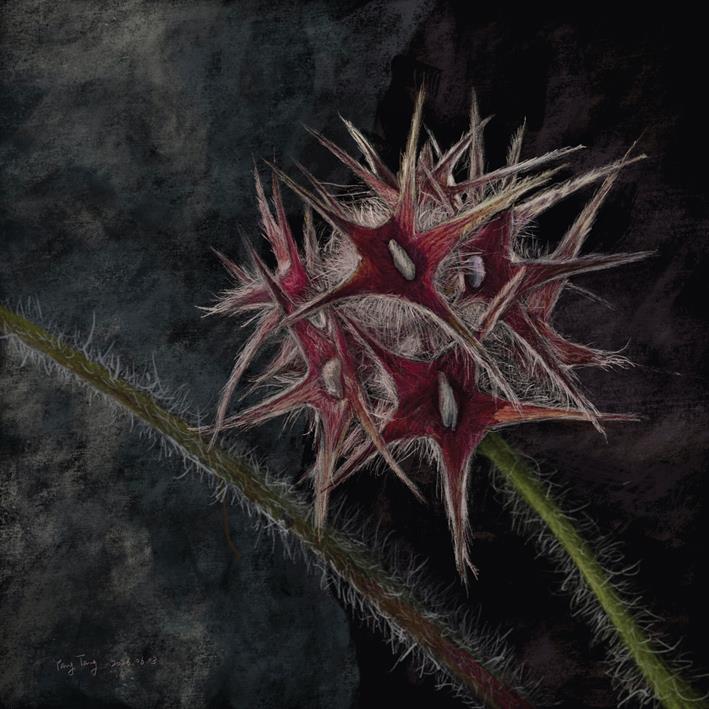
Some early works took little more than an hour. Star Clover took eleven hours. The wild flowers did not teach me how to paint faster. They taught me how to slow down, let go of control and learn to wait.
You describe the wild flowers as "appearing" to you. What does that moment of appearance feel like - physically, emotionally, almost spiritually?
For me, "appearance" happens on two levels: the appearance of an encounter, and the appearance that happens through painting and understanding.
At the level of encounter, I do not plan these meetings. I am happy to meet any flower. But whenever I discover a new plant, learn its name, and begin to understand its habits, I feel a simple kind of joy. This is especially true during orchid season. After searching for a long time, almost giving up, and then suddenly finding one hidden in the grass, the feeling is difficult to describe.
The second kind of appearance happens while I am painting. When a flower is enlarged on my screen, I notice details I would never normally see.
Gradually, I stop seeing it as a species and start seeing it as this particular flower in front of me. This process made me realise that very often we think we have seen something, when in fact we have only learned its name. Real looking begins after the name.
 You mention that each drawing comes from a specific encounter. Is there one encounter - besides the Crocus longiflorus - that still lingers with you, perhaps because of the place, the weather, or your own state of mind?
I remember almost every encounter with these flowers - where it happened, what the weather was like, and what the day felt like.
The Datura was a flower I encountered soon after arriving in Malta. It grew on a small patch of wild ground near the seafront in St Julian's, glowing softly in the evening light. A year later, at the same time, I went back and found it there again.
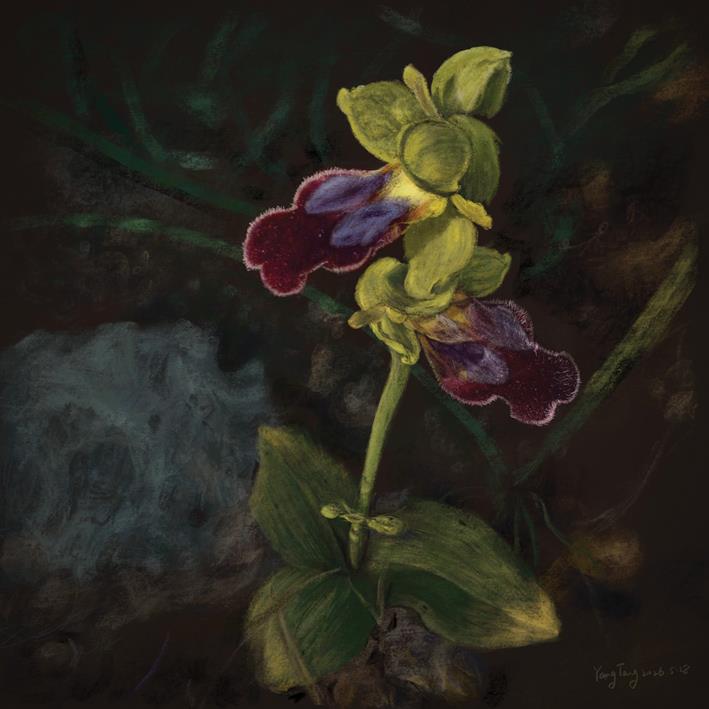
But perhaps the most memorable encounter was with the Bumblebee Orchid. I walked along the cliffs from Xemxija towards Mistra Bay, looking for wild orchids, but finding none. By the end of the path, I had almost given up. I crouched down to tie my shoelace and there it was, growing quietly in the grass beside my feet. The evening sun was shining on it.
In Malta, the landscape can feel overwhelming in its brightness and heat. How did working on such small, intimate subjects such as flowers change your relationship with the island?
In Malta, we are outsiders. Although I have travelled a lot, this is the first time I have tried to live in a foreign country not as a visitor, but as a resident.
Living and travelling are completely different. When we travel, we look for things considered worth seeing: dramatic landscapes, historic sites, famous buildings, festivals and celebrations. When we arrived in Malta in 2024, we did exactly that. We walked many hiking routes, visited churches, watched fireworks and attended religious feasts.
But seeing and painting wild flowers changed something. It slowly turned me from a traveller passing through into someone who lives here.
In order to understand the flowers, I joined local wild flower groups and met people who had spent decades studying Malta's plants. I began learning which species were native or invasive, which flowers could be eaten, and which needed protection. The knowledge itself was not the most important thing. What mattered was that it allowed me to see Malta through the eyes of the people who live here.
Over time, I came to know the plants, the animals and the ordinary rhythms of life on the islands. Slowly, it began to feel like home.
You originally imagined painting cacti - strong, sculptural, monumental. What do you think the wild flowers taught you that the cacti never could?
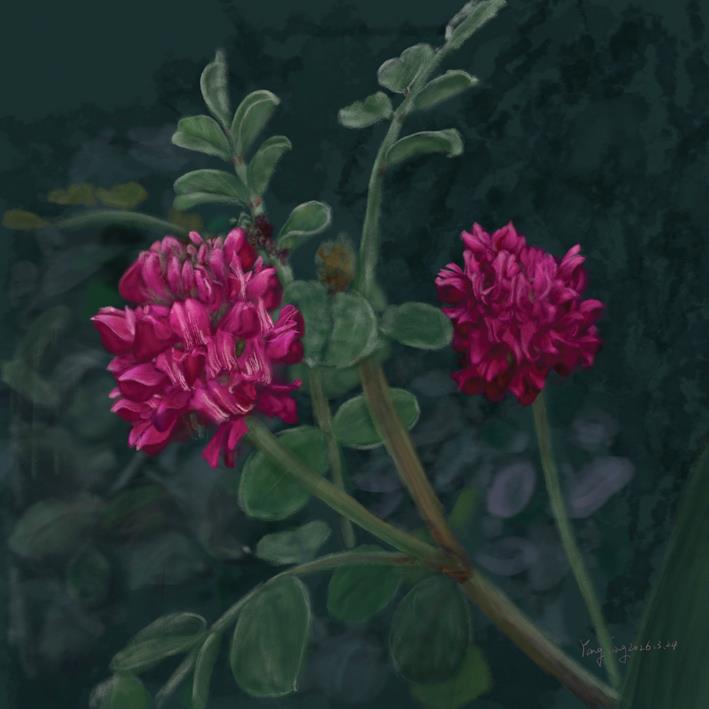
When I submitted my proposal to MSA last May, I originally planned to paint cacti. I thought it would be interesting to place the softness of Jiangnan peach blossoms alongside the toughness of wild Mediterranean cacti.
But what truly moved me in the end were the wild flowers - the unnamed and easily overlooked ones.
Their brief flowering seasons, and these tiny lives growing in cracks between rocks and in the cold wind, made me realise that strength does not have to be monumental, nor expressed through thorns.
Wild flowers look fragile, yet they possess remarkable resilience. They do not resist their surroundings. Instead, they find their own ways to grow within limitations. They do not try to become the centre of the landscape, nor do they demand to be seen. But if you are willing to stop and look carefully, you will discover how much variation, richness and vitality they contain.
Perhaps what wild flowers have truly taught me is another way of understanding strength. It is not resistance. It is not proving something. It is simply growing quietly, at your own pace.
The peach blossom paintings "form a space the viewer can enter", while the wild flowers "remain with the object itself". How do you think these two ways of seeing reflect different moments in your life?
During the ten days when I painted the peach blossoms, the series moved from a single blossom, to a branch, to a tree, to an entire peach orchard, and finally to a person losing herself among the blossoms. On the surface, it was a change of space. In reality, it was also a change in my own thoughts and emotions.
Those works were unstable, constantly changing and full of emotion. The peach blossoms seemed to be the subject of the paintings, but they were also a portrait of myself - someone who was constantly exploring and questioning. At that time, I believed that the most important thing in art was self-expression.
After 2022, I stopped painting for a while and began to read. Gradually, I realised that instead of constantly expressing myself, I wanted to understand what this "self" really was. Later I came to feel that the answer might not lie in endless self-expression, but in the process of observing the world.
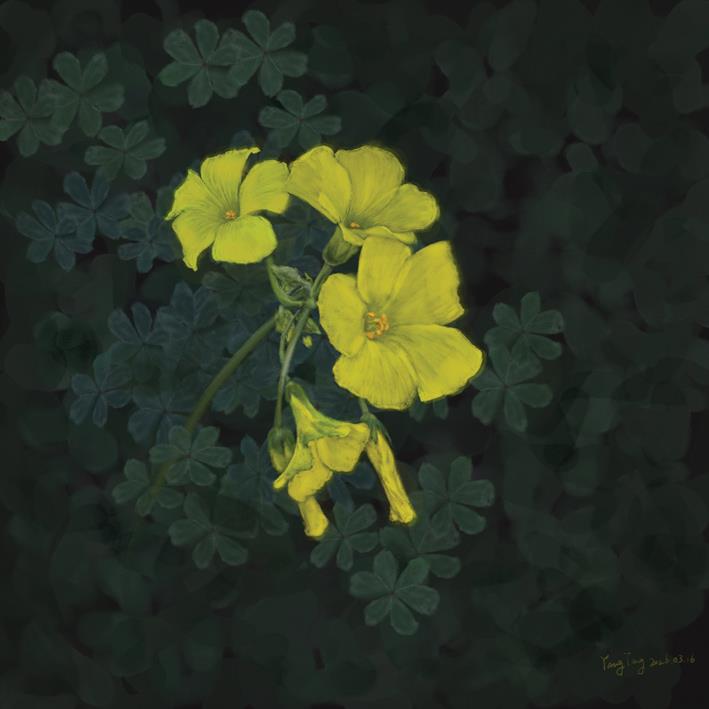
The wild flower series marks my return to painting after three years. By then, I was no longer so eager to express myself. I was no longer in a hurry to turn the world into my language. Instead, I tried to listen to what it had to say.
During the peach blossom period, I always wanted to create a world. During the wild flower period, I became more willing to enter a world that already existed.
You record the exact place and date of each flower. Do these notes form a kind of diary for you - a map of your time in Malta perhaps?
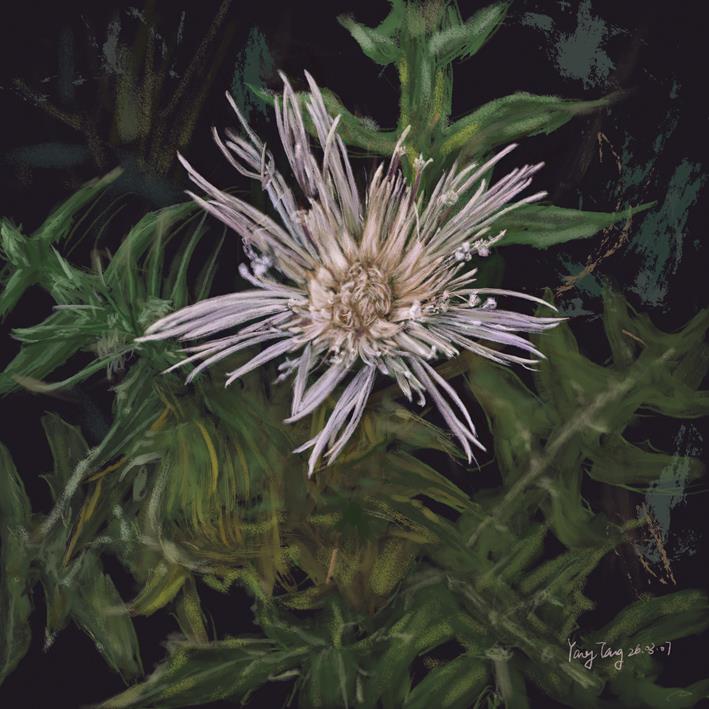
It is not a diary. I simply want to record these encounters. To me, each flower is not just a species with a Latin name. It is itself. It is this particular flower, in this particular place, at this particular moment.
Later, I realised that recording the place and date has another meaning. Everything has its season. Flowers bloom one after another, each according to its own rhythm. Recording the date is also a way of recording the rhythm of flowering.
There are always a few flowers that bloom ahead of their season, or stay a little longer than the others. Perhaps plants are like people. Most follow their own seasons. But there are always a few that begin earlier.
Working digitally allowed the images to be printed and shared more freely. How has this shift in medium changed your understanding of what an artwork is, or how it lives in the world?
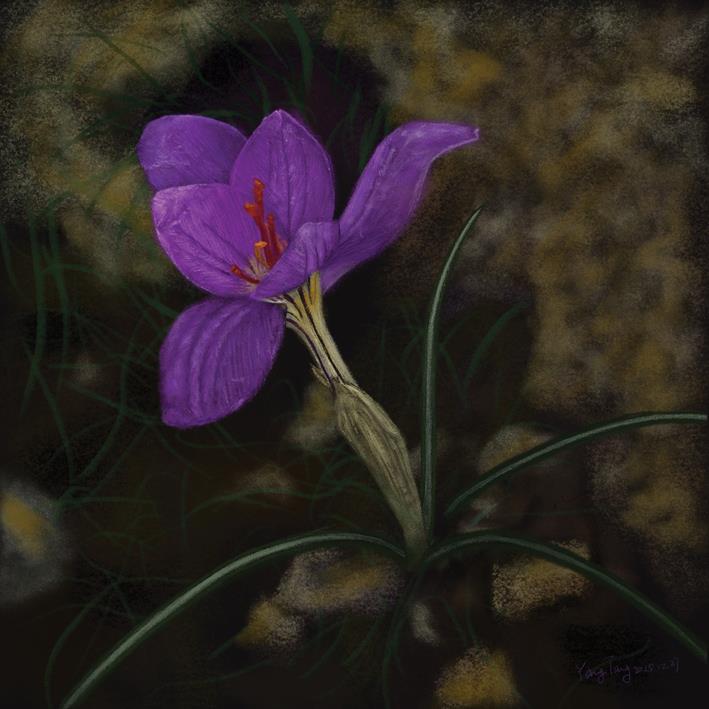
I did not choose to paint wild flowers on an iPad because I wanted them to spread more easily. At first, it was simply because digital painting allowed me to work more deeply without taking up much physical space. Only later did I realise that this medium suited the spirit of the project.
Wild flowers do not belong to anyone. They grow along roadsides, on cliffs, in valleys and in fields. Anyone who is willing to stop can see them. I hope the wild flowers I paint can keep this openness.
For this series, what matters more to me is not uniqueness, but whether more people can see them. Wild flowers already belong to everyone. Digital painting simply allows me to share them in a way that feels true to this project.
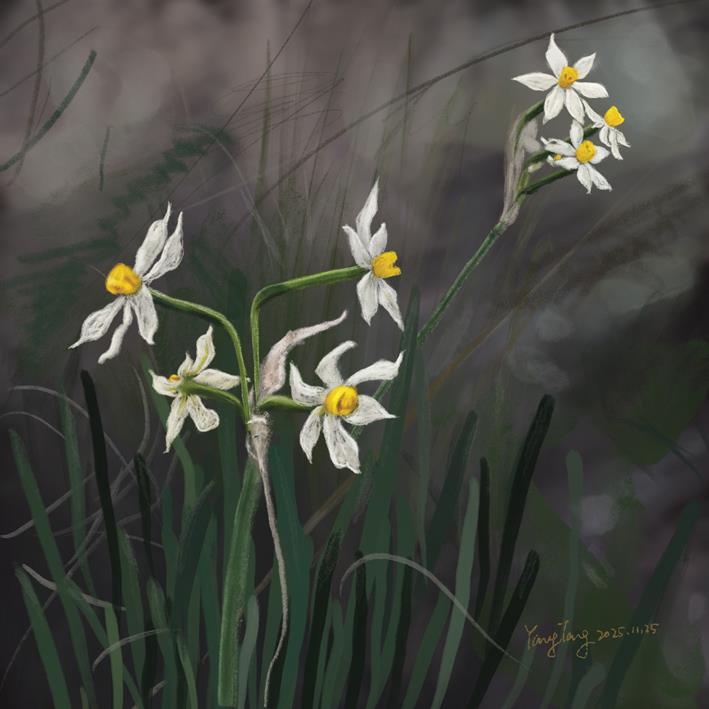
You sent postcards to people around the world, and you hosted an online drawing activity. What did you learn from watching other people look at flowers - perhaps for the first time?
From the moment I painted my first wild flower, I began sharing these drawings on my Chinese social media. At first, almost nobody paid attention. But gradually, more and more people started leaving comments.
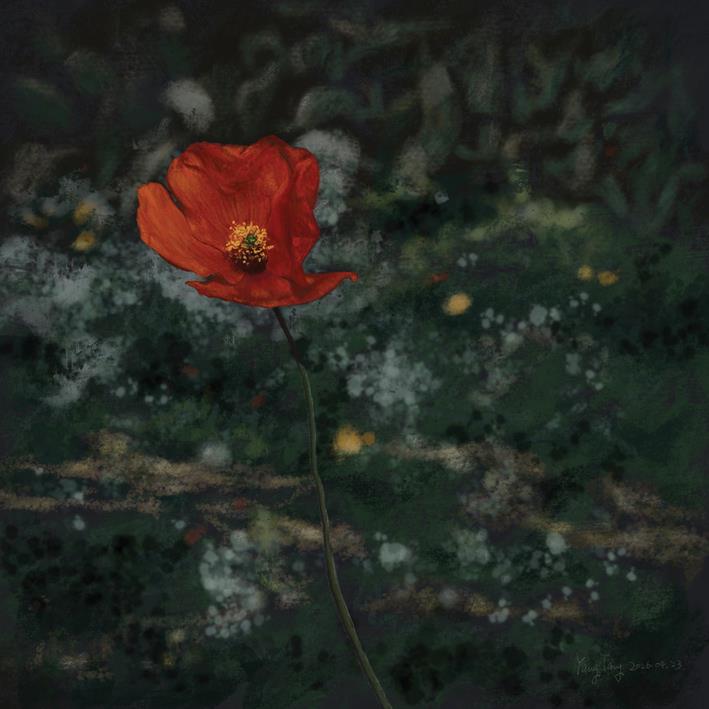
After I painted the white rocket flower, a classmate in the United States wrote to me. He said he could feel an undercurrent of life and strength in the painting and asked whether I could let him have it. I sent him the original file and told him to print it himself. He was delighted, and I was very happy too.
Later, I started a small project called Wild Flower Drift, sending postcards of Malta's wild flowers to friends around the world, together with my good wishes.
Another project grew out of these flowers in an unexpected way. A painting school in China invited me to teach an online course on Mediterranean wild flowers. During that month, more than eighty participants created over two thousand paintings. I shared the flowers I had encountered in Malta, and encouraged everyone to look at the wild flowers around them.
One person said: "I have been visiting the Tang Mausoleum for twenty years. This is the first time I noticed how many wild flowers grow there."
Perhaps, during that month, we were not simply learning how to paint flowers. We were learning to look.
Your next exhibition Two Springs spans 10,000 km and five years. If you look back at the person you were in Tangqi, China and the person you are now in Malta, what has changed most deeply?
The deepest change is that I no longer place art at the centre of my life in the way I used to. I care more about life itself.
I am not sure whether painting wild flowers changed my life, or whether life itself changed the way I look at wild flowers. Art and life have never been separate for me.
Five years ago, I was always thinking about how to paint better, how to find my own language, and how to create works with a stronger personal style. Today, I still love art, but I feel that art is not separate from life. Reading, walking, growing vegetables, talking with people, or watching a flower slowly open - these things are already precious.
Art is no longer a way for me to prove myself. It has become a way to understand life and participate in it. I have also become more willing to accept that some answers take time to appear. If Two Springs records anything, I think it records not only two springs, but also the change in my relationship with art.
What do you hope visitors carry with them when they leave the exhibition - not as an idea, but as a sensation?
I hope they will take home a postcard of a wild flower. I will prepare many free postcards and invite anyone who likes them to take one away.
As for the feeling, I hope that when people leave, they carry a quiet sense of unfamiliarity. As if they had just seen a world they had always known, but never truly noticed.
Perhaps the next time they come across a small flower by the roadside, on a hillside, or outside their door, they will pause and take a second look.
Two Springs will run from 2 July to 30 July 2026 at the MSA Gallery, Malta Society of Arts, located at Palazzo de La Salle, 219 Republic Street, Valletta.