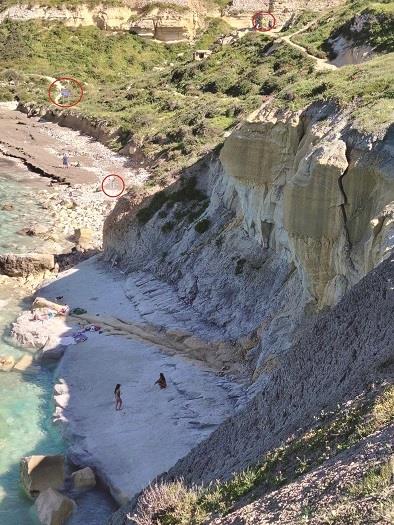
Mellieħa mayor Gabriel Micallef has called for part of Imġiebaħ Bay to be closed off from the general public amid safety concerns over a rock fissure appearing in the swimming area's cliffside.
Micallef publicised these concerns made by himself and the Mellieħa Local Council on Sunday, through his Facebook page.
When contacted by The Malta Independent, Micallef said that he had been corresponding with local authorities to take appropriate action with the area since April of 2025.
This has included continuous follow-ups with the Malta Police Force, the Lands Authority, the ERA, the Public Works Department, and the Coastal & Shoreline Unit that was formerly under the Ministry for Transport, Infrastructure, and Public Works (MTIP), he said.
He noted that while three warning signs have been installed to inform visitors about the structural concerns in the area, "warning signs alone do not eliminate the danger" and the dangerous area in question is still yet to be cordoned off or block any and all access to it.
"As long as the rock face remains unstable and people can still access the area beneath it, the risk remains very real," Micallef said.
The Mellieħa mayor said that access to the hazardous section of Imġiebaħ must be immediately closed off "until all the necessary interventions have been completed and the site has been officially certified as safe."
While sharing some of his long correspondence over the past 14 months between himself and local authorities on this situation, Micallef said that the government's architect confirmed that the area posed an imminent threat and was structurally unsafe for public access back in May 2025.
This conclusion was followed by a geotechnical assessment being recommended for the site; but Micallef could not say for sure whether these assessments were done or not.
'These reports should be taken more seriously,' mayor says
Frustrated about the safety issue, Micallef told this newsroom that he believed some of these reports should be taken more seriously.
Stating that he thinks all reports of this kind should be assessed, a concerned Micallef said that this is not a political issue and that he cannot understand why these reports are not followed by immediate action beyond the installed signage.
Micallef said that the site at Imġiebaħ Bay, Mellieħa, was first ruled unsafe for public access, then a geotechnical assessment was suggested.
He said that the local council sent repeated reminders for authorities to intervene, and the Lands Authority installed the warning signage before informing him that the MTIP's coastal and shoreline unit is responsible for any further interventions.
He said that as mayor of his local council, he must depend on the relevant authorities' cooperation for the locality to see any progress in this regard.
While outlining the long correspondence he's had with authorities on the matter, Micallef said he had requested warning signage and for access to this perilous area, beneath the cliffside, to be blocked in June last year, and that a new police inspector took over the report for this case last October.
While speaking with The Malta Independent, the Mellieħa mayor provided some suggestions for how the country can react better to reports of potential rock collapses, after visibly deep cracks are observed around cliff faces.
Namely, Micallef said that "there must be some sort of surveillance" in such areas and perhaps better communication between environmental rangers and the Mellieħa Local Council on where these rangers are being stationed around the northern locality.
He added that, certainly, Imġiebaħ Bay requires "the presence of some sort of authority, anything" to be stationed there to keep passersby away from the dangerous zone - especially with it being a relatively untouched, nice, dog-friendly beach with its own appeal.
Additionally, he called for a study to be conducted across coastal areas to determine whether further geotechnical assessments must be organised to precede potentially further action.
He also said that safety measures must be installed in sites of high footfall with safety concerns.
As an example for this, he cited a time, when he was still a councillor, when a cliff edge broke off in Anchor Bay, Mellieħa, resulting in a tourist falling, though she was fortunately able to hang on and avoid another tragedy.
This near-fatal incident pushed the local council to push to add fences in that area shortly afterwards.
On Saturday, a 26-year-old Chinese tourist lost his life in Comino after a large rock from a natural archway collapsed onto the passing jet-ski. His body was recovered from the seabed some 24 hours after the accident occurred. The 27-year-old Chinese woman on the jet-ski with him suffered grievous injuries.
Earlier this June, a section of St. Peter's Pool was cordoned off by local authorities after a deep fissure by the cliffside posed a serious danger to the public.
Similarly to Micallef's comments on Imġiebaħ Bay, prior to this cordoning off in Delimara, this part of the touristic area was being used by visitors as a place for shade despite the visibly deep cracks in the cliffside. Last updates on the area by the Public Works Department stated that the area remains dangerous.
Nearly two years ago, on 19 July 2024, 22-year-old Mirabelle Falzon lost her life in a Marsascala rockfall at the Riħama Battery in St. Thomas Bay. A year after Falzon died, her parents and their lawyer - now Opposition MP Conrad Borg Manché - said that the accident could have been entirely avoided if authorities had acted on repeated warnings about the area's visibly diminishing structural integrity.