There are productions of Hamlet that rely on spectacle, and there are those that trust William Shakespeare's text to do the heavy lifting. MADC's latest staging, directed and designed by Michael Mangion, confidently achieves both. Performed beneath the open skies of the Msida Bastion Historic Garden in Floriana, this ambitious production delivers an engrossing interpretation of one of the Bard's most celebrated tragedies, balancing visual flair with emotional depth and reminding audiences why Hamlet continues to resonate more than four centuries after it was first written.
From its opening moments, Mangion establishes an atmosphere of unease. The historic setting itself becomes an extension of Elsinore Castle, with the bastion walls and surrounding darkness lending an authenticity that no conventional theatre could easily replicate. Rather than competing with the location, the production embraces it, allowing the architecture and natural surroundings to heighten the sense of isolation, political intrigue and impending doom that permeates Shakespeare's tragedy.
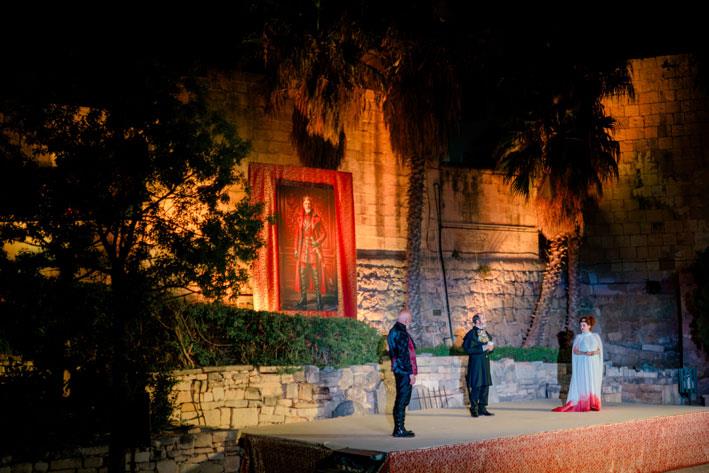
At the centre of the production is Alex Weenink's compelling portrayal of Hamlet. It is a performance built on restraint rather than theatrical excess, presenting the Danish prince as a deeply conflicted young man torn between grief, vengeance and self-doubt. Weenink captures Hamlet's emotional volatility without descending into caricature, moving seamlessly between moments of quiet introspection and explosive confrontation. His delivery of the character's most famous soliloquies feels personal rather than performative, inviting the audience into Hamlet's fractured state of mind instead of simply reciting familiar lines.
Equally impressive is Stephen Oliver as King Claudius, whose interpretation avoids reducing the character to a conventional villain. Oliver presents Claudius as charismatic, politically astute and outwardly composed, making his darker actions all the more chilling. His interactions with Hamlet carry a constant undercurrent of suspicion and hostility, creating a believable battle of intellects between nephew and uncle. Rather than dominating scenes through force, Oliver commands attention through measured authority, reinforcing Claudius as a ruler desperately trying to maintain control while his carefully constructed kingdom begins to unravel.
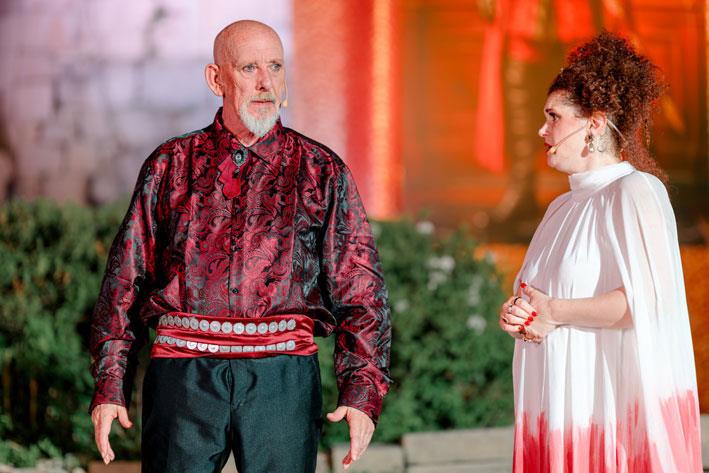
Larissa Bonaci brings warmth and complexity to Queen Gertrude, portraying a mother caught between maternal affection and loyalty to her new husband. Rather than depicting Gertrude as wilfully blind, Bonaci offers a nuanced interpretation of a woman attempting to preserve stability in an increasingly volatile court. Her scenes opposite Weenink are among the production's most emotionally charged, particularly as Hamlet's frustration and heartbreak collide with Gertrude's inability to fully comprehend the consequences of her choices.
Eoin Kennedy delivers an entertaining and thoughtful Polonius, providing measured moments of humour without undermining the seriousness of the narrative. His portrayal highlights Polonius' tendency towards long-winded advice and political manoeuvring while maintaining genuine affection for his children. The performance avoids becoming merely comic relief, instead emphasising how Polonius' meddling ultimately contributes to the tragedy unfolding around him.
Jeremy Paul Grech gives Laertes a welcome sense of urgency and determination. While Hamlet spends much of the play wrestling with moral hesitation, Laertes serves as his decisive counterpart, driven almost immediately towards revenge. Grech effectively communicates both the character's grief and impulsiveness, ensuring the final confrontation carries the emotional and dramatic weight audiences expect.
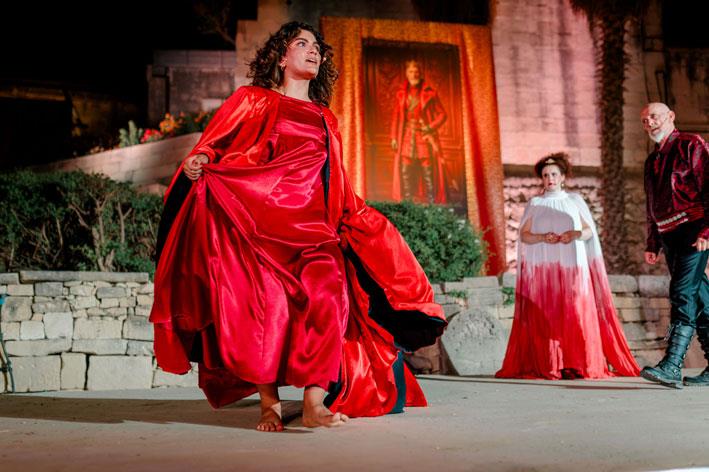
Maya Micallef Engerer portrays Ophelia with remarkable sensitivity, charting the character's gradual psychological collapse with dignity rather than melodrama. Her early scenes present Ophelia as intelligent and quietly resilient, making her later descent into madness particularly heartbreaking. Instead of relying solely on emotional outbursts, Micallef Engerer allows subtle changes in expression, movement and voice to convey Ophelia's deteriorating mental state, creating one of the production's most memorable performances.
Supporting performances also strengthen the overall production. James Sultana and Jonathan Scicluna contribute effectively to the political and dramatic landscape surrounding Hamlet, while Sarah Farrugia adds further depth to the court's increasingly fractured relationships. Together, the ensemble succeeds in creating a believable royal court where suspicion, grief and ambition constantly simmer beneath formal appearances.
The production also benefits from the inclusion of choreographed sequences by Moveo Dance Company, featuring Anna Friedrich, Edmilson Zammit and Pablo Daniel Silva Gonçalves. Rather than feeling like separate interludes, the movement pieces integrate naturally into the storytelling, providing visual representations of the emotional and psychological turmoil experienced by the characters. These moments add another layer to the production without distracting from Shakespeare's language.
Michael Mangion's direction demonstrates a clear understanding of the play's central themes. Rather than modernising the text simply for novelty, he focuses on the universal questions that continue to make Hamlet relevant: justice, morality, political corruption, family loyalty and the destructive nature of revenge. The pacing remains confident throughout, allowing quieter scenes sufficient room to breathe while ensuring the production never loses momentum.
Visually, the production is equally accomplished. Mangion's design complements the historic venue without overwhelming it. Carefully considered lighting transforms the bastion gardens as daylight fades into darkness, creating increasingly ominous images that mirror the play's descent towards inevitable tragedy. Costuming maintains a timeless quality, avoiding unnecessary gimmicks while supporting the production's overall aesthetic.
The sound design also deserves recognition, particularly in creating an immersive atmosphere. Moments of silence are used effectively, allowing Shakespeare's dialogue to command attention, while music and sound effects heighten dramatic tension without becoming intrusive. The voice of Manuel Cauchi as Hamlet's murdered father lends the Ghost an appropriately haunting presence, setting the revenge narrative in motion with quiet authority.
Importantly, this production trusts its audience. Shakespeare's language is delivered with clarity and conviction, avoiding the temptation to over-explain or simplify complex passages. While Hamlet remains a demanding play, Mangion's direction ensures the emotional stakes remain accessible even for those less familiar with Shakespeare's work.
No production is entirely without imperfections. Given the scale of Shakespeare's text, certain scenes inevitably feel more tightly paced than others, and the open-air environment occasionally presents acoustic challenges. Yet these minor issues do little to diminish the overall impact of the performance, particularly considering the ambitious nature of staging such a monumental work outdoors.
Ultimately, MADC's Hamlet succeeds because it understands that Shakespeare's tragedy is not merely about revenge but about the devastating consequences of indecision, ambition and moral compromise. Supported by a talented ensemble led by Weenink and Oliver, Mangion has crafted a production that feels both faithful to the original text and engaging for contemporary audiences. Set against the remarkable backdrop of the Msida Bastion Historic Garden, this is a thoughtful, visually striking and emotionally satisfying interpretation of one of theatre's greatest masterpieces, proving once again that when performed with intelligence and conviction, Hamlet remains every bit as powerful today as it was four centuries ago.
Photos: Josmar Muscat