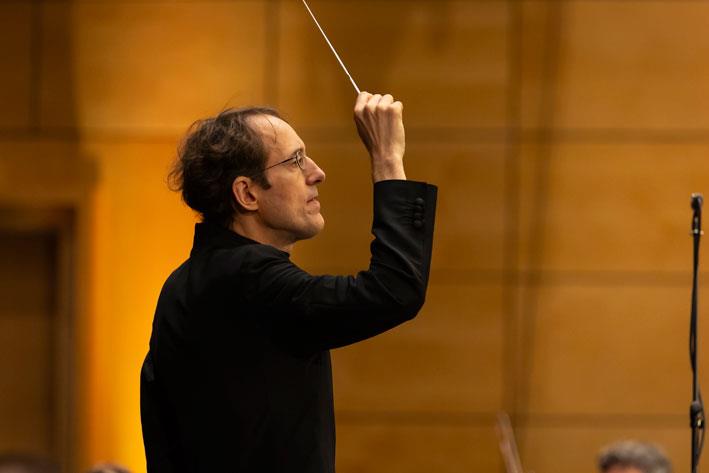
Last week I attended a concert by the Malta Philharmonic Orchestra at the Grandmaster's Suite, Hilton Malta. The orchestra was conducted by Pablo González, with Marcelline Agius as leader, and the programme was devoted entirely to the music of the Spanish composer Manuel de Falla. Roberto Cominati appeared as the piano soloist in the central work of the evening. It is unusual nowadays to hear an entire concert devoted to a single composer, and even more unusual when that composer is De Falla.
Manuel de Falla (1876-1946) is generally regarded as Spain's greatest composer of the twentieth century. His music combines the techniques of the classical tradition with the rhythms, colours and folk influences of Spain, especially those of Andalusia in the south where I had spent over a month, and so it was of particular interest to me. Although his works are admired throughout the world, they never lose their distinctive Spanish character. Throughout the evening it was possible to hear the sounds of Spanish dance, song and guitar translated into rich orchestral colours.
The concert opened with the Interlude and Dance from La vida breve. This opera was one of De Falla's earliest major successes and tells a tragic story of love and betrayal. The Interlude and Dance are among the most frequently performed excerpts from the work. They immediately established the Spanish atmosphere of the evening with their vivid rhythms, colourful orchestration and dramatic flair. The Dance in particular had tremendous energy and served as an exciting curtain raiser. It was impossible not to be drawn into the world of Spanish passion and drama that De Falla evokes so effortlessly.
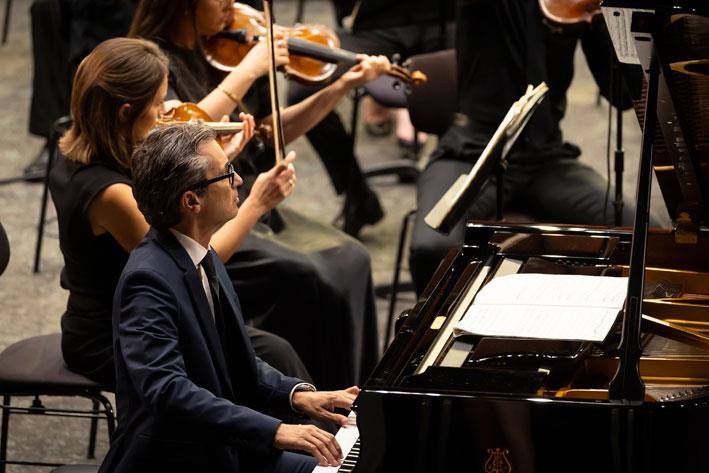
The centrepiece of the programme was Noches en los jardines de España (Nights in the Gardens of Spain), with Roberto Cominati as soloist. For me, that evening, the main attraction was not De Falla but Cominati.
This work occupies a unique position in the repertoire. Although it features a piano soloist, it is not a conventional concerto. De Falla described it as a series of "symphonic impressions" inspired by Spanish gardens and landscapes. The piano is not engaged in a continuous display of virtuosity but is woven into the orchestral texture, contributing colour and atmosphere.
I was especially pleased to hear Roberto Cominati perform this work. I remembered hearing him in Malta many years ago when he was still a young artist at the beginning of his career. Since then he has enjoyed an impressive international career and it was fascinating to hear him again after so many years. His playing displayed refinement, sensitivity and considerable poetic insight. The music itself is more concerned with mood than with drama, conjuring up moonlit gardens, fountains and the mysterious atmosphere of warm Spanish evenings. The piano often seems to shimmer above the orchestra rather than dominate it. I loved his playing.
The three sections of the work create contrasting musical pictures. The opening movement, inspired by the gardens of Granada, is dreamy and atmospheric. The second movement is more distant and mysterious, creating a sense of solitude and reflection. The final movement is more animated and festive, suggesting the life and colour of Spanish celebrations. Not an easy piece to perform.
As beautiful as the performance was, I could not help wishing that Cominati had been given a larger role in the evening. Because the piano is integrated into the orchestral fabric rather than constantly displayed, one naturally wants to hear more from such a distinguished pianist.
After the interval came Suites Nos. 1 and 2 from El sombrero de tres picos (The Three-Cornered Hat), one of De Falla's most popular compositions. Originally written as a ballet, the score was created in collaboration with artists associated with Sergei Diaghilev's famous Ballets Russes and has become one of the most celebrated examples of Spanish music in the orchestral repertoire.
The First Suite introduced the colourful world of the ballet and immediately revealed De Falla's gift for capturing Spanish folk idioms within a sophisticated orchestral framework. Rhythms inspired by traditional dances, vivid instrumental colouring and a strong sense of theatrical character brought the music vividly to life.
The Second Suite raised the level of excitement even further. Here De Falla's imagination seemed limitless. The famous dances are bursting with energy and humour, while the orchestra has opportunities to display brilliance and virtuosity. Under Pablo González's direction the orchestra responded with enthusiasm and vitality, bringing the evening to a thrilling conclusion.
One slight disappointment was the absence of an encore. Given Roberto Cominati's appearance and the warm response from the audience, a short solo piece would have been very welcome. A Spanish miniature by Albéniz, Granados or even De Falla himself would have rounded off the evening beautifully. Nevertheless, the concert as a whole was immensely rewarding.
What I appreciated most was the opportunity to immerse myself completely in the world of Manuel de Falla for an entire evening. The programme demonstrated the remarkable range of his music. It was a reminder of how distinctive and imaginative a composer he was and why his music continues to occupy such an important place in the orchestral repertoire. The Malta Philharmonic Orchestra, Pablo González, Marcelline Agius and Roberto Cominati all contributed to a memorable celebration of one of Spain's greatest musical voices.
Several individual musicians stood up and the audience clapped enthusiastically for them. Quite honestly I have no idea why but I joined in the clapping nevertheless.
I suspect there will not be another De Falla evening in my lifetime. But how about an evening of Chopin or Liszt? Or indeed that wonderful English composer Albert Ketѐlbey? When he visited Gozo around 1921, one quiet evening, he heard the bells of Ta'Pinu ring. He was moved and it inspired him to write a delightful piece Bells Across the Meadow. The original manuscript as written down by Ketèlbey himself is still kept in the musical archives at the Aurora Opera House Gozo.
Please consider an evening of Ketèlbey. It is light music but almost every one of his compositions is tuneful and listening to his music is effortless.