Tomoko Fait's artistic practice offers a compelling example of how the collective unconscious, as theorised by Carl Gustav Jung, can be reactivated within contemporary abstraction. Her paintings do not merely reference symbolic traditions; rather, they materialise archetypal structures as living visual processes, revealing how deeply embedded psychic patterns continue to shape artistic expression across time and culture. In this sense, her work participates in a re-emergence of what may be described as historical visual DNA: not imitation, but transformation, where inherited forms are re-coded through subjective experience.
As the curator of her upcoming exhibition The Archetypal Self at the Bizzilla Art Space, Mapfre MSV Life (3-17 September), I view Fait's paintings not as representations in the conventional sense, but as fields of emergence in which perception, memory, and psychic structures converge. Within this framework, the image does not function as depiction but as manifestation, an event in which archetypal forces become perceptible through intuitive form. This insight is crucial, for it situates Fait's practice within a deeper ontological dimension: the painting as a site where the visible and the invisible intersect.
The canvas as a generative field
At the heart of Fait's work lies the proposition that imagery does not originate solely within the individual artist, but emerges from a deeper, shared psychic reservoir. Jung defined the collective unconscious as a universal substratum populated by archetypes, primordial forms that structure human perception and symbolic production across cultures (Jung, 1968). Fait's visual language appears to unfold within precisely this domain. Her work weaves together ancient spiritual imagery and modern visual strategies to generate compositions that function as symbolic diagrams of inner life.
In studying her creative evolution, I have come to realise that in Fait's paintings, the image emerges not as an act of invention but as a process of revelation, in which collective psychic structures rise into visibility. This understanding aligns her practice closely with Jung's concept of active imagination, whereby unconscious material is allowed to take form through spontaneous image-making (Jung, 1968). The canvas thus becomes a generative field, rather than a pre-planned composition.
Mandalas and the architecture of the self
A central motif in Fait's work is the mandala, which Jung identified as the archetype of the self, the organising principle of the psyche and the goal of individuation (Jung, 1981).
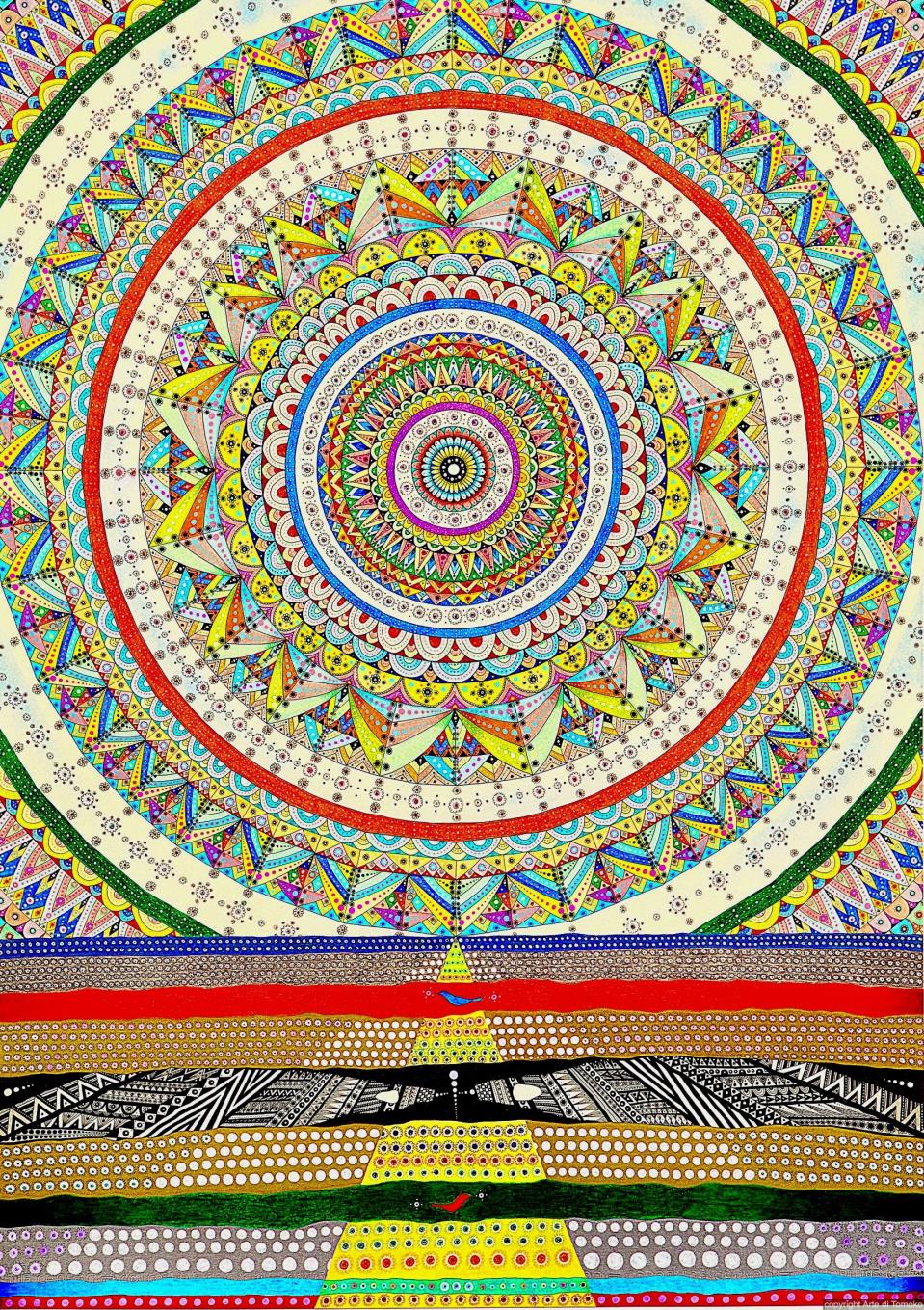
In the majestic Talmud (2009), an intricate, kaleidoscopic mandala dominates the upper register, anchored below by stratified, horizontal bands of patterns and stylised avian motifs. It acts as a monumental bridge between earthly foundations and a celestial, structured order.
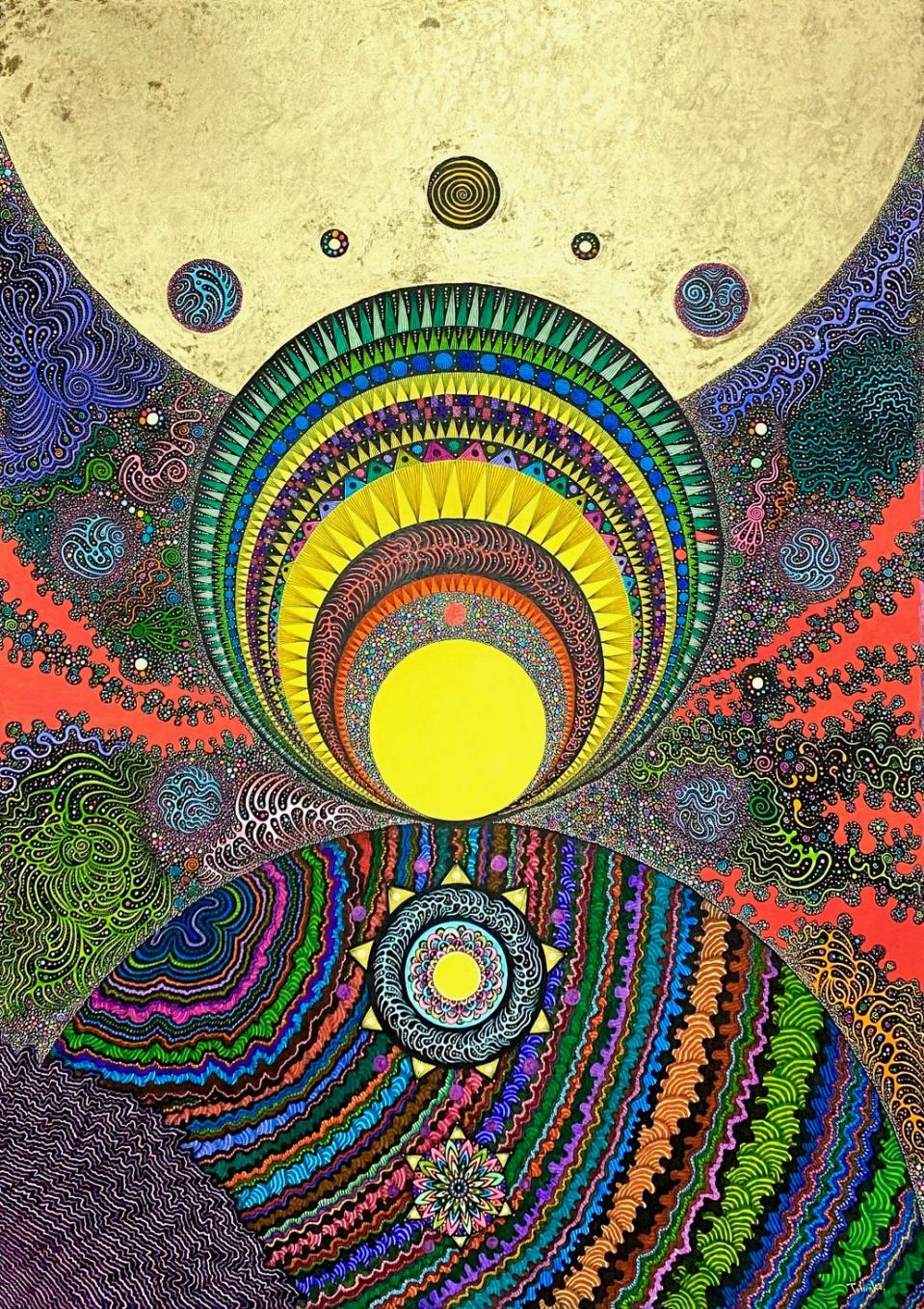
This evolution reaches a peak of cosmic intensity in Dimensioni frattali (2023). Here, spiralling, multi-coloured geometric arches frame a brilliant, central yellow sun, flanked by a gold leaf horizon and surrounded by vibrating, fractal-like organic micro-patterns.
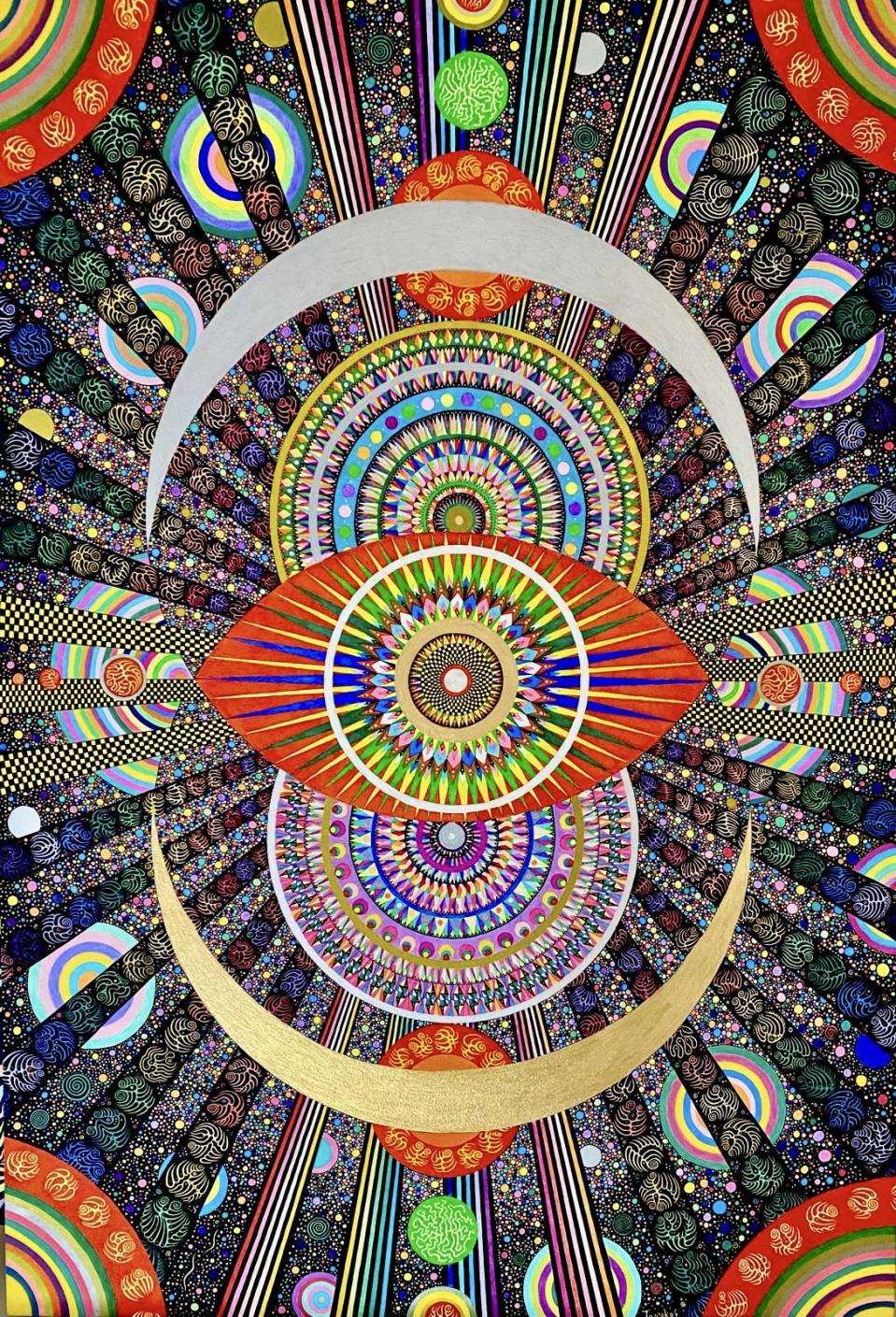
These spiralling vortices guide the viewer inward toward a luminous centre, producing a visual analogue of psychic integration. These forms are never rigid or mechanically symmetrical; instead, they pulse and evolve, unfolding in waves of colour, motion, and light that suggest a living, breathing structure.
Here, Fait departs from purely formal abstraction and instead constructs images that function as processes of becoming. I interpret this dynamism as indicative of a deeper psychic movement: the continual negotiation between order and flux, stability and transformation. The mandala, in this context, is not an emblem of completion but a site of ongoing integration.
This is further reinforced in Simmetrie e Asimmetrie Astrali, where the emergence of a central "eye" within concentric configurations acts as an image of awareness: an internal gaze through which the psyche reflects upon itself (Jung, 1981). Such imagery transforms the painting into a cosmogram of interiority, where perception and symbol converge. Fait's work does not describe the external world but maps an inner topography of consciousness.
Mythopoetic flux: Labyrinths and flight
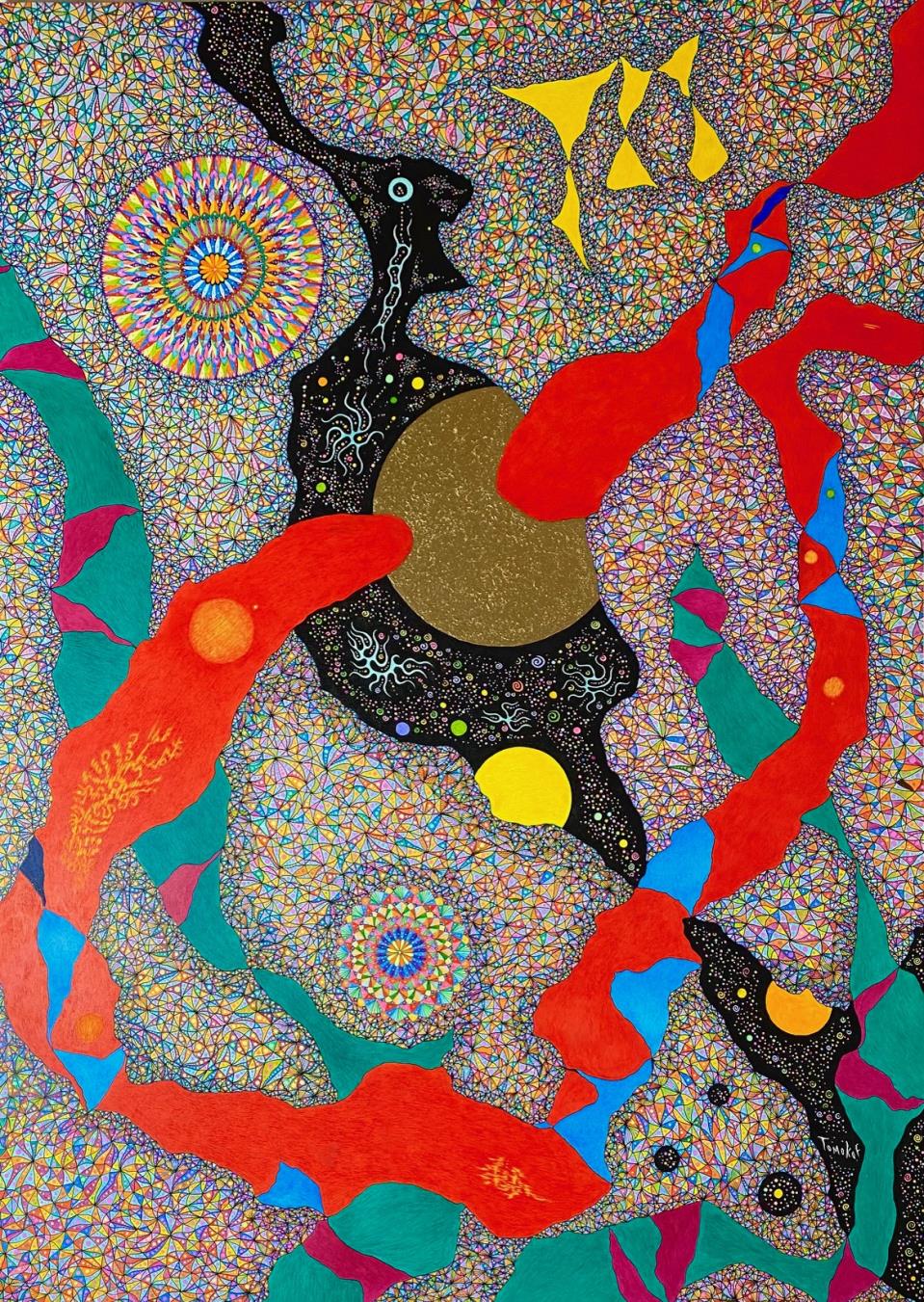
Beyond geometric structures, Fait's paintings engage a fluid, mythopoetic register that navigates the tension between order and chaos. In Il filo delle vita (2024), a sprawling, labyrinthine network of multi-coloured cells forms a dense background, punctuated by bold, undulating streams of vibrant red and teal, and a central, dark cosmic silhouette holding a gold celestial disc. The painting perfectly captures the Jungian idea of life's interconnected threads and the journey through the psychic maze.
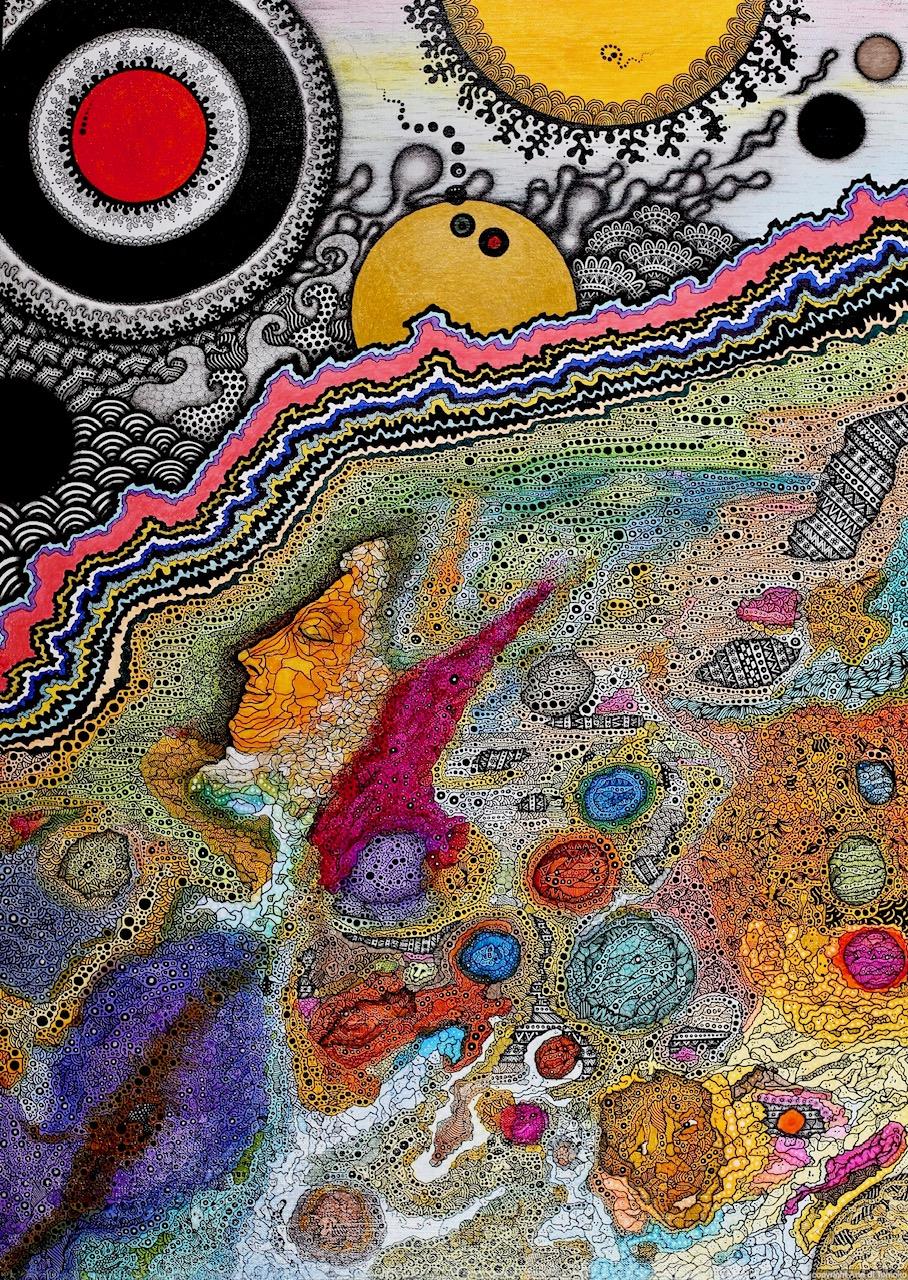
Similarly, Icaro (2013) utilises an incredibly intricate, stippled topography of earthy and oceanic tones, contrasted against stark, swirling solar discs and dark cosmic orbs. It evokes the psychological weight of the myth, the yearning for ascension countered by the turbulent, fragmented realities of the subconscious terrain below.
Importantly, such archetypal elements are never fixed or illustrative. They remain in flux, dissolving and reforming within the pictorial field. This is a defining feature of Fait's work: the image as a dynamic system, in which meaning emerges through movement rather than representation.
A universal and culturally mediated language
The collective unconscious in Fait's practice functions as a universal visual language. Her imagery resonates with multiple symbolic traditions, Eastern mandalas, Western alchemical diagrams, and mythological archetypes, without being reducible to any single source. This accords with Jung's assertion that archetypes manifest across cultures while retaining a shared psychic core (Jung, 1968). The viewer thus encounters forms that are at once unfamiliar and deeply resonant, producing a sense of recognition that precedes rational interpretation.
At the same time, her work remains subtly inflected by her Japanese heritage. Even in the absence of explicit references, her compositions reveal a sensitivity to rhythm, repetition, and organic flow, qualities deeply embedded within Japanese aesthetic traditions. Her paintings are universes of forms in continuous mutation, characterised by intricate linework and immersive visual pathways that invite contemplation. These features suggest that the collective unconscious is not only universal but also culturally mediated, shaped by inherited perceptual frameworks that persist beneath conscious awareness.
Fait's long residence in Europe adds another dimension to this dynamic. Her work embodies a profound dialogue between Japanese sensibility and Western abstraction, resulting in a distinctly contemporary artistic language. I view this intersection not merely as stylistic but ontological: it reflects the capacity of the collective unconscious to function as a bridge across cultural and historical boundaries, enabling the emergence of forms that are both deeply rooted and universal.
Ultimately, I am convinced that Fait's art occupies a space where the individual gesture becomes inseparable from a broader psychic inheritance, where painting itself becomes an act of mediation between the personal and the collective. In this sense, her work does not represent the collective unconscious; it enacts it, transforming archetype into lived visual experience.
Fait's paintings stand as vital expressions of the enduring presence of archetypal structures within contemporary art. Through intuitive process, symbolic density, and cultural synthesis, she reactivates the collective unconscious as a living and generative force. Her work demonstrates that these ancient psychic patterns are not relics of the past, but dynamic and evolving frameworks through which the present continues to be imagined, experienced, and understood.
Professor Louis Laganà PhD (Lough) is an academic, curator and practising artist