Guess who's back at il-Kamra ta' Fuq, much to our delight? Here's a hint: this will be his third solo exhibition at our space. Yes, it's Fabio Borg, and he's back with a bang. His latest venture is titled Ħafna Nies fil-Kamra, and, once again, I have the pleasure of curating it.
I know I've done Fabio's "background check" a few times before, but for those of you who are only now joining us, here it goes. (And, since my last article, Fabio certainly hasn't been sitting around twiddling his thumbs!)
Fabio Borg received his early artistic training in painting and drawing at the Malta Society of Arts and the Malta School of Art in Valletta, where he developed a disciplined approach to technique alongside a strong interest in emotional and intuitive expression. His years living and studying in Italy further broadened his artistic perspective, shaping a visual language that balances structure with spontaneity and pushes the expressive boundaries of abstraction.
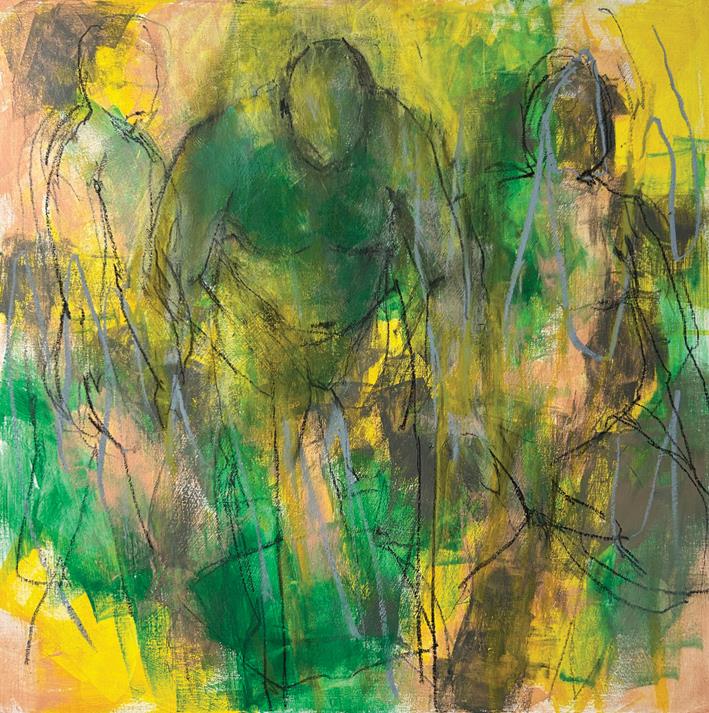
Borg has exhibited extensively both in Malta and abroad. Among his international exhibitions was a major solo presentation at Galleria Vittoria on Via Margutta in Rome in April 2022. In 2025, he presented a new body of work at Konsum163 in Munich, Germany, further expanding his presence on the European art scene and demonstrating the continued evolution of his practice.
And evolution is certainly the operative word here. The body of work presented in Ħafna Nies fil-Kamra marks a notable shift within Borg's ongoing exploration of abstraction, as the human figure begins to take centre stage. Human forms and symbolic figures emerge from his compositions, creating an intriguing dialogue between abstraction and representation. Yet these are far removed from conventional figurative depictions. Rather, the figures become expressive presences as vessels for emotion, memory, movement and psychological states. Their appearance signals Borg's continued fascination with that elusive territory between what we see and what we imagine.
Ħafna Nies fil-Kamra transforms il-Kamra ta' Fuq into a space inhabited by quiet, anonymous presences (although, of course, that is definitely not the case during the buzzing of the opening night!) At first glance, the room appears full of people, yet these figures resist individuality. They are not portraits or representations of specific identities, but distilled reflections of the human condition, inviting viewers to recognise something of themselves in each form. In a sense, they become silhouettes of fragments of our inner worlds - snippets of thoughts, dreams, memories and imagined scenarios.
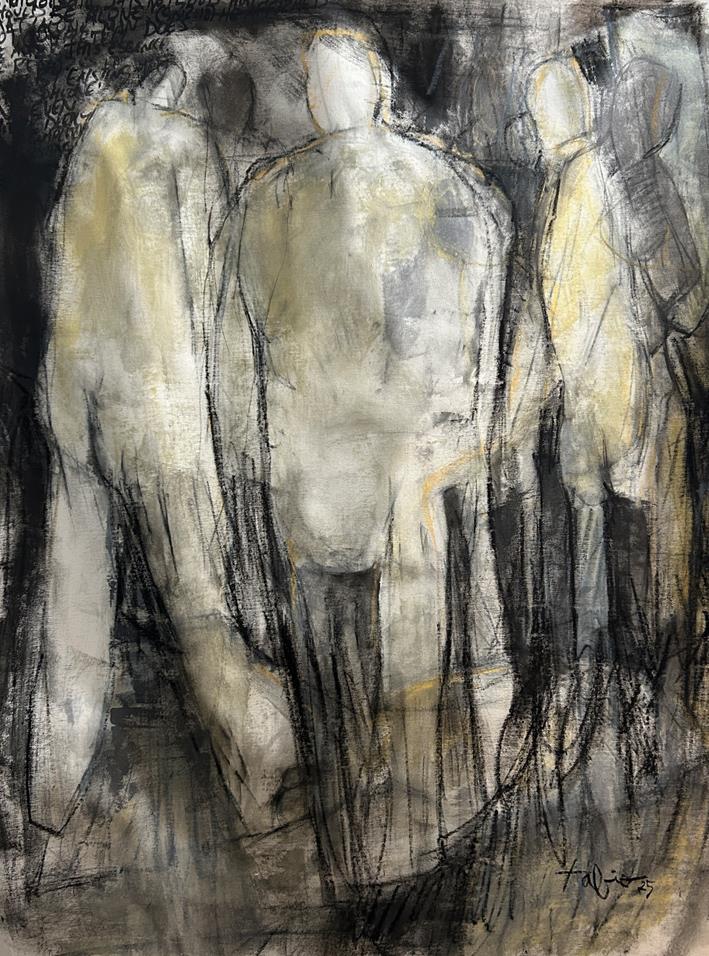
Working through a restrained, semi-abstract visual language, Fabio Borg deliberately strips away the markers that usually define us. Clothing, status, profession and social identity are absent, allowing the body to exist in its most essential state. Far from exposing vulnerability for its own sake, these simplified figures speak of honesty, equality and a shared humanity that exists beneath the roles we perform and the images we carefully construct.
What remains is our rawness, the unfiltered, the vulnerable human being beneath all the layers. Borg is not interested in what we choose to show the world, but in what remains when those layers are removed.
The exhibition quietly questions the value we place on outward appearances in a culture increasingly shaped by visibility and self-presentation. By reducing each figure to its simplest elements, Borg redirects our attention from what distinguishes us to what unites us. His paintings become meditations on authenticity, encouraging moments of stillness in which we can reflect on the transient nature of achievement, reputation and appearance.
And, of course, within the intimate setting of il-Kamra ta' Fuq, the witty title chosen by Borg acquires an additional resonance. The room fills not only with painted bodies, but with the many selves we bring into it. Together, these silent figures offer a gentle reminder that beneath every difference lies a common humanity, a humanity that is fragile, dignified and profoundly shared.
The titles of the individual works also play an important role in this body of work. They often provide another little doorway into the figures, with some reading almost like snippets from memories, fragments of dreams or moments of wishful thinking. In this way, the paintings exist somewhere between the tangible and the imagined: we are looking at a body, yet the title may lead us somewhere entirely different. Perhaps this is another of Borg's invitations to look beyond appearances and to allow our own memories, thoughts and associations to enter the room alongside his many people.
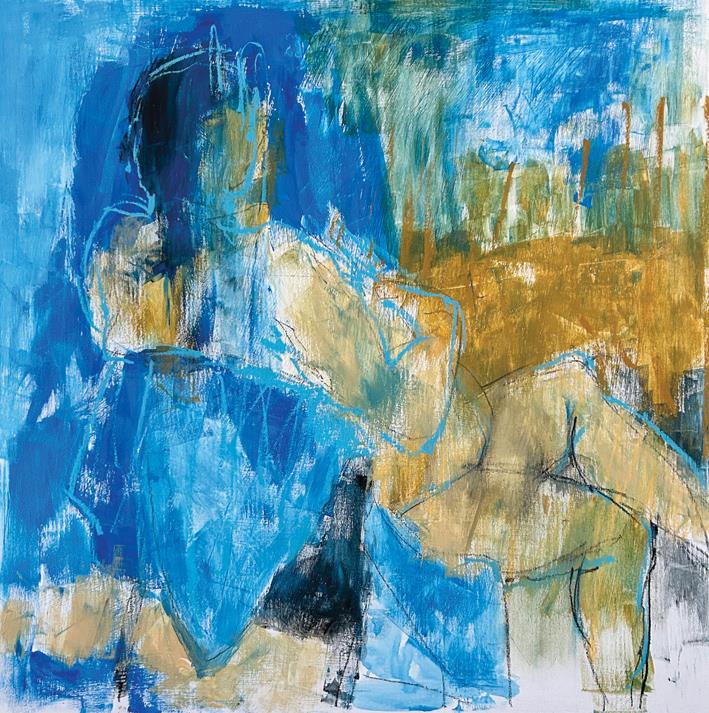
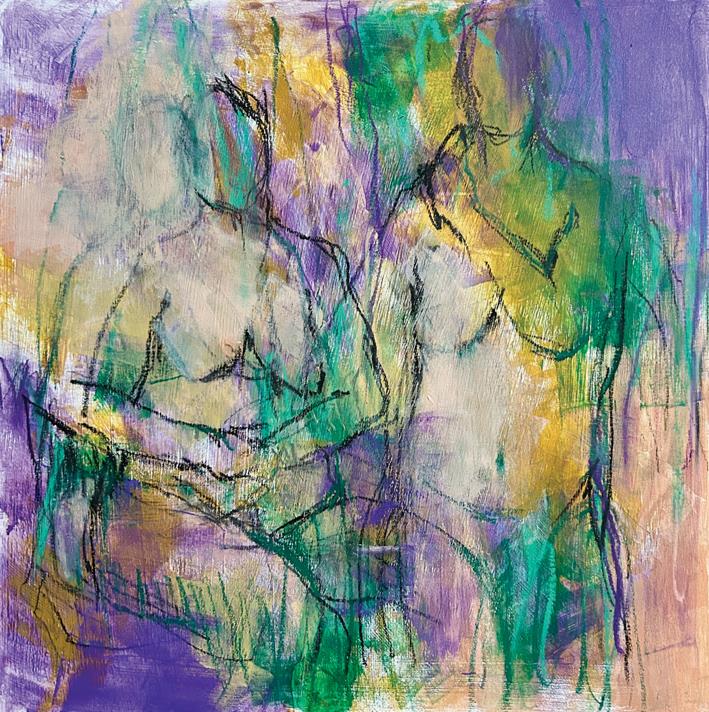
Ħbieb tat-tfulija is a case in point. We feel transported to a moment in time that may or may not have happened. Two female figures sitting comfortably beside one another, perhaps enjoying a chat, perhaps simply enjoying each other's company in silence.
Silence seems to be the order of the day in Waħdi ma jdejjaqni ħadd, although the vivid abstract patches of colour almost give the impression that there is some background music playing in this particular scene. Here, Borg introduces a prop: a chair. It is a small but significant addition, giving the otherwise stripped-back composition another element around which the imagined narrative can unfold.
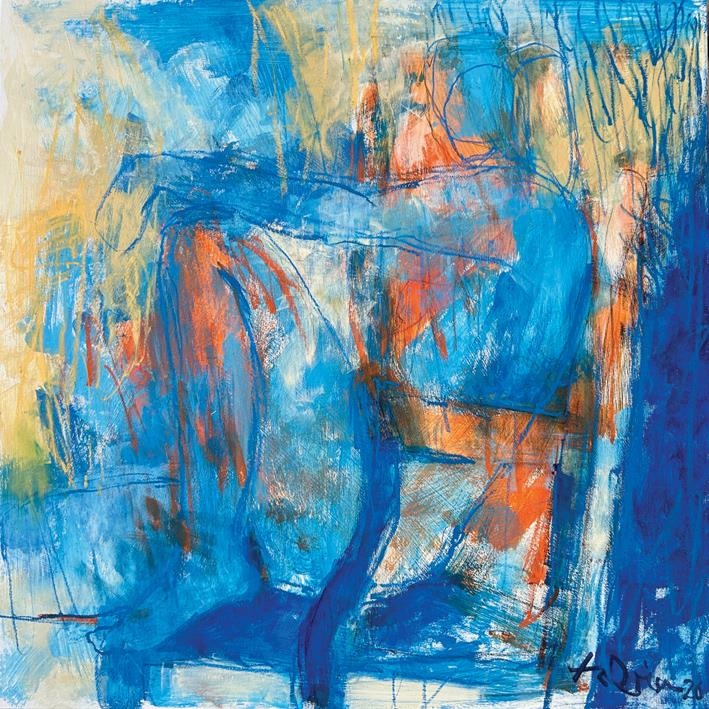
We encounter an armchair again in Meditazzjoni fuq il-ħajja, where a solitary figure lounges with one foot casually raised on the chair, seemingly oblivious to us as he meditates on life or something like it. He is engulfed by contrasting blues and oranges, which give the scene an almost dreamlike quality.
And, as always, I have my favourite. I am usually very drawn to Fabio's pink palette, but this time I fell in love with Niċċassa għall-kwiet. This predominantly blue scene features the chair once again, although this time we are presented with only the idea of a chair. Borg cleverly suggests its presence through a piece of fabric casually draped over it. The figure faces away from us, completely absorbed in a scene of his own. Hints of what could be a landscape or scenery emerge in the background, once again rendered through an abstract vocabulary. Perhaps the title of this particular work is what I secretly wish I were doing myself: niċċassa għall-kwiet, gazing peacefully, undisturbed, at nothing in particular and having a break from everything.
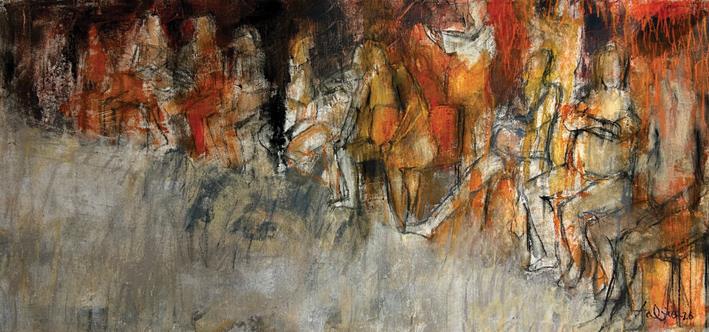
Two large works, Grupp ta' nies and Folla, bring numerous silhouetted figures into the compositions, each seemingly minding their own business. The work with perhaps the greatest number of figures, aptly titled Ħafna nies fil-Kamra, portrays what looks like a slice of street life, with numerous figures sitting together and creating a beautiful diagonal that follows the perspective of the street. Perhaps it is a tribute to the regulars of the New Life Bar, who sit outside on the street on a daily basis, discussing with incredible expertise on all matters, everything that happened to happen the day before.
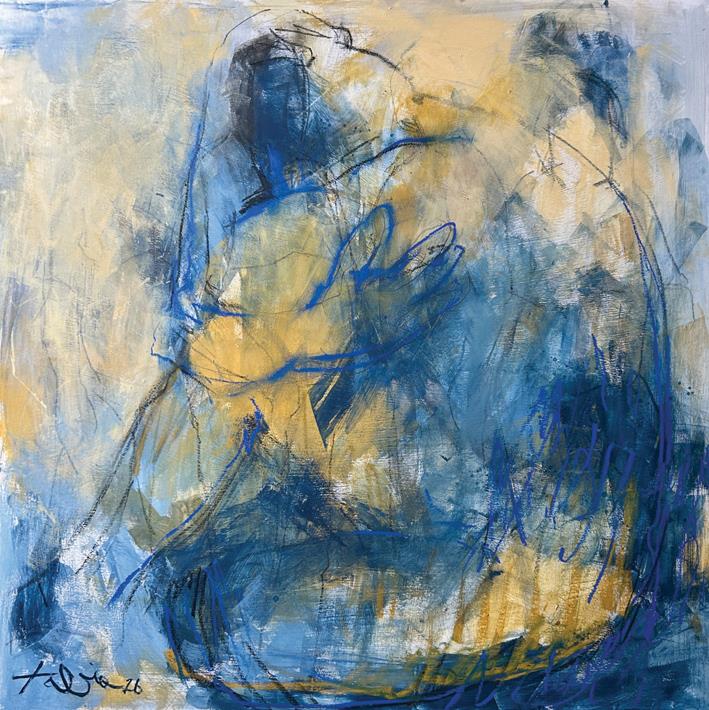
Another enigmatic work that I find particularly compelling (yes, once again, washed in blue) is Preżenza li tibqa'. There is something deeply personal about this painting, although precisely what that personal element might be is left open to interpretation. The crouching figure embraces itself, almost as though seeking comfort and protection from whatever difficulties life may have thrown its way. Borg emphasises the power of this embrace through the exaggerated scale of one the hands. One reaches across the body, attempting to cover and protect as much of it as possible, while the other shields the head, almost creating a small, enclosed sphere of safety. The figure appears to retreat into itself, yet there is something profoundly human in this gesture. It is a reminder that sometimes the most instinctive response to vulnerability is also the simplest: to hold ourselves together.
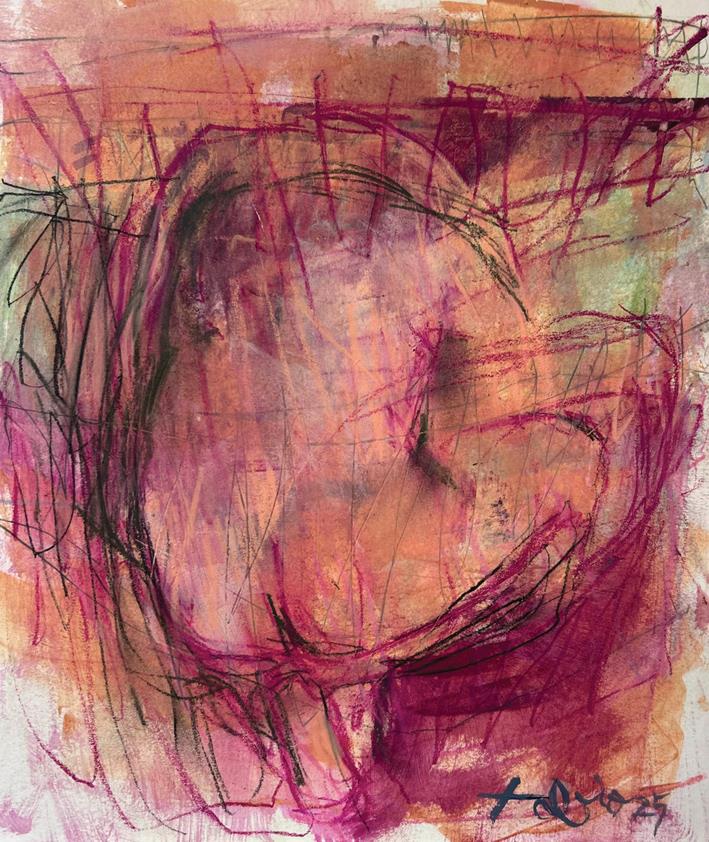
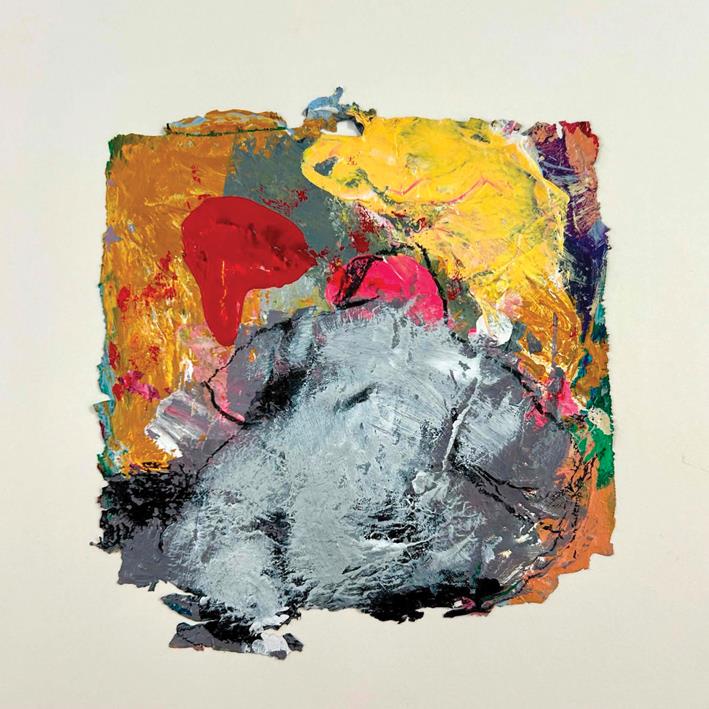
Two smaller works are executed somewhat differently, perhaps hinting at where Borg's artistic journey may take him next. Most of the works in the exhibition are executed in acrylics, oil pastels and pencil on canvas or wooden panels. Figura and Dak li jibqa' jitkellem daqstant qawwi, however, are both executed solely in an impasto of acrylics and on paper, resulting in a very particular finish that feels noticeably different from what we have seen from Borg so far. The change in surface and medium gives these works an added sense of immediacy, while also suggesting new possibilities within his practice.
These works carry memories, thoughts, dreams, vulnerabilities and stories. Some are imagined, some perhaps drawn from life, and many left deliberately open to our own interpretation. And perhaps that is what makes Ħafna Nies fil-Kamra so engaging. There may be many people in the room, but ultimately, we are all bringing a little bit of ourselves into it.
The exhibition is on at il-Kamra ta' Fuq until 13 September. Follow us on social media for further information and updates.