Visual artists Emma Weller and Mieke Buddenberg both came to Gozo from dense urban environments - Weller from London, UK, and Buddenberg from Düsseldorf, Germany. The move to Malta's sister island brought a significant shift in their surroundings, from the pace and infrastructure of the city to Gozo's far more rural landscapes and rhythms. Over time, this change of environment filtered into both artists' practices, influencing the materials they use and the imagery they gravitate towards.
At first glance, Weller and Buddenberg's practices appear different, almost worlds apart. Buddenberg often works with organic tones and materials through a more intuitive, expressive approach. Weller is known for an abundant use of pink, artificial materials and imagery that is deliberate and metaphorical. On the surface, there appears to be a considerable distance between the artist's work, yet beneath the aesthetics lie unexpected resonances.
Early this year both artists began to meet regularly and share their life experiences, often discussing life on the island, and, most importantly, what it means to be a female artist. What does it mean to navigate the art world, and the world more broadly, as a woman? These conversations gradually disclosed mutuality between their practices, laying the foundations for their upcoming exhibition Hija, meaning "she" or "she is" in Maltese.
Over the course of six months, the artists developed 16 artworks shaped by memory, pain, perception and material symbolism, with Gozo's influence woven throughout the process.
The unexpected discovery of recurring motifs
When viewing the exhibited works in Hija, recurring motifs appear across both artists' work. These similarities were not planned or discussed beforehand; rather, they emerged naturally as the artists developed their work, making the parallels all the more surprising.
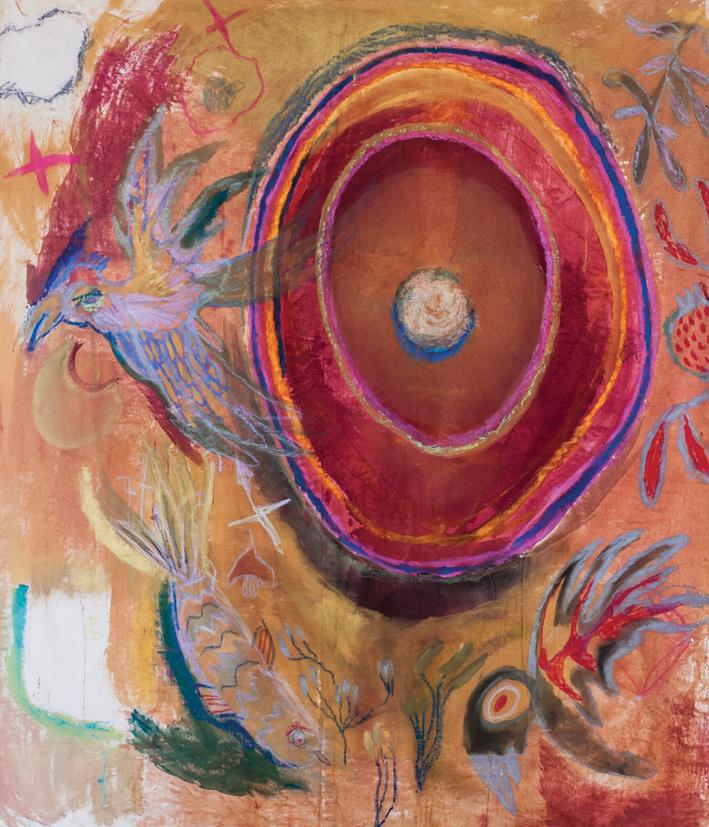
For example, the image of the bird appealed to both artists. Buddenberg's Birds of Paradise, the first work seen on entering the exhibition, presents birds and fish flying around a deep and richly toned circle, with stars and plants swirling around its gravitational pull. The pastel circle, an egg or single cell, draws attention to concepts of fertility and beginnings.
Weller's sculpture offers a continuation in conversation. As We Sit on This Rock features mythological Harpies; female bird-like creatures historically associated with female rage and empowerment. Perched upon a rock, Weller presents a larger mother-like hybrid, alongside a smaller offspring, both with troubled male faces. Together, the works open up a wider conversation about fertility, motherhood and the changing expectations placed upon women today.
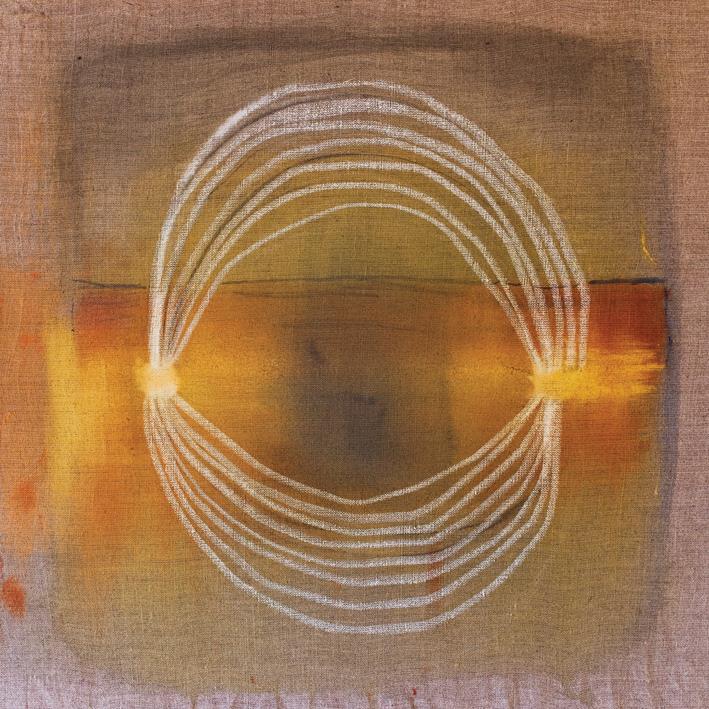
The circle, or hole, became another recurring motif, appearing in a number of works including Buddenberg's Love Between Two and Weller's Wound. For Buddenberg, the white circles represent "magnetic fields" between individuals and objects; for Weller, the opening holds the possibility of another dimension, alongside darkness and uncertainty.
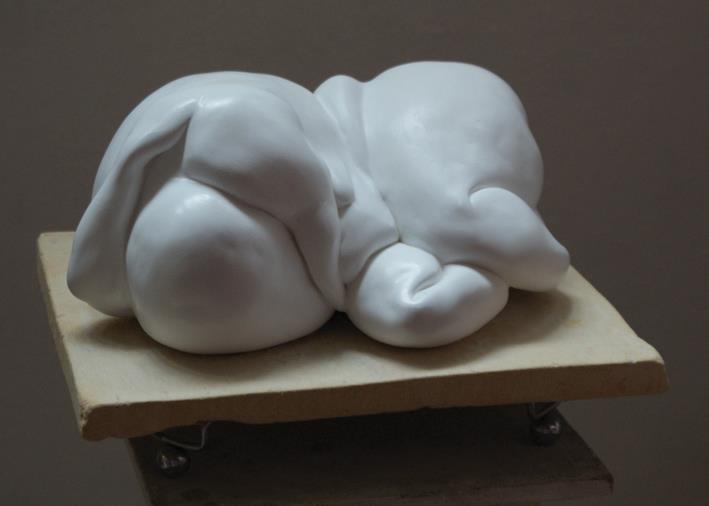
The reclining or resting female body became another meeting point between the artists' work. In Weller's Laying Down, the female form is abstracted into a distorted shape, making the simple act of resting or sleeping feel less certain. The Gozitan limestone beneath the figure appears soft, yet remains cold and hard, creating a contrast between appearance and reality.
Buddenberg's Resting leans more into the tranquillity of repose, depicting a blue female figure lying in a pink haze, her body attuning with the hills of Gozo. The painting, divided into four panels, was dipped in locally sourced Gozitan beeswax, giving the surface a skin-like texture that Buddenberg describes as a "protective layer".
Inner self vs outer self
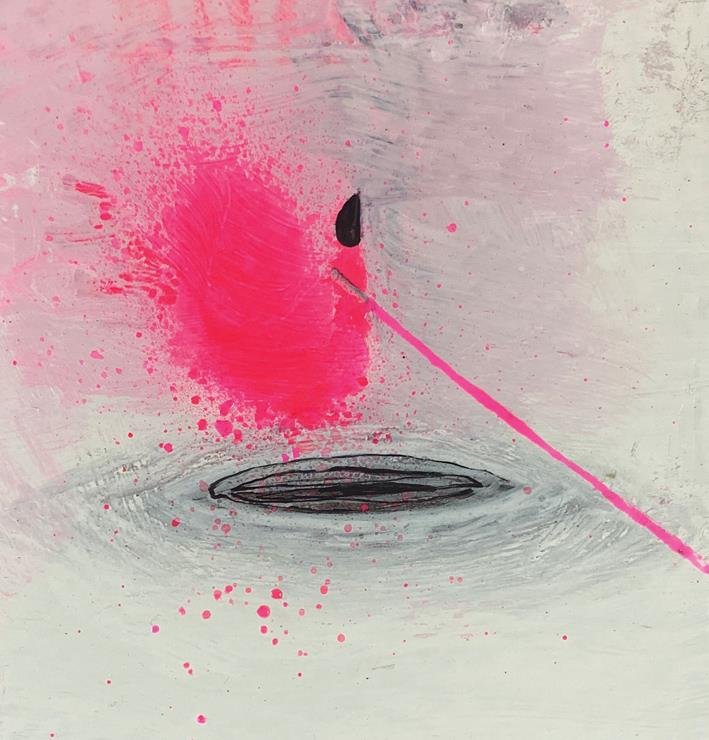
Throughout the process of putting Hija together, abstraction became a way to give form to what cannot be seen. A number of works look beneath the surface of what we present to the world, into the thoughts, feelings and contradictions that may not always fit the image others see.
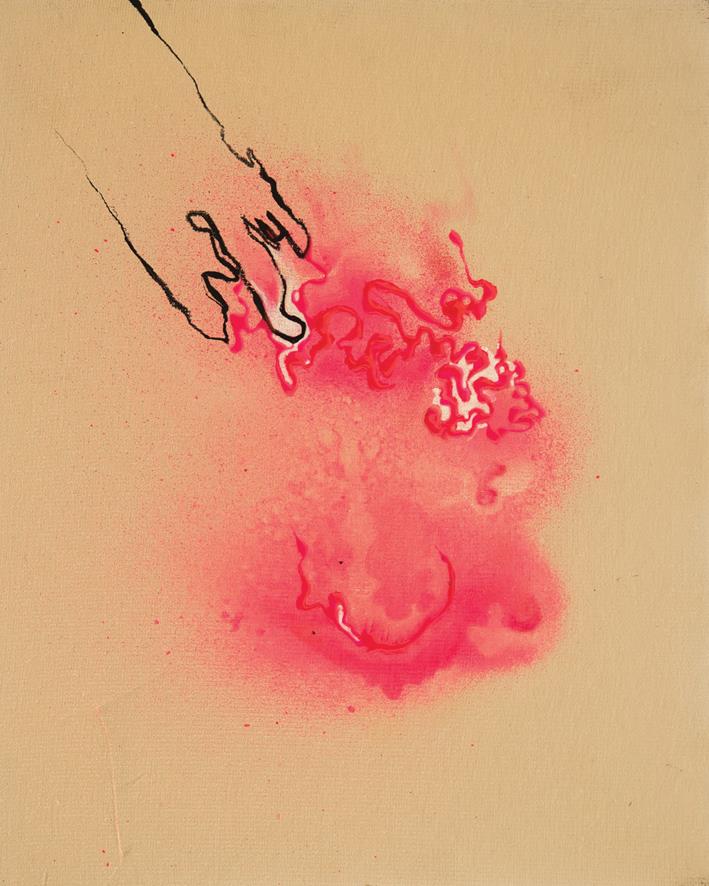
Thoughts in Flux by Weller looks inwards, capturing a nuanced inner thought that is both tender and jagged. The neon blush, made from crushed resins, feels like a soft chemical reaction, as does the liquid lines, suggesting a naturalness, a fluidity. However, the charcoal line joins the image scene like a bold distraction.
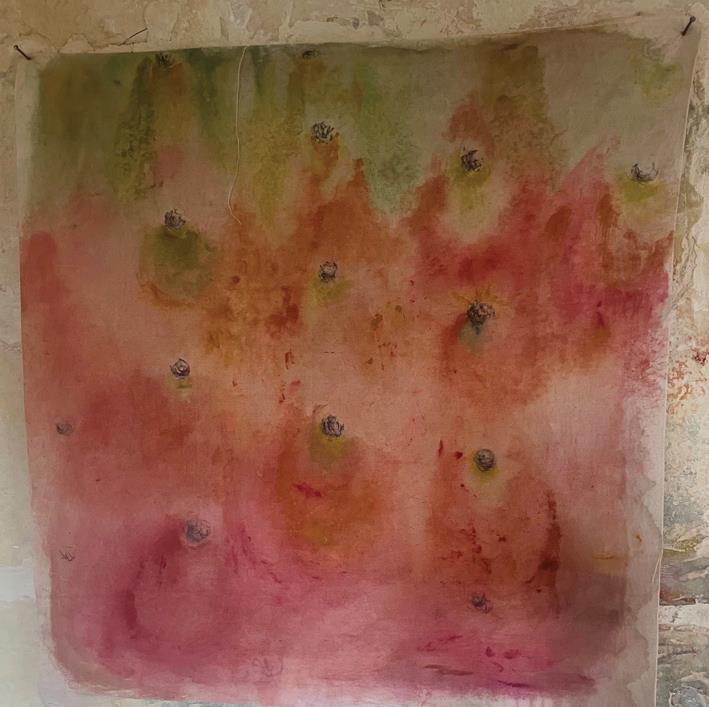
One of the most intriguing moments in the development of Hija came when Buddenberg and Weller realised they had unknowingly made works with an extraordinary similarity. Buddenberg's Prickly Pears, which is dyed with the fruit, and Weller's Holes were created simultaneously. When the artists compared the works, they discovered that both contained exactly 15 circular marks. Neither artist had seen the other's work while making their piece, making the coincidence all the more striking. At this point, Hija seemed to take on a life of its own, revealing connections that neither artist had consciously planned.
The exhibition is divided into two spaces, connected by Otherside, a collaborative textile installation. The hand-sewn, weighted curtain was tailored by Buddenberg and embroidered by Weller with excerpts from her poetry. As audiences pass through it, Otherside acts as a transitional divide between the two spaces.
On entering the second space, visitors encounter a short documentary by Francesca Mercieca, offering a glimpse into the artists' process throughout the making of Hija. The film adds another layer to the exhibition, bringing the artists' voices and processes into the space alongside the finished works.
For creatives, art lovers and visitors, Hija is a chance to see the vibrant artistic community that exists on Gozo, and the new spaces and opportunities being created by artists on the island. Exhibiting outside a traditional white-cube gallery, the exhibition shall be held at Franka Inn, an intimate and atmospheric location in Fontana, Gozo.
Hija opens on Friday, 4 September from 7pm. The exhibition continues on Saturday, 5 and Sunday, 6 September from 12noon to 3pm, with the artists present throughout. For one weekend, Weller and Buddenberg invite audiences to contemplate the concepts at the root of the exhibition and form their own interpretations.