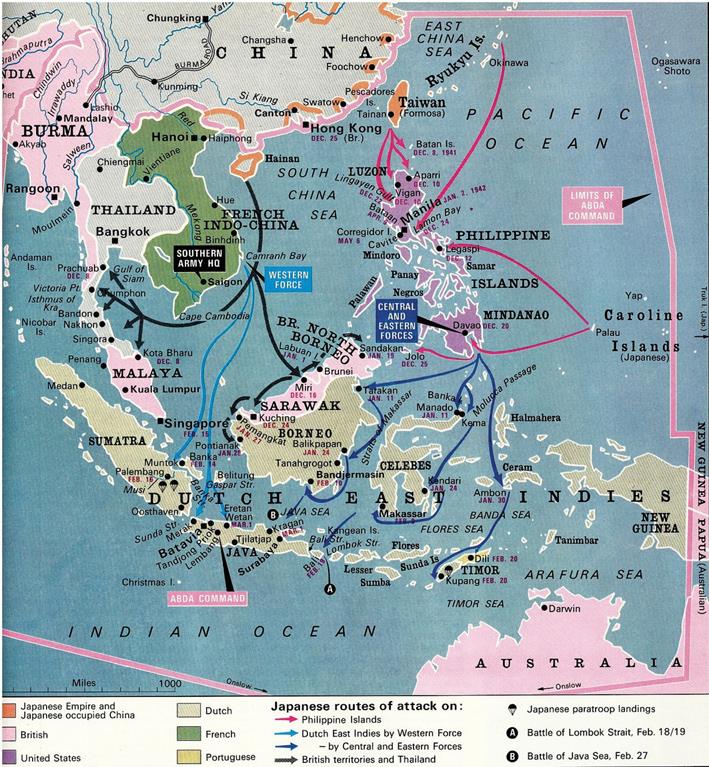
Throughout the planning of Operation C3, the invasion of Malta, the experiences encountered during similar operations by the two other members of the Tripartite Pact, the Germans and the Japanese, were brought to notice. Both of them had vast experience in both amphibious and airborne invasions respectively; the Germans in airborne invasions and the Japanese in amphibious invasions in south-east Asia and the Pacific.

In mid-February 1942, Generale Ugo Cavallero (the Commander-in-Chief of the Italian Supreme Command) got permission from Il Duce Benito Mussolini, to ask for advice from the Japanese about the vast experience they accumulated in their theatre of war, against China, the European and US colonies of south-east Asia and in many of the vast number of Pacific islands.

German considerations about the Japanese amphibious landings in the Far East
All their amphibious landings in the Far East were nearly always in the same way. They selected one particular example as a model of how to perform a fully prepared amphibious landing. One of the most striking elements of the report is the Japanese insistence that secrecy and psychological discipline are superior to technical equipment.
Every normal infantry division is adapted for a landing. Japan had some special landing divisions, which are employed in time of need. The difference between these troops and other divisions consisted mainly in the fact that they had special training for the landings. Also, the landing divisions included also a pioneer regiment that is employed for the service of landing crafts between the transport fleet and the coast. The same regiment was not employed on land.

The crafts that transported the troops to the coast were able to transport tanks and artillery. The training of the units that were to be employed in the landings had to assure the maximum velocity to embark and land from the crafts. Also, intense training had to be done inspired by real combat that they might face during their landing on the coast. Especially the younger officers, and also the NCOs, had to be particularly trained. On the other hand, the troops had to be sufficiently trained for a week.

For the landing, the Japanese had special equipment to surpass inequality of at least 50 metres, by using ladders and anchors. The anchors were thrown by hand or launched, with one end tied with a landing craft, while the same anchor was thrown to the highest place of the coast. The troops had to be equipped with mountain boots in order to climb the high coast or cliff.
The first wave had to consist of normal assault infantry troops, reinforced by pioneers and heavy weapons, in order for these troops to have autonomous tactic. It wasn't known if these special landing troops were employed by the Navy or how they were equipped. Landings were directed towards different places, for example, two regiments one next to the other and battalions lined up in profundity, in order to continually augment their regimental operative.

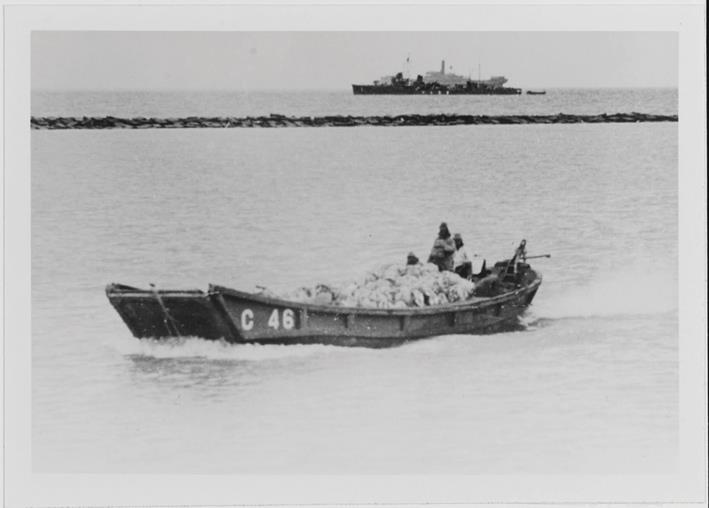
The single waves had to be followed one after the other. The most dangerous was when the empty landing crafts of the first wave had to find their respective transport ships. The transport of troops happened normally at a distance of two miles from the coast. The Japanese Army had a variety of craft for landing troops, including unprotected reconnaissance craft employed secretly at night, and protected craft that sailed ahead of the landing craft and were armed with a 54 mm gun and two twin-mounted machine guns.

Special Protected landing crafts for the commanders were destined for commander of companies. Large landing crafts - they could carry a tank or 10 horses with light guns, and 70 men. These landing crafts were to be put in the sea already fully loaded, in case they had to carry equipment. In the bow they had a walking way, which passed along the length of the same landing craft, from where they could download the war material.
Light landing craft transported 35 men, which were protected over the bow only. There were also what were called dispatch landing crafts, which were light and fast.
All the landing crafts were equipped with a water pump, and the bottom part was robust and flat. The landing crafts destined to carry the tanks and heavy equipment had a double bottom, in order not to turn upside down on the beach. The protection of the landing craft was against infantry weapons and artillery splinters. The transport fleet had a large landing crafts reserve of every type and size.
It did not result in the formation of a reserve of swimmers. Their employment was not considered suitable for various technical and operational reasons, as this could have caused indecision during the final action. The action, once planned, had to be carried out without changes and according to the established plan. Any additional intervention would only have created confusion. The tonnage of the troop transports had to be between 2,000-6,000 tons. Anti-aircraft protection had to be provided by naval artillery and by the transport ships, as well as by the machine guns and other small arms carried by the infantrymen of the landing troops.
To increase the mobility of the troops, no special means was envisaged. The main question was that the motor vehicles and the horses disembark fast after the first wave. Regarding the presence of enemy obstacles, the use of swimmers was also adapted to remove the same obstacles. Floating obstacles were removed by the landing crafts that throw their anchor on the same obstacles, removing it backwards.
Obstacles found immediately beneath the surface of the sea and whose presence had been ascertained by the reconnaissance craft were removed using explosive grenades. The transport craft would have a rocket launcher, that can fire at a distance of 600 metres. Also, the pioneer regiment had explosive material equipment.
Good example of co-operation which never materialised into action
The Japanese assistance in planning for the invasion of Malta was one of the rare occasions where there was real co-operation between all the Axis powers.
They proposed a purely seaborne operation, without the use of paratroops, to be launched during the night. Army units were to consist of three Japanese divisions, totalling 23 infantry and six artillery battalions. There was a difference of opinion about the use of air power during the seaborne operation against Malta. The Italian plan included that during operation there must be aerial activity to confuse, but also help the invasion forces. On the other hand, the Japanese proposed that, at the beginning of the operation, the invasion force should remain under the command of the Navy, but that after the landing it would come under the command of the Army.
Charles Debono is senior researcher at National War Museum