You began painting after retirement. What prompted you to start making art at that stage of life?
My son, Gabriel, challenged me with a new sketchbook and a set of pencils, and I had no choice but to take him up on it. Retirement was not a choice, so I had to replace one passion with another. I worked from 4.30 am onwards, Sunday to Sunday, to learn and discover this new passion.
Were you interested in art before retirement, or was painting a completely new pursuit?
I was always interested in art and the history of art. In fact, I attended classes at the School of Art, under Dr Christian Attard and Matthew Mallia, however, I never took any technical lessons. I came to it without following the conventional path of art school education or years of academic training. In that sense, I approached the canvas with very few preconceived ideas about what I was supposed to do. Perhaps that was an advantage. I simply made mistakes, learned from them, and gradually discovered my own language. Looking back, I think beginning later in life allowed me to approach painting with greater freedom and passion. I wasn't trying to become an artist, I was simply trying to express myself.
How has your previous career influenced the way you approach painting?
My previous career as a businessman, taught me discipline, strategy, responsibility, owing to the environment in which I worked. Thanks to this, I could tackle this journey differently. Painting is almost the opposite of a structured professional environment. There are no fixed answers and no guaranteed outcomes. That contrast is something I enjoy. My career taught me to analyse and solve problems, painting taught me when to stop analysing and trust instinct. I believe the two have found a balance in my work. My art is not a disciplined decision but an emotional one.
What challenges did you encounter when learning to paint later in life?
The biggest challenge was knowing nothing, starting from zero. But when starting later in life, you are very conscious of what you don't know. There is temptation to compare yourself with people who have been painting since childhood or who have had years of formal training, but I eventually realized this is pointless. Age has actually given me patience. I am much more willing to experiment, destroy something that isn't working and start again. I have learnt that painting is not about avoiding mistakes, it is about knowing how to use them.
Your biography describes your artistic language as "instinctive, raw and deeply personal". What does painting instinctively mean in practical terms, and how much planning goes into a work before you begin?
For me, painting instinctively means allowing the painting to develop rather than trying to control every stage of it. I usually begin with an idea, an emotion, study it, and work on it in sketches or directly to the wooden panel or canvas. I search for similar references to broaden the idea and develop it into a feeling. I don't usually have every detail planned beforehand. Sometimes, a colour or a change in composition takes the work somewhere completely different from where I imagined it to be going. This is where the rawness comes from.
Why are you drawn to colour and expressive brushwork?
Because colour speaks before anything else. I am fascinated by the emotional power of colour. A colour can create warmth, tension, sadness, energy or tranquillity without requiring any explanation. I am not interested in making a photographic representation of reality, I want to interpret it as a feeling. Bold colour also allows me to move away from simply reproducing what I see. The movement of the brush becomes part of the emotional language of the painting. For me, colour and brushwork are not decoration, they are the vocabulary with which I speak.
Do you consider technical accuracy important, or is emotional impact your main goal?
Technical ability is important because it gives an artist tools, but it is not my ultimate goal. I am much more interested in whether a painting makes you feel something. I believe emotion is what gives a work its life. That doesn't mean I disregard technique, quite the opposite. I am constantly learning and refining my technique. But I want technique to serve emotion rather than emotion being sacrificed for technical perfection. I will always choose emotion over perfection.
Which artists have influenced your style most strongly?
I admire artists who were prepared to see beyond literal representation and use colour, form and gesture to communicate something deeper. Cezanne has always fascinated me because of the way he reduced what he saw into structure, colour and form. His work reminds us that a painting doesn't have to imitate reality to make us believe in it. Leonardo da Vinci is also a major source of fascination, with his signature sfumato technique, in his figurative art.
The flowers in the vase appear to be wilting rather than flourishing. Was that intentional?
Yes, it was intentional. I am drawn to the beauty of things that are not perfect, and for me wilting flowers have a particular emotional quality that flourishing flowers don't possess. They speak about time, fragility, and impermanence. I paint flowers carrying a sense of vulnerability. They are beautiful precisely because they are temporary. For me wilting flowers are not necessarily about death, they can represent resilience. The ability to retain beauty and meaning even when something is beginning to fade.
What emotions were you hoping viewers would experience when looking at the still-life painting?
I would hope that viewers experience something personal rather than something prescribed. Perhaps a sense of melancholy, tenderness, nostalgia. The wilting flowers can suggest loss, but they can also suggest acceptance and the beauty of impermanence. I don't wish to tell the viewer exactly what to feel. Once a painting leaves me, it belongs to the person looking at it or owning it. Then it is up to them to feel about it as they wish.
The reclining figure is highly simplified. Why did you choose abstraction rather than a more realistic representation?
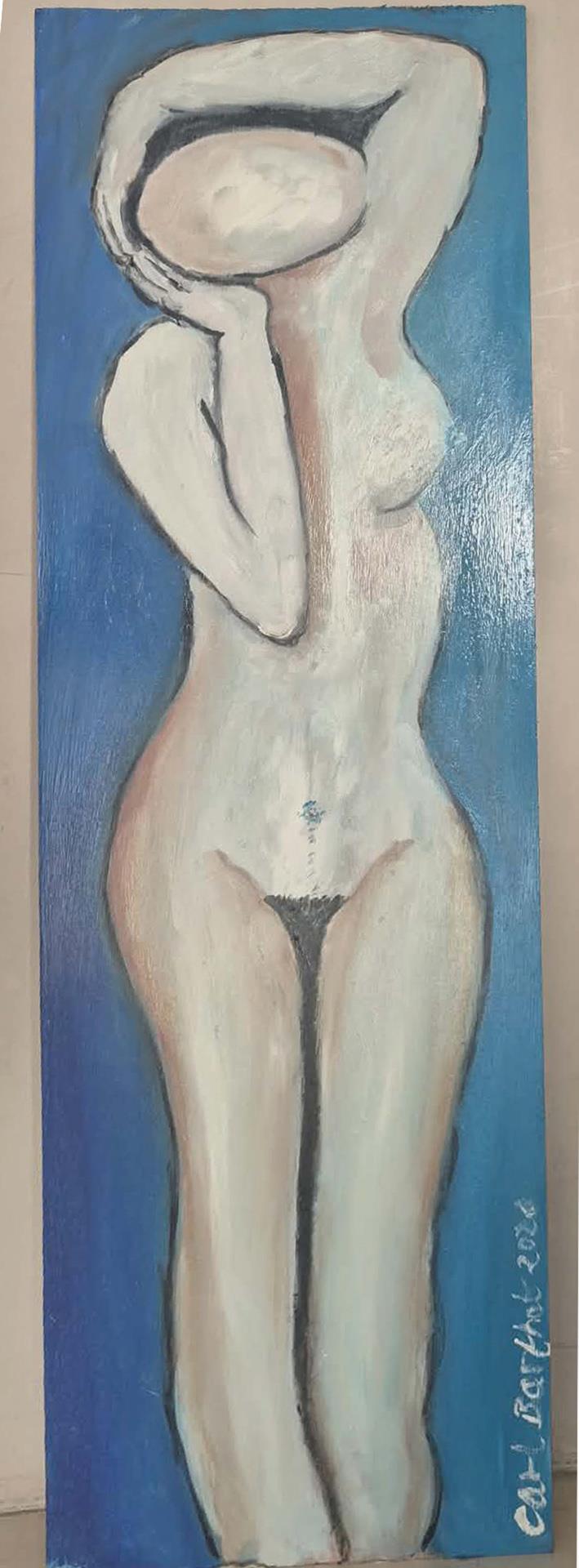
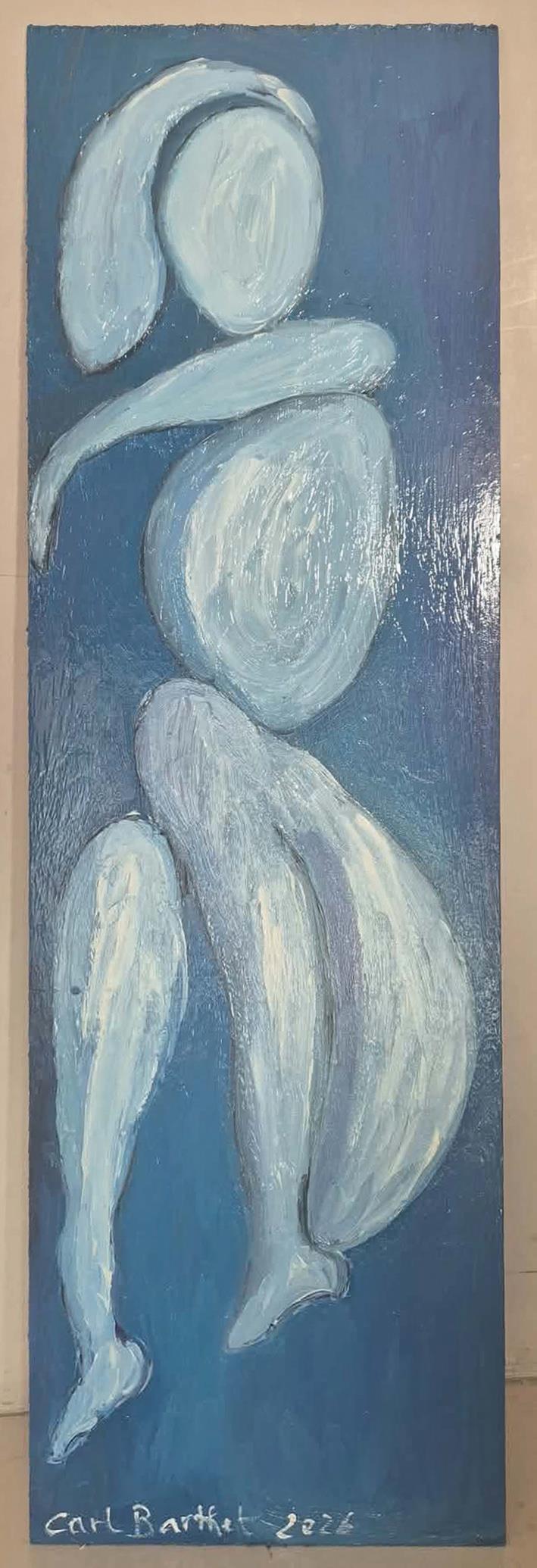
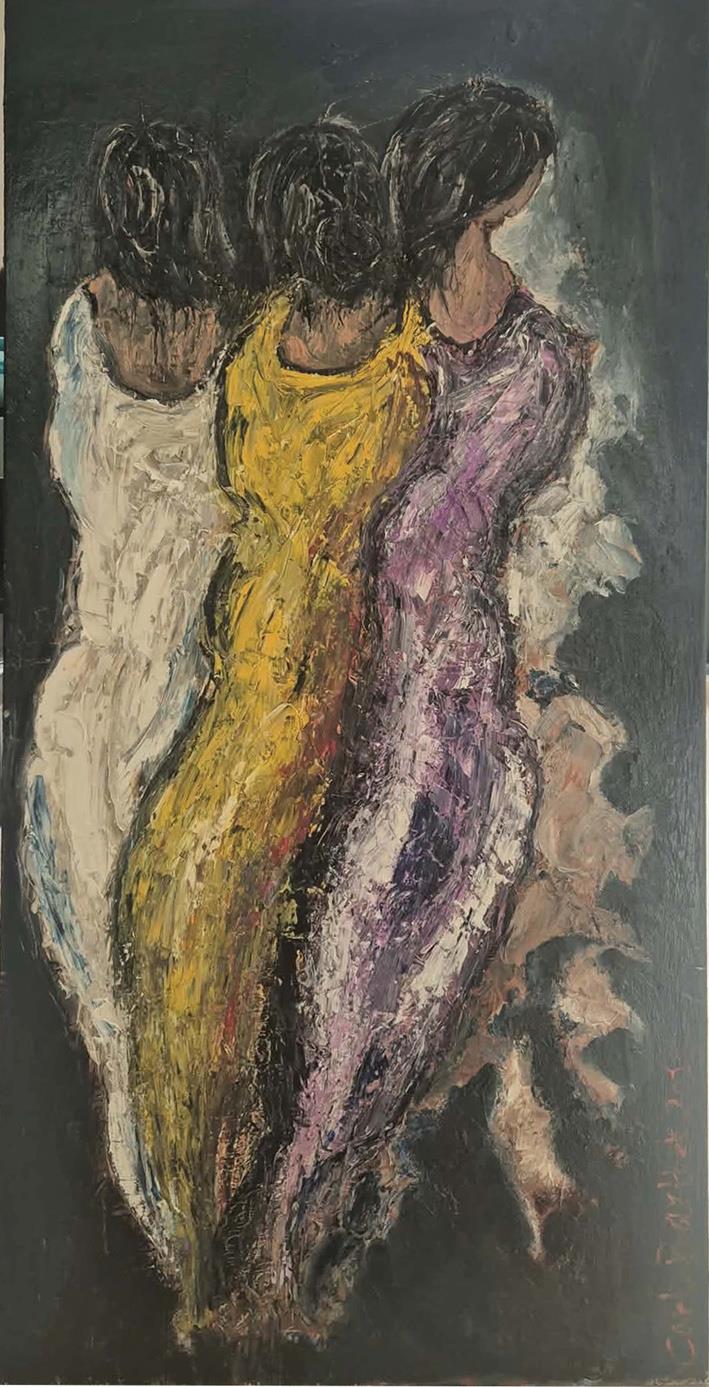
Those three Mattisse-like figures represent in my mind and soul, the Goddess of the Earth, the God of the Sky and the Goddess of the night. This is my beginning in my journey. The blue and white colours give this feeling. The choice of abstraction over realism gives me the freedom to work. To distort proportion, exaggerate gesture and use colour in ways that would not necessarily exist in reality. Hence the connection to Greek mythology in this body of work. The simplification makes the emotion stronger. An invitation to the viewer to complete the image with their own imagination.
What role does colour play in conveying meaning in these works?
Colour is central to my work. It is part of the meaning from the beginning. A particular blue can suggest distance or self-reflection. Red can carry passion, anger or vitality. Yellow can bring warmth and hope, but it can also create tension and ambiguity.
Your statement speaks about love, joy, longing, pain, resilience and vulnerability. How do you translate these emotions into colour and form?
There is no formulaic way. There isn't a particular colour that always means sadness or a particular shape that always means love. It is more intuitive than that. It is emotional painting.
Are these particular emotions you find easier, or harder, to express through painting?
Pain is usually my strongest emotion. I have painted a series of children in war, their suffering and distress. One example is my Gaza Boy which I completed two years ago, for my first exhibition held at SkyParks.
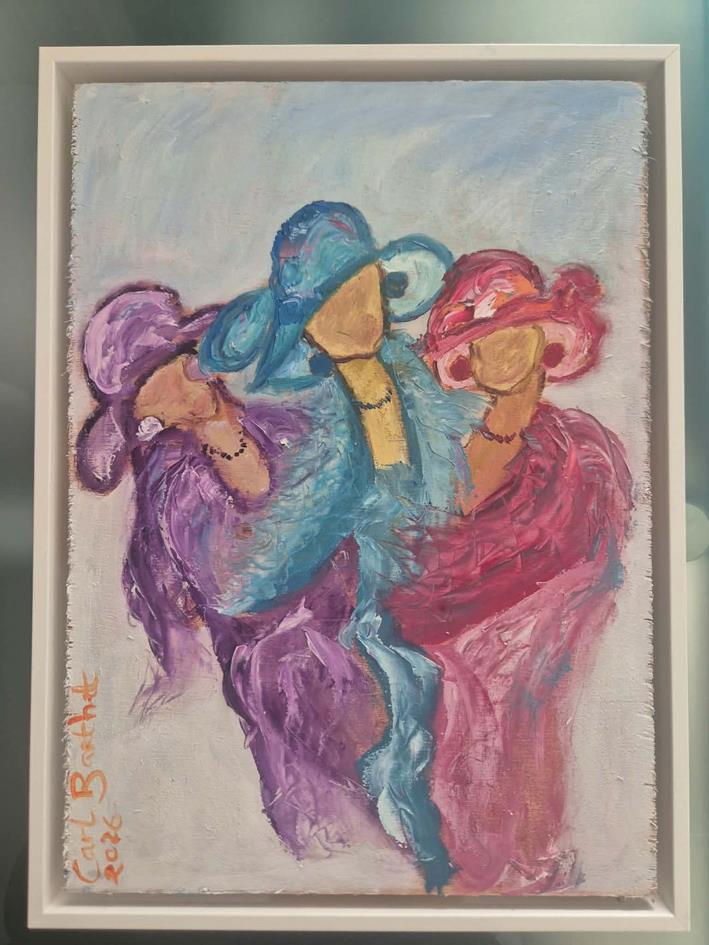
The pain in his eyes is felt when you look at him deeply. Other paintings related to the Gaza genocide are close to my heart. I also paint hope in the form of still life paintings and figurative art. This is always difficult but one has to never give up on hope. Joy is easier because it naturally lends itself to colour, movement and energy. I have a series of paintings which I titled Good Sisters, Sisterhood, and others, showing this bond of love and joy.
Do you want viewers to understand a specific message, or do you welcome interpretations that differ completely from your original intention?
I wish the viewer or the buyer to choose their own interpretation, which might have nothing to do with mine at all. The painting must have a newly acquired life.
Some viewers might see the simplicity of your forms as naïve rather than expressive. How would you respond to that?
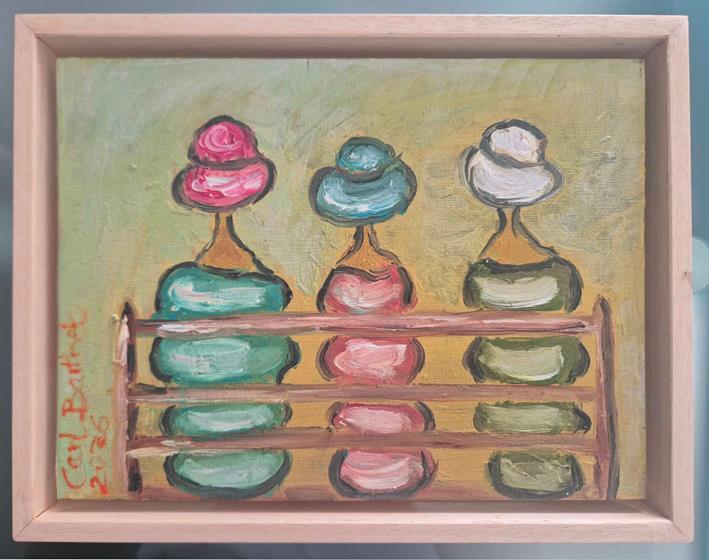
There is a difference between simplicity and lack of sophistication. I consciously remove information from my figures because I want to concentrate on what I believe is essential. If someone sees my work as naïve, I respect their interpretation but my simplicity is intentional. It is part of my visual language. Sometimes reducing an image allows the emotion to become much louder.
What would you say to someone who does not immediately connect with your work?
I would say: don't force yourself to connect with it. Art doesn't work for everyone. We all bring different experiences, memories, and emotions to what we see. Perhaps a painting that means nothing to you today might speak to you differently in years to come or perhaps it never will. That's life. I paint for myself, not to make a living. I did that before, with success.
In today's art world, what makes a painting emotionally powerful rather than merely decorative?
A decorative painting can be beautiful, but an emotionally powerful painting makes you stop and feel it. It creates a feeling. That is art for me.
How do you judge whether a painting is finished?
A painting is never finished but you have to end it one way or another.
What distinguishes your visual language from that of other contemporary artists?
I do not want to paint views of Valletta, Mdina or Birgu, or traditional boats. These are beautiful works, but traditional art is not what I wish to do. I love to paint the feeling around me, being pain, joy or resilience and respond to it. I use simplified forms, expressive brushwork and strong colour. Perhaps the most important distinction is that I link music to my art. A song is always connected to a painting of mine. Usually the painting starts first, as an emotion, and the music is chosen for it. I present it and title it accordingly. I believe this is a combination of my love for life. Discovering my language is still a work in progress and I wait with excitement where this will lead.