What first inspired you to begin ballet, and when did you realise it could become a professional career?
My mother enrolled me in baby ballet when I was two-and-a-half years old at Brigitte Gauci Borda School of Dance. From a young age, Ms Brigitte saw potential in me and encouraged me to take my training further through private coaching and additional opportunities. As I grew older and began training and competing internationally successfully, I realised it could be much more than a hobby. That was when a professional career started to feel like a real possibility.
Growing up in Malta, what were the biggest influences on your dance journey?
My early training at Brigitte Gauci Borda was fundamental to my development. I had excellent teachers who nurtured me and helped me improve both technically and artistically, while also instilling a strong sense of discipline in me. Ms Brigitte also created opportunities that were extremely valuable to my development. She organised courses and ballet stages with international guest artists, which gave me the opportunity to be exposed to professional dancers and teachers at a young age. This gave me an insight into the standards of the international ballet world and helped me develop at a much faster pace.
Ms Brigitte also took us overseas to compete in international competitions, giving me invaluable experience and encouraging me to challenge myself beyond Malta. She even choreographed two neoclassical pieces especially for me, which gave me the opportunity to develop artistically and gain confidence as a performer.
Growing up in Malta also made me very ambitious, because I knew that to pursue ballet professionally I would need to seek opportunities abroad and compete at an international level. Looking back, the combination of strong training, discipline and the opportunities I was given through the school played a major role in shaping my journey and ultimately helping me progress towards a professional career.
Was there a particular performance or dancer that made you fall in love with ballet?
Ms Brigitte put on a production of Giselle at Pjazza Teatru Rjal, where I had the opportunity to perform in the pas de quatre as well as dance as a Wili. Luisa Lopez, a principal at the Royal Swedish Ballet, performed the role of Giselle, and watching her was incredibly inspiring. I remember thinking that one day I wanted to become a ballerina just like her.
Growing up I also watched Yasmine Naghdi in many cinema relays of The Royal Ballet Company and I was immediately drawn to her artistry and presence on stage. When I learned that she trained at The Royal Ballet School, it strengthened my ambition to one day train there myself.
You have trained in the Cecchetti, Vaganova, Russian, and English styles. How has each method shaped you as an artist?
A marriage of impeccable technique and versatile artistry is vital to becoming a professional dancer and I feel fortunate to have trained in several different methods that each contributed something unique to my development.
The Cecchetti method, which I learnt at Brigitte Gauci Borda School of Dance, gave me my foundation. It shaped my port de bras, head placement and musicality. The Vaganova method, which I learnt at the Bolshoi Ballet Academy (Moscow) and the Vaganova Ballet Academy (St Petersburg), helped me develop my strength, turnout and flexibility, while also encouraging a greater sense of expression and presentation. My training at The Royal Ballet School helped me tie all of those elements together, refining my technique and teaching me greater versatility and adaptability. Technique can only take a dancer so far. Drive, determination and passion are what allow a dancer to stand out and continue progressing.
What was the biggest challenge in adapting from one ballet tradition to another?
Probably accepting that the same step can be approached very differently depending on the school or teacher. Details such as port de bras, épaulement and placement can change considerably. At first that was difficult, but eventually it taught me to adapt quickly and not become too fixed in one way of working.
What lessons from your time at the Royal Ballet School do you carry with you every day?
Discipline, consistency and attention to detail. I learned that progress rarely comes from one big breakthrough; it comes from improving small things every day. I also learned that technique is there to support artistry. Ultimately, you want the audience to see the performance rather than the effort behind it.
How did your experiences in Russia influence your approach to technique and artistry?
Training in Russia made me much more aware of strength, precision and presentation. There was a strong emphasis on how movement travels through the whole body, including the upper body, head and eyes. It also made me more independent, because I was living and training away from home at a young age.
When preparing a role, do you focus first on the technical demands or the character's story?
I usually begin by making sure the choreography and technical demands are secure, because that gives me a foundation. Then I can focus more fully on the character, story and intention behind the movement. Ideally, by the time I perform, the technique feels natural enough that the character can take over.
Which role has been the most personally rewarding to perform so far, and why?
Due to an illness one of the dancers who had to dance the main role of Firebird was unable to perform. I was therefore asked the day before the performance to take on the role, with only one rehearsal to prepare for this demanding 10-minute piece. Firebird is an extremely demanding piece, requiring both stamina and strong dramatic interpretation, particularly in portraying a bird desperately trying to escape from a hunter while becoming increasingly exhausted. I was incredibly grateful for the opportunity to perform such an iconic role, and it pushed me both technically and artistically.
How do you connect emotionally with a character while maintaining technical precision?
Once the choreography is secure, I try to give every moment an intention rather than thinking only about the steps. The technical work is done at rehearsals so that on stage I can trust my body's muscle memory to perform the steps well while being able to focus more on the character, music and what I want the audience to feel.
What goes through your mind in the moments before you step on stage?
Usually a mixture of excitement and nerves. I try not to overthink the choreography at that point because the work has already been done. Instead, I focus on the character I am about to portray, the emotions they are experiencing and visualise how I want the performance to feel on stage. Once I'm on stage, the nerves usually become adrenaline.
Do you have a favourite ballet, either to perform or to watch?
My favourite ballet is Giselle. I love the contrast between the two acts - the first has such a warm, realistic village atmosphere, while the second becomes completely ethereal and other-worldly. The music is also incredibly beautiful and adds so much to the emotion of the story. I feel very lucky to have performed in Giselle in Malta at such a young age, and later to have seen it live at the Royal Opera House while I was a student at The Royal Ballet School. Those experiences made the ballet even more special to me.
What has it meant to join Birmingham Royal Ballet at such an exciting stage in your career?
I am extremely grateful to have joined Birmingham Royal Ballet 2, my dream company, straight from school. It has been hugely important because it allowed me to make the transition from student life into a professional company smoothly. I have experienced touring, large productions and a wide variety of repertoire very early in my career. I was inspired by the high standards.
Working under Carlos Acosta, what have you learned from his artistic vision and leadership?
I have learned how important individuality and performance quality are. Technique is essential, but there also has to be personality, energy and something that makes the audience want to watch you. His unique choice of repertoire also shows how classical ballet can evolve and reach wider audiences while still maintaining a very high artistic standard.
Among your recent roles, which challenged you the most as a dancer and artist?
The BRB2 repertoire was particularly challenging because it required very different qualities within the same programme. Moving between works such as Les Sylphides, Scheherazade, Les Biches and Firebird demands versatility, because each piece has its own style, musicality and dramatic quality.
You have danced everything from 'Don Quixote' and 'The Sleeping Beauty' to 'Black Sabbath'. How do you adapt between such different productions?
I try to approach each production with a fresh mindset. Classical ballets demand a particular style and respect for tradition and correct technique, whereas something like Black Sabbath requires a completely different movement quality and energy. I enjoy that contrast because it pushes me to become a more versatile performer.
What was it like performing at the Royal Opera House as a student?
It was incredibly special. As a student, performing on a stage with so much history is quite overwhelming, especially knowing how many dancers you admire have performed there. It gives you an early sense of professional responsibility, because once you step onto that stage, you want to perform at the highest level you can which makes the experience infinitely more rewarding.
Looking back, is there one performance that marked a major turning point in your career?
A major turning point was performing professionally after graduating from The Royal Ballet School. That transition is something dancers work towards for years, so being part of a professional company suddenly made everything I had trained for feel real. BRB2 was also important because it gave me more featured opportunities and responsibility allowing me to develop myself at a quicker rate.
You received the Captain and Mrs John Moore Award for excellence in science related to dance. How does science influence your understanding of ballet?
Ballet is artistic, but the dancer's instrument is the human body. Understanding anatomy and recovery has helped me work more intelligently and understand how to apply certain corrections more efficiently. I think that knowledge can help dancers train more efficiently and hopefully sustain healthier, longer careers. My thesis on Psychological Skills Training also equipped me with knowledge of how to cope with the immense pressure which training and a career in dance puts on the body and on the mind.
What motivates you to keep improving when you have already achieved so much at a young age?
The fact that there is always more to learn is what motivates me. Ballet is an art form where you never really feel finished, a step or choreography will never be perfect. There will always be something to work on and improve whether artistically or technically. As you develop, your goals keep changing, and something that once felt like a major achievement often becomes the foundation for the next challenge.
How do you respond to setbacks, criticism, or difficult periods in training?
I try to separate criticism of my dancing from criticism of me as a person. Corrections are a constant part of ballet, and difficult periods are inevitable. I try to take what is useful from them and turn it into something practical I can work on. Often those periods lead to the most growth.
Outside the studio, what interests help you stay balanced and inspired?
I love travelling and experiencing different cultures, and I also enjoy reading, especially self-development books. Cooking and baking are another big part of my life. Having interests outside ballet is important because dance can become all-consuming, and it helps me return to the studio feeling more balanced.
You enjoy travelling and exploring different cultures. Have these experiences influenced your artistry?
Definitely. Ballet is very international, and experiencing different cultures makes you more open-minded and adaptable. It teaches you to observe people and environments differently, which I think naturally feeds into artistry and the way you interpret different characters and styles.
What qualities do you believe are essential for success in a ballet career?
Discipline, resilience, consistency and adaptability. Talent can open doors, but you still have to turn up and work hard every day. You also work with many different teachers, directors, choreographers and partners, so being able to absorb information while maintaining your own individuality is extremely important to stand out in such a competitive environment.
If you could give one piece of advice to a young dancer dreaming of a professional career, what would it be?
Work hard, but don't become so focused on reaching the next goal that you forget to enjoy the journey. There will always be another audition, role or ambition. It is crucial to not allow one person's opinion to define what you believe you are capable of achieving.
Are there any dream roles you hope to perform in the future?
It has always been a dream of mine to perform a principal role in Malta in front of my family, teachers and friends. So much of my journey began here, and many of the people who supported me from a very young age are still such an important part of my life. That is why I am particularly excited to be returning to the Brigitte Gauci Borda School of Dance for its next production, where I will have the opportunity to dance the lead role of Mary Poppins as well as choreograph part of the production. After training and performing abroad, being able to return home and dance a leading role on a Maltese stage, while also contributing as a choreographer, feels incredibly special and very full-circle.
What artistic goals have you set for yourself over the next five years?
Over the next five years, I want to continue developing as both a dancer and a teacher. Artistically, I would love to take on more challenging roles and continue broadening my experience, but I also want to invest in the next generation of dancers in Malta. Returning to teach at Brigitte Gauci Borda School of Dance feels very full-circle, and one of my goals is to pass on the knowledge, discipline and experience I have gained abroad while continuing to grow myself as an artist.
How would you like audiences to describe your dancing after seeing you perform?
I would love them to say that I made them feel something. Of course I want my dancing to be technically secure, musical and refined, but ultimately I think audiences remember emotion and presence more than individual steps.
When your career is over many years from now, what kind of legacy would you like to leave in the ballet world?
I would like to be remembered as someone who was generous as an artist and gave everything to the roles she performed. I would also love to share what I have learned to the next generation of Maltese dancers, which is why I am so grateful to be teaching at Brigitte Gauci Borda School of Dance. It feels as though I am returning home to my roots, with the opportunity to bring back the knowledge and experience I've accumulated through training and performing internationally, and to share that with my students.
When the curtain falls after a performance, what do you hope the audience takes away from your dancing?
I hope they leave having felt something, whether that is joy, sadness, excitement or simply the feeling of being transported somewhere else. Ballet communicates without words, and if an audience connects with the emotion or story through movement and music, then I feel I have done my job.
Brigitte Gauci Borda's comments
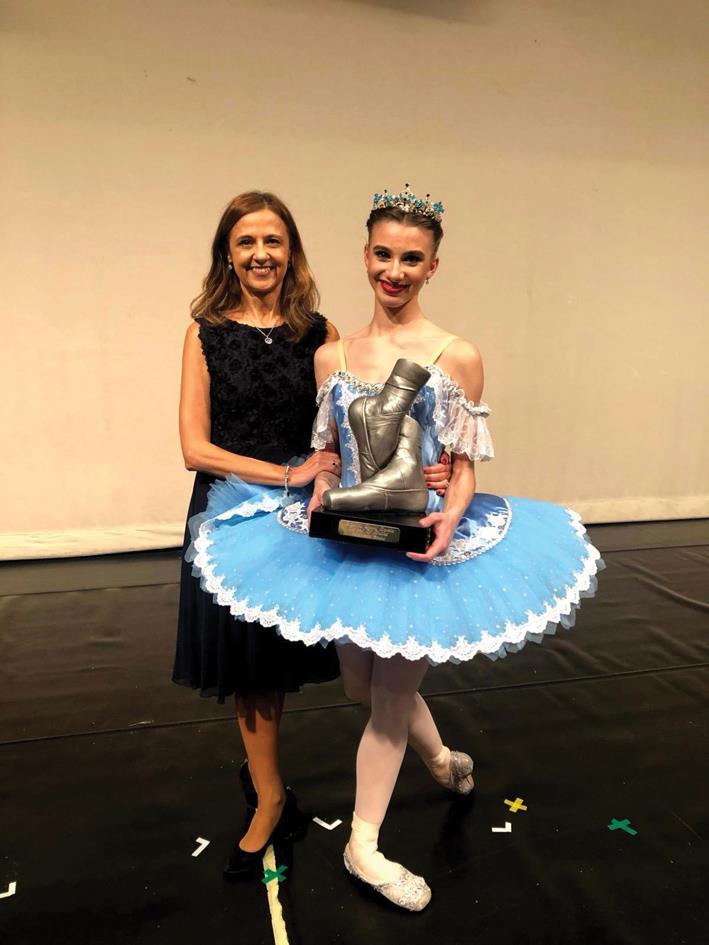
Throughout my career, I have believed that a teacher's greatest achievement is seeing their students succeed. Watching students from my school train and perform professionally in countries including the United Kingdom, Germany, Spain, Switzerland, Italy, Russia and the United States has been an incredible source of pride, fulfilling dreams I never imagined possible.
My goal has always been to bring the highest level of professional ballet training to Malta. Over the years, I have been fortunate to organise courses and ballet stages with renowned international artists from companies such as The Royal Ballet, Royal Swedish Ballet, Bolshoi Ballet, Vienna State Opera Ballet, The Hungarian National Ballet, La Scala, Los Angeles Ballet and Hong Kong Ballet. I have also staged several full‑length ballets, inviting professional guest dancers from these companies, to perform alongside my students. Giving young dancers the opportunity to work with and learn from artists of such calibre has always been at the heart of my school's ethos.
Andrea's journey is particularly special. I have watched her grow from a two-and-a-half- year-old student into an accomplished professional dancer who has trained and performed internationally; to now see her return to the Brigitte Gauci Borda School of Dance, bringing back the experience she has gained abroad, is incredibly rewarding.
Seeing a student who once walked through my studio door as a little girl now return as a professional dancer, choreographer and teacher is one of the greatest fulfilments of my career. Her journey reminds me why I chose this path and strengthens my commitment to guiding the students who will follow in her footsteps.