The Agius Catania family was an old Maltese business family, that since the 19th century, operated as agents, importers, exporters, contractors and suppliers to the local government.
The Royal Over-Seas League (ROSL) is a not-for-profit institution founded in 1910, dedicated to promoting international friendship pursuant to its royal charter, an ethos which binds its global membership.
Originally known as The Overseas Club, it was founded on 27 August 1910 by Sir John Evelyn Leslie Wrench. Wrench was an early pioneer of equal rights.
The ROSL was founded as The Overseas Club in 1910, at a time when the British Empire was the focus of unprecedented interest by politicians, churchmen, theorists and idealists of all kinds. The idea of Empire with its potential for the creation of an advanced multicultural society, benefiting its people both materially and spiritually, had become a dominant force in British life.
Promoting the imperial idea
By 1907, Britain was exploring ways how its Empire could grow and examining the future of the imperial idea. This interest had led to the formation of many societies fostering Empire connections, such as the Royal Colonial Institute, the Victoria League, the Navy League and the Boy Scouts.
In the Empire itself, the new countries were developing their independence and looking for ways in which they could assert their individuality without challenging their ties to the Mother country.
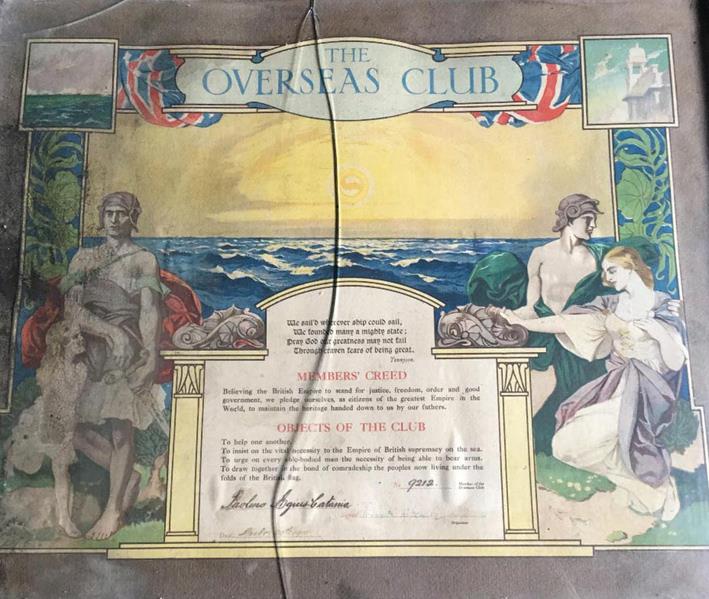
The club's creed and objects
The Members' Creed as stated on the certificate is, "believing the British Empire to stand for justice, freedom, order and good government, we pledge ourselves, as citizens of the greatest Empire in the World, to maintain the heritage handed down to us by our fathers".
The objects of the club as stated on the certificate are:
- To help one another;
- To insist on the vital necessity to the Empire of the British supremacy on the sea;
- To urge every able-bodied man the necessity of being able to bear arms; and
- To draw togethger in the bond of comradeship the peoples now living under the folds of the British flag.
Entertainment at the Royal Overseas Club
The National Archives of Malta (NAM) hold a wealth of information on the British period. The information obtained reveals that on the occasion of the King's birthday (23 June 1936), the massed bands of the King's Own Scottish Borders were scheduled to perform a programme in Palace Square.
It was customary for the government to entertain military bands who played in the villages at the government's expense. It was suggested a request be made to the Governor to entertain the massed bands at the Overseas Club at the government expenses. It was calculated that about 130 bandsmen would take part and the expense would be £8 and £9.
The encouragement of combined programmes by Maltese and English bands was very much in line with the ideals of promoting the imperial idea.
Sugested expropriation of club premises
During 1931, the premises of the club was situated opposite the Palace on the south-west side of the Main Guard. The club's premises were owned by Scicluna Bank, which had received competing approaches from interested parties seeking to acquire the site in October 1931. This would have meant displacing the Overseas Club.
Also, the premises had been the subject of debate in Parliament with a view to the same being acquired by the government in order that the side be kept available in the event of constructing a new Parliament House thereon and over the back of the Main Guard and upon the Garrison Library.
The debate on whether to construct a new House of Parliament centred on the fact that the holding of meetings of both Houses of Parliament with only one room available for both was not reconcilable with the smooth functioning of parliamentary government.
In 1929, rough tentative sketches of the plan of the ground and first floor and elevations of the projected parliament building had been drawn up. There was also consideration of the possibility to invite a competition for the design and also the possibility of expropriating the shops underlying the Casino Maltese. All this would have entailed the government an excessive expense apart from difficulties of a technical nature.
A rough estimate of the cost of the scheme was £65,000, of which £30,000 was for the expropriation of the buildings between the Main Guard and Sda. Teatro (now Old Theatre Street). It was estimated that the shops would have yielded about £300 in rent.
The following were the rooms to form part of the first floor plan of the proposed Houses of Parliament:
- President of Senate
- Clerk of Senate
- Clerks
- Steongraph
- Registry
- Senate Hall
- Reference Library
- 2 Rooms for Members of Senate
- 2 Rooms for Members of Legislative Assembly
- Members Buffet
- Hall of Legisative Assembley
- Gallery
- Central Hall
- Balcony
- Corridor
The above discussions and proposals regarding alternative site for the Houses of Paliament had been put forward during 1929 by Prime Minister Gerald Strickland, but no new parliament building was ever constructed. Parliament continued to operate at the Grandmaster's Palace in Valletta, which had served as the meeting place since 1921. Political instability and constitutional suspensions led to the dissolution of the Senate entirely in 1933.
In 1976, relocation of Malta's Parliament involved moving the House of Representatives from the Tapestry Chamber of the Grandmaster's Palace to the former Palace Armoury within the same palace.
A permanent dedicated parliament house was not realized until 2015, when Malta's first purpose-built Parliament House was ultimately built near City Gate, designed by world-renowned architect Renzo Piano. It was inaugurated on 4 May 2015, marking the first time the legislature met in a dedicated building rather than the Grandmaster's Palace.
Later use of the Overseas Club
The club was the subject of a letter written to a local newspaper in 2006. The author had read that on 16 October 1956 a reception was held at the Royal Overseas Club, Valletta and enquired about the club's premises which were situated on the corner of Sta Lucia Street and overlooking Republic Street in Valletta. The author wrote that access to these premises seemed to be through a bar and coffee shop in Sta Lucia Street.
It was pointed out in the said letter that the main hall and reception room contained four life-size portraits by Willie Apap, considered as national heritage and their subjects part of our history. The portraits were of Sir Gerald Creasy, Governor of Malta; the Earl Mountbatten of Burma, Commander-in-chief of the Mediterranean Fleet; Mgr Sir Michael Gonzi, Archbishop of Malta, and the author's father, Mr Justice Anthony J. Montanaro Gauci, who was president of the Overseas League, St George's Club for many years. There also was a fifth portrait of Joseph E. Mamo, vice-president.
During the 1970s and 1980s, the Overseas Discotheque, often simply known as Overseas, was an iconic nightclub and a legendary cornerstone of Malta's nightlife. The club, which used to occupy the upper floor is no longer operational.
As per conclusion, it is noted that the Royal Over‑Seas League (ROSL) which are situated at Over‑Seas House, Park Place, London do hold historical archives relating to the Royal Over-Seas League and its predecessor organisations. However, these records have not all been digitised and are therefore not searchable. They also do not have specific searchable documentation relating to the Malta branch, so it was not possible to do detailed historical research, particularly for enquiries dating back to 1910.
The ROSL branch in Valletta was operational until around the 1960s and although it is no longer active, it enjoyed a long association with Malta and has welcomed many Maltese members throughout its history.
References:
Internet
National Archives of Malta (NAM)
- NAM CSG 01, H of M, 450/31 - British Overseas Club Premises on the Palace Square, Suggests expropriation by government
- NAM CSG 01, H of M 349/31 - Premises of Club opposite the Palace on the s/w of the Main Guard
- NAM CSG 01 118A/33, 25/5/33 - Speech delivered by H.E. Governor at the dinner of the Overseas Club on 25 May 1933
- NAM CSG 01, 1797/1936 - Authority to entertain the Massed Bands of the K.O.S.B at the Overseas Club on 23 June. Also Massed Bands of the S.W.B and La Vallette Bands on 15/7/36