My next collaboration is with ceramist Joseph Agius, and this one takes us to a new venue - well, a new venue for the general public, but not for Joseph himself. The exhibition, titled Disillusioned, will be held at his private art gallery, ALA Gallery, situated in Santa Venera.
Joseph Agius hardly needs an introduction, but for those who may not be familiar with his work, here goes.
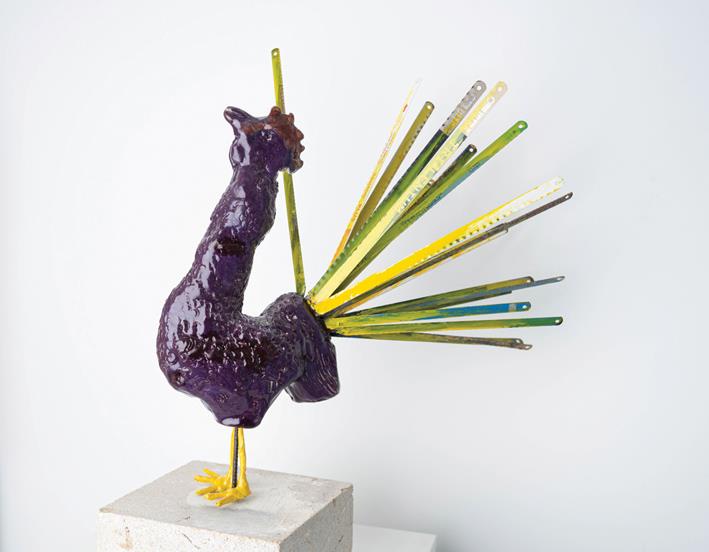
A senior staff nurse at Fairyland Ward for the past 30 years, Joseph began his journey into ceramic sculpture as a hobbyist and has since established himself as one of Malta's foremost ceramists.
His profession as a nurse exposes him to a world in which pain, disease, despair and death are ever-present realities. World news also serves as a source of inspiration, which perhaps explains his preference for a socially engaged, neo-realist aesthetic. Those familiar with Agius's work may recognise where some of his darker subject matter originates. Yet those who know him personally are also aware that there is a fun-loving side to him, offering an interesting contrast to the often sombre themes explored in his art.
Joseph frequently draws on linguistic metaphors and figures of speech as springboards for his creations. The titles of his works often originate from familiar expressions, which he then transforms into visual narratives in clay. We will encounter several examples of this throughout the discussion that follows.
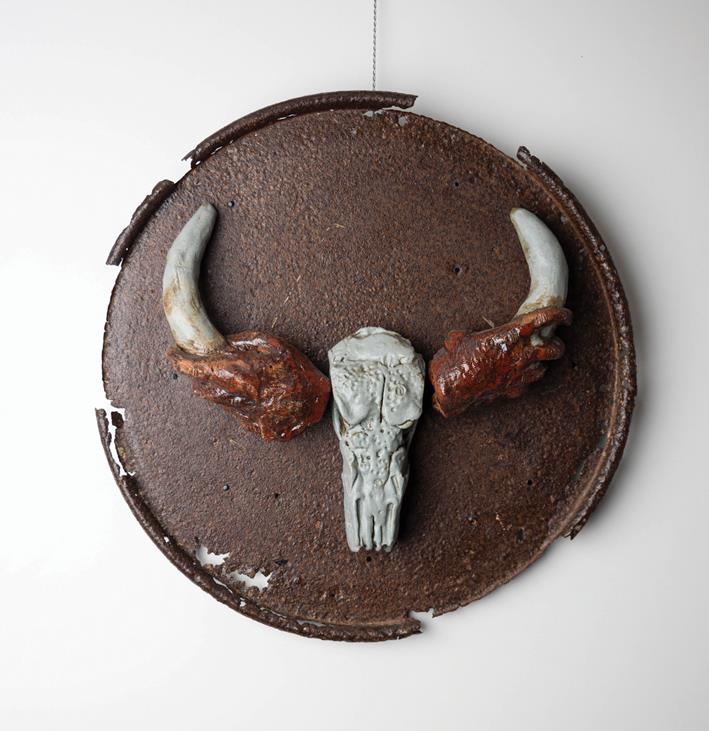
The rather spacious exhibition venue will be hosting almost 70 works by Agius! All are executed in ceramics, although some incorporate mixed media. Joe occasionally introduces other materials into his ceramic works, sometimes as props, sometimes through recycling, and at other times simply because the artwork calls for it.
Disillusioned offers a provocative reflection on the cruelty, contradictions and injustices that define the world we live in. Through his work, Agius confronts the darker aspects of human nature, drawing attention to the suffering, indifference and moral decay that persist across societies. From migration and poverty to violence, genocide and injustice, the issues explored expose a world in which compassion is too often overshadowed by cruelty and human dignity disregarded.
The title Disillusioned captures a growing sense of disappointment and loss of faith in humanity, reflecting the frustration of witnessing the repeated failures of a world that should know better. Neither offering easy answers nor turning away from uncomfortable truths, Agius invites viewers to reflect on the contradictions of human existence and the troubling distance between the values we profess and the actions we tolerate.
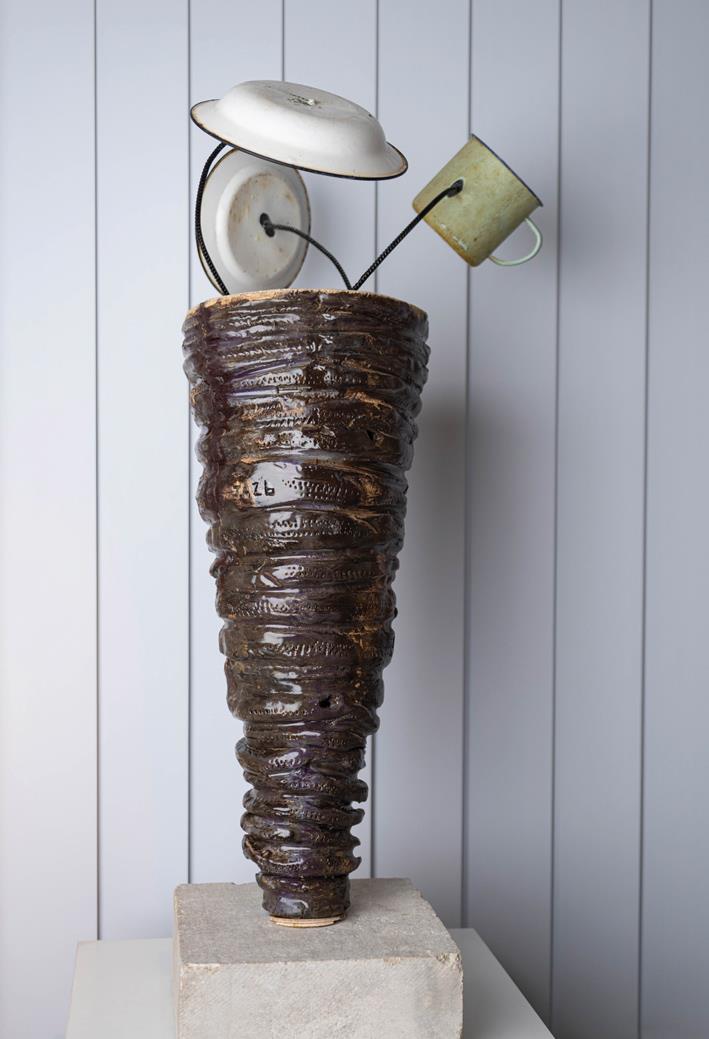
Although many of Agius's works draw inspiration from some of life's saddest episodes, highlighting the darker aspects of our existence, there is often an unexpected twist in the way he approaches them. Agius has a particular knack for turning grim realities into tongue-in-cheek scenarios, frequently using irony and sarcasm to deliver his message. His choice of titles plays a crucial role in this process; far from being mere labels, they are an integral part of each artwork, guiding our interpretation while adding another layer of meaning.
Through this distinctive approach, Agius confronts the realities we often prefer to ignore, questioning the attitudes, social norms and behaviours that allow suffering and injustice to persist. The result is a body of work that manages to be both unsettling and darkly humorous, inviting us to reflect on uncomfortable truths while occasionally catching us off guard with a wry twist.
The issues explored in Disillusioned are increasingly becoming a sort of norm. But is this really a new norm? Perhaps things have always been this way throughout the centuries. Or perhaps, nowadays, we have become so absorbed in our digital bubbles that we allow our small screens to dictate what we see, read and believe, feeding us a constant stream of both real and fake news. We spend hours scrolling through AI-generated content, often without taking the time to understand or absorb what is actually happening around us.
Perhaps it is not necessarily that the world has become darker, but that we are now exposed to its darkest corners more frequently than ever before. In this day and age, news travels fast, and we are bombarded with an endless stream of information. Yet, amid the reports of suffering and injustice, there is also an abundance of irrelevant gossip and an endless supply of pointless reels from self-proclaimed influencers. We consume it all, often without distinction, until the truly important and the utterly trivial become part of the same relentless feed.
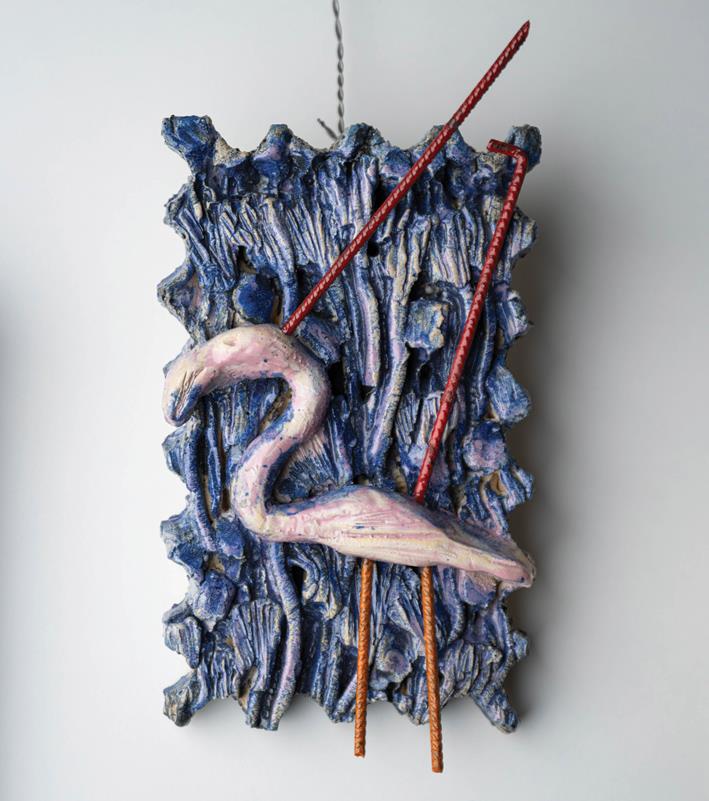
But enough of that. Time to look at some of the works.
One of my favourites, Stamp Series #1, presents us with an oversized ceramic postage stamp. Traditionally, stamps celebrate national symbols, significant figures, landmarks and memorable events, carefully selected fragments of a country's identity deemed worthy of recognition. Agius, however, offers a far more disturbing image: a murdered pelican, its flesh pierced by iron rods. Rather than commemorating something to be celebrated, the work becomes a stark indictment of illegal hunting and the cruelty inflicted on wildlife. It is an image that demands attention, turning an otherwise familiar object into a powerful statement about humanity's disregard for the natural world.
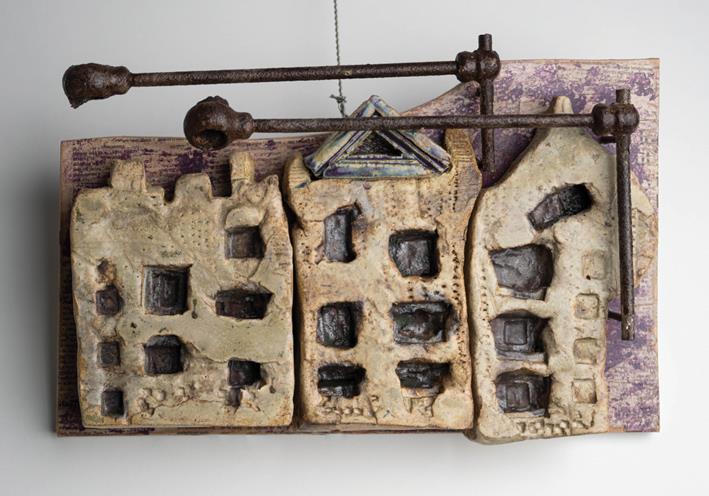
City Skyline surely needs little explanation. It touches on one of Malta's most common daily complaints: the ever-changing skyline, where spotting how many cranes one can count from any given location has almost become a national pastime. Beneath the humour, however, lies a sad portrayal of the situation we find ourselves in, serving as a visual protest against relentless overdevelopment and the transformation of our surroundings into an increasingly dense concrete jungle.
Pitted Brains presents a cluster of zombie-like human figures, each with a deep hole literally carved into its skull. As Agius often does, he takes a familiar expression and gives it a literal interpretation. The pun is intentional, leaving us to wonder whether these hollow-headed figures represent a lack of thought, reason or awareness or perhaps a reflection on the state of society itself.
Another example of Agius's literal approach is Spilled Beans, which depicts a number of ceramic beans scattered across a container. The work refers to the familiar expression "to spill the beans", meaning to reveal a secret or disclose information that was meant to remain hidden.
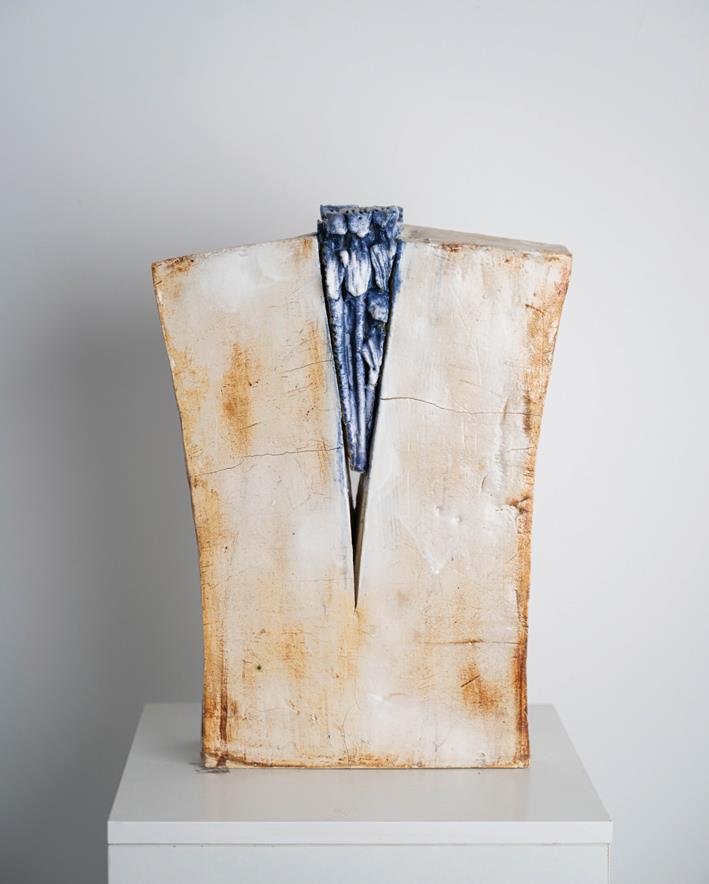
The Power of Combined Effort, I feel, carries a dual meaning. We see figures, executed in Agius's signature style of portraying the human body, piled on top of one another and squeezed into a V-shaped space between what appear to be the pillars of society. Look closely, and tiny, deliberate cracks become visible in these imposing structures. Perhaps they suggest that the institutions and systems that govern our lives, despite their apparent strength and authority, are far from perfect and have flaws of their own.
Yet the title offers another interpretation. When people come together, their collective strength can challenge established structures and break down barriers. Those seemingly insignificant cracks may therefore symbolise the first signs of resistance - small fractures in the foundations of oppression, reminding us that unity can be a powerful force for change.
People of the World Unite is one of the few works in this exhibition that offers a ray of hope and light, both within Disillusioned and in the reality we inhabit every day. It presents a vision of a world in which people come together, racism is overcome, wars cease, sexism ends and greed gives way to solidarity. Perhaps, in this imagined moment of unity, humanity might finally recognise that we share a common responsibility: to protect one another and the world we call home.
Through these works, Joseph Agius brings attention to the injustices and contradictions that surround us we might otherwise prefer to ignore. And perhaps this is where Disillusioned becomes more than a collection of ceramic sculptures. It becomes a reflection of our collective frustration, our gradual desensitisation to cruelty, and our tendency to accept the unacceptable simply because we have grown accustomed to it.
But if disillusionment begins when reality fails to meet our expectations, what happens when we stop expecting anything better? When injustice becomes routine, indifference becomes convenient, and cruelty no longer shocks us, have we not already surrendered something far more important than our faith in humanity?
Perhaps the real danger is not that the world has become cruel, but that we are slowly learning to live with its cruelty. And perhaps the question Agius leaves us with is not whether there is still goodness in the world, but whether we are willing to recognise it, defend it and act upon it. After all, if disillusionment has become the norm, challenging that norm may be the first step towards changing it. Some glaringly obvious, others so deeply embedded in our everyday lives that we barely notice them anymore. With his characteristic irony, sarcasm and dark humour, he forces us to confront realities
For more information about Joseph Agius and his work, follow him on social media.