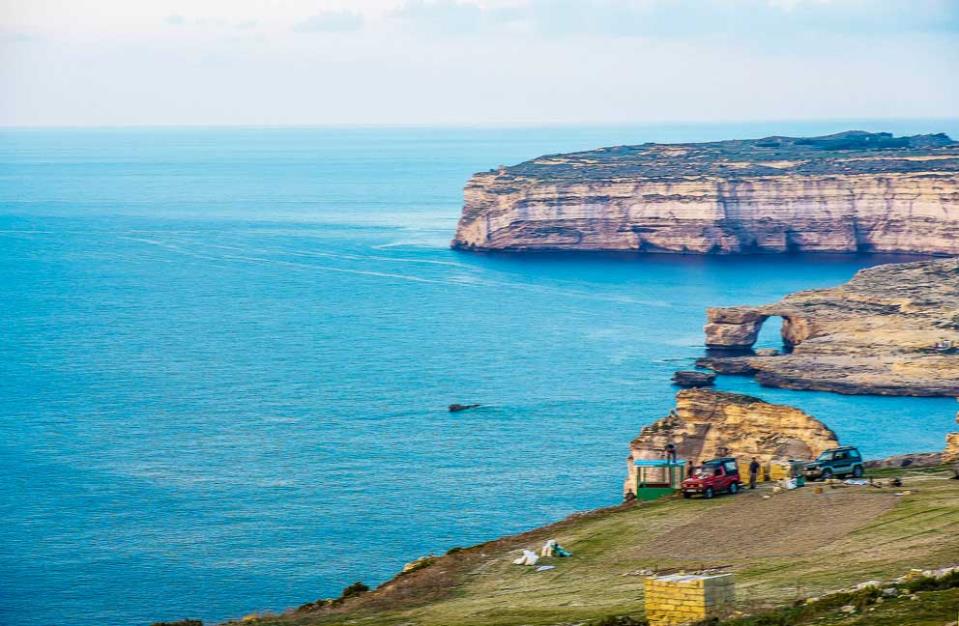
The European Commission, by way of its Environment Commissioner Karmenu Vella, has said it is “aware” of the situation at Gozo’s Ras il-Wardija, a protected Natura 2000 site, where hunters and trappers have levelled land and destroyed protected vegetation to make way for their pursuits.
Following a European parliamentary question raised by Maltese MEP Therese Comodini Cachia, following reports in this newspaper, Dr Vella last week said that “the Commission is aware of the circumstances raised by the Honourable Member and the potentially damaging impacts of trapping activities on Natura 2000 sites, designated under the EU Habitats Directive in Malta”.
He added that, “In this regard, it should be noted that the relevant national legal framework generally prohibits the trapping of birds within protected areas, including in certain Natura 2000 sites. Therefore, national authorities have the primary role to play in addressing these alleged breaches.”

Dr Comodini Cachia has urged the European Commission to look into the abuse of a Natura 2000 site in Gozo after reports in this newspaper exposed a number of illegalities taking place at Ras il-Wardija in Gozo.
In October and November of last year, The Malta Independent on Sunday published a number of photographs showing how trappers had taken over large portions of the west of Gozo.
The story dealt with the area called Ras il-Wardija, where a Punic/Roman temple is located. One of the photos showed great areas of land that had been burnt. Dozens of trappers were seen in the area operating in earnest - some had also sprayed herbicides on the ground to destroy wild plants in order to prevent their nets from becoming entangled when they lift them to catch wild birds. Two trappers were seen placing imitation birds near ponds to lure live birds down into the traps. Illegal bird lures — electronic recordings of bird song that trick birds into thinking that other birds are nesting in the trapping areas — were frequently heard.
The most disturbing development, however, was a group of half a dozen trappers and hunters levelling the ground of an EU-protected Natura 2000 site, laying nets and building a hide. They were using off-road vehicles to access this ecologically sensitive area.
Even if European laws were to be ignored, the land is still considered an extremely important area by various Maltese authorities, who describe it as one of great cultural, environmental and aesthetic value.
In her European parliamentary question, Dr Comodini Cachia asked the European Commission whether it was aware of the situation at the EU-protected site and, if so, whether it has sought an explanation of the situation from the competent Maltese authorities.
She also asked whether, if unaware of the situation, the Commission will consider taking remedial action to address this abusive practice.
Article 6 of the Habitats Directive – which has been transposed into Maltese legislation through the Environment Protection Act and the Development Planning Act – defines how Natura 2000 sites are managed and protected, requiring member states to take appropriate conservation measures to maintain and restore the habitats and species to a favourable conservation status, and to avoid damaging activities that could significantly disturb these species or deteriorate the habitats, Dr Comodini Cachia pointed out in her EPQ.
Dr Vella also highlighted how the Commission is currently pursuing an infringement procedure against Malta over its application of a derogation allowing finch trapping.
The European Commission is currently finalising its analysis of Malta’s derogation to allow the trapping of finches this year and it has threatened to take legal action over the matter if necessary, former Environment Commissioner Janez Potočnik said last October.
In reply to another European parliamentary question on the contentious issue tabled by British MEP Paul Brannen, Mr Potočnik said, “The Commission has recently been informed that the Maltese Government has decided to authorise a derogation allowing the trapping of finches in 2014.
“The Commission has already raised its concerns with the Maltese authorities as to whether this authorisation is in conformity with relevant EU legislation.
“The Commission is now finalising its analysis. If it establishes a breach of the legislation, the Commission will promptly take appropriate measures, including legal action if necessary, to ensure compliance with the relevant EC laws.”
The trapping of finches and other strictly protected bird species is prohibited under the EU Birds Directive and Malta had been given a transitional arrangement in the Accession Treaty to phase out this activity. The arrangement expired in 2008.
Commissioner Potočnik, in his reply, pointed out that member states may derogate from the requirement of strict protection if the conditions set out in Article 9 of the Birds Directive are met.
He added, “A derogation is an exception to the application of the legislation and its use must be strictly limited and fully justified in accordance with the directive.”