“We approached the boat and turned bow to bow,” former AFM chief Martin Xuereb said, explaining that he was on one of the Rigid-Hulled Inflatable Boats (RHIB) that raced from the MOAS boat (Phoenix) to the site where migrants were in distress. “My job was to hold onto the tyres of the migrant vessel, trying to keep our RHIB close to the boat, while another rescuer was handling the RHIB , one helped migrants off the boat and another organised seating”.
While doing his job, using his strength to keep the RHIB close to the boat, he heard a Syrian woman yelling “Baby! Baby! Baby!”.
Brigadier Xuereb, who is now head of the Migrant Offshore Aid Station (MOAS), looked up to see this woman handing him a 4-5 month-old baby with a soiled nappy. “I took her and handed her to one of the migrants seated behind me and turned back to the tyre. All of a sudden it clicked – I wasn’t sure if the baby was breathing. I looked back and she had her eyes closed, slumped over. I tried to determine whether the baby had a pulse, however the baby was small and chubby, which made it difficult to determine where the carotid artery was. At that point my background in first aid kicked in and I tried to find the femoral pulse”.
“When I placed my hand on the area and pressed, the baby screamed. She was asleep the whole time, and just as quickly as she awoke, she went back to sleep. It’s stories like this that make you realise just how surreal the situation is”.
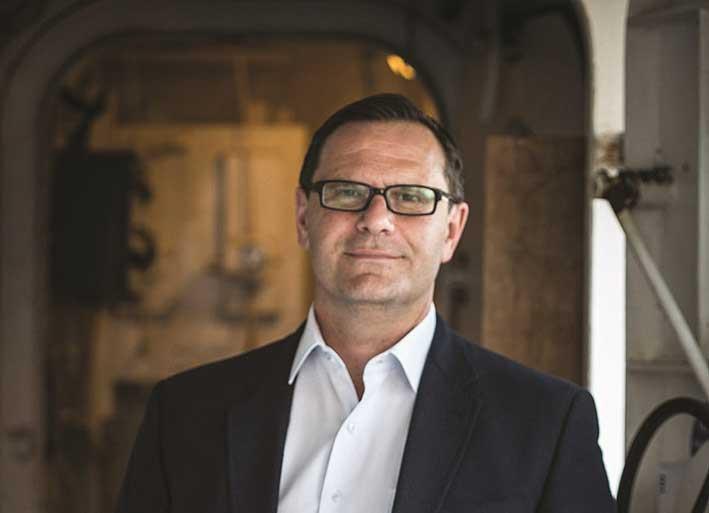
(Photo top: Brigadier Martin Xuereb sitting at the bow of a dinghy during a rescue operation involving MOAS; Photo above: Brig Martin Xuereb, now head of MOAS. Photos Jason Florio and MSF)
The Brigadier recently spent around 14 days aboard the Phoenix, patrolling the Mediterranean alongside other rescue ships, trying to do his part to curb the ongoing tragedy around our island’s borders.
He described the rescue involving this particular incident as one of the harder ones MOAS had seen to date, adding that it occurred the same week a tragedy that saw over 200 people drown on August 5, when a migrant vessel sank. The Phoenix was around five hours out when the August 5 tragedy occurred, and had gone on scene to provide assistance using its drone, searching for any survivors, or more likely, to recover any floating bodies.
The MOAS team had received notification that a migrant vessel had overturned from the Rome Maritime Rescue Co-ordination Centre (RMCC). An Italian warship was directed to assist the Irish Naval vessel that was already on site. When we arrived, the boat had sunk and some 300 had been rescued.
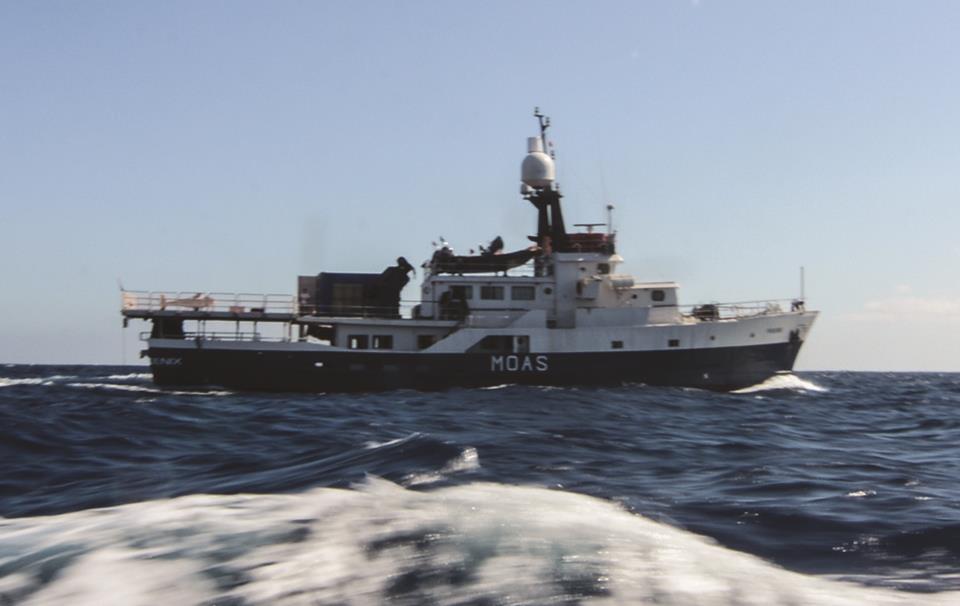
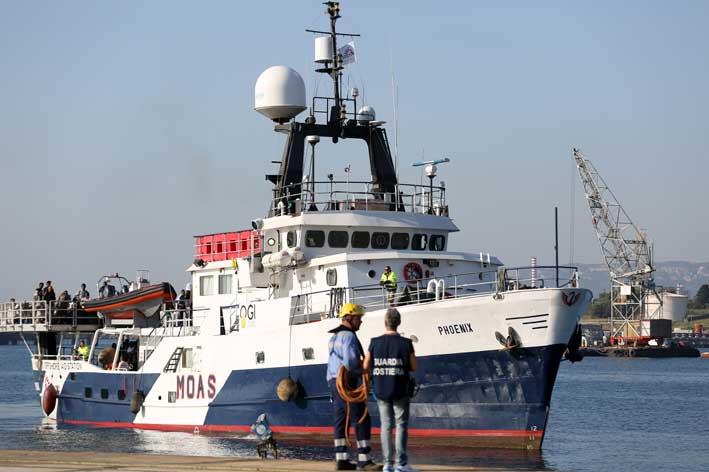
The Phoenix carried MOAS crew as well as personnel from Médecins Sans Frontières (MSF).
Médecins Sans Frontières (MSF), an international, independent, medical humanitarian organisation that delivers emergency aid to people affected by armed conflict, epidemics, natural disasters and exclusion from healthcare, offers assistance to people based on need, irrespective of race, religion, gender or political affiliation.
The details of the rescue
MOAS played a major role in a rescue which occurred around 36 hours after the August 5 tragedy. “The Phoenix received notification from the RMCC of a boat in distress. It was early in the morning and we were quite close, along with the Argos (another rescue ship). The Minbelli, an Italian warship, was further to the west. The Argos was first on scene and they immediately informed the RMCC of the situation, stating that there was a lot of confusion, with people screaming. It wasn’t a low-lying boat with migrants inside, it was different. All of them were on deck and on the superstructure of the boat, so the centre of gravity was quite high-up. The boat was swaying from one side to another. Although we were still around 10 nautical miles away, we launched our RHIB, with two 60 ft long inflatable devices with ropes along their sides where migrants can hang on. They were dispatched towards the boat as our RHIBs are faster than the Phoenix”. This would be the rescue that saw the Brigadier take the 4-5 month-old baby.
When our first RHIB arrived, the Italian warship (theMinbelli) also arrived on scene - however issued instructions to wait for the Phoenix to direct the rescue. In the mean time we launched our second RHIB and 2nd set of inflatable devices. The phoenix later arrived on scene, and was stationed within 100m from the vessel along with the Argos. We wouldn’t get too close to the migrant vessel as it would create confusion and they would attempt to jump on. One of our RHIBS was coordinating the others and we were going in, rescuing the people and bringing them back to the rescue boats. Some people were jumping into the sea, and swam towards the inflatable devices. It was total chaos. There were many nationalities on board – Syrians, sub-Saharans, Africans from the Horn of Africa, Eritreans, Bangladeshis – You can imagine this cacophony of languages. We were attempting to speak to them in English, French, Italian and even Maltese in the hopes that the Arabic would come through. At one point we managed to gain some semblance of order, telling them to bring forward the women, children and the elderly”.
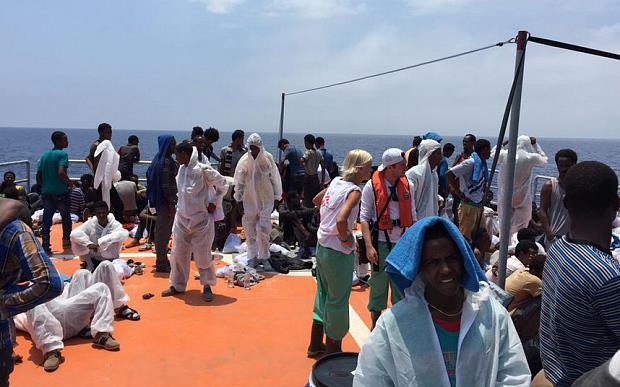
The rescuers kept calm, Xuereb explained. “The fact is that when they see assistance at hand, and if their rescuers are calm and not in a panic, it would help calm them down a bit”. He added that lifejackets were also handed out to those on the boat. “That way we know that if something happens, those in the water would at least have life jackets. It was a very intense situation for around an hour and a half, taking those rescued on the RHIB back to the Phoenix and then heading back to the fishing boat”.
Professionalism plays quite a large role in rescue operations. “I would like to think that at that time professionalism cuts in, and this is why we have people used to this scenario on the Phoenix. Training and experience allow you to hold back your concern and avoid panic. There were people holding onto the inflatable device, clearly safe, screaming their heads off. If someone isn’t trained, they would probably go straight for the person screaming the loudest, however we knew the person hanging on to a flotation device is safer and there is someone who would require aid more urgently”.
Throughout the rescue, the thought of the boat going under was constantly at the back of his mind. “That thought conditions you to take every precaution. For example when approaching the boat, you would do so from the bow and not from the side, as a 100 people might move from one side to the other resulting in the boat going under. You know that if the boat flips, many would die – and we were so close to this boat flipping. Till this very day I cannot believe it didn’t go under. We only managed to save them as we were quick and it stabilised once we began offloading people”. He explained that had the rescue teams arrived 30 minutes later, it would have most likely been a very different story.
Following a rescue, the MOAS team review footage of their rescue, to see what could have been done better and what mistakes were made. “We go through what we call a ‘lessons identified and lessons learned’ process. It is then that one realises what a challenge this rescue was”.
An eerie feeling looking at what could have been a floating coffin
On the boat, post-rescue, there’s an eerie feeling looking at what could have been a floating coffin, he said. “Then you see some objects floating in the water, knowing that they represent someone’s past – a child’s inflatable Disney character, Nike trainers, sandals – and then you walk around the boat, and a young girl would come up to you and say ‘I have a bag filled with school books, can I go and get it back?’”.
While Brigadier Xuereb was aboard the Phoenix, he took part in four rescues.
After a rescue, if the migrants are aboard the Phoenix for a few hours, Martin would sit and speak with some of those rescued. “There are those who have been living and working in Libya for years, who just want to go home. This was some of the Bangladeshis aims and the only way they felt they could leave Libya was through crossing the Mediterranean. After the big rescue, we had family units separated, some on the Phoenix, and some on the Argos. One woman who was with us wouldn’t stop crying. She had a child on the Argos and kept pointing to the other ship crying ‘Baby… baby… baby”. The two boats stayed close together and both disembarked the migrants onto a Norwegian rescue boat under Frontex operation later that evening. The families were separated for around 3 hours”.
While out at sea, MOAS’ priority is post-rescue care, and this is where their partnership with MSF comes to the fore. “The contribution they give towards the operation is truly important. We are not solely focused on search and rescue, but also post-rescue care. Once aboard, MSF give migrants a bag with water, high energy biscuits, socks etc, helping them settle down”. The first three hours are spent calming the migrants down, feeding them, offering medical attention and this is where MSF takes the lead and MOAS acts as support”.
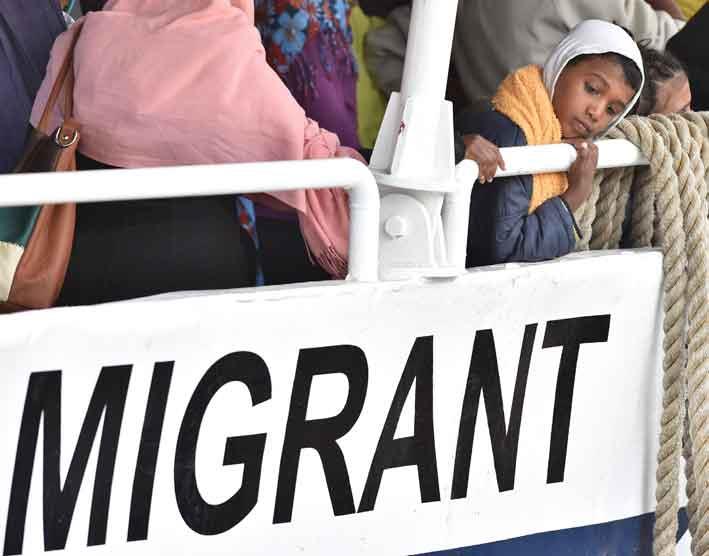
Brigadier Xuereb had the opportunity to converse with a migrant after one of the rescues prior to this one. The migrants were aboard the Phoenix for around 40 hours, and were going to disembark in Calabria. “During this time we tried to identify those who not only needed physical follow-up support, but also those who have suffered some form of abuse. Obviously it depends on how comfortable these people are and if they are willing to open up. If they do we would pass on referral notes at disembarkation. One story which stuck with me concerns a Nigerian gentleman, around 30 or 31 years-of age. He was a farmer travelling alone and came from an area where Boko Haram posed a threat, in the North East of the country. He moved his wife and four children to another district however could not provide for them. He took a boat to Europe to try and earn enough to support his family. When I asked him if he had children, he just broke down and wouldn’t stop crying”.
‘I don’t think they reflect too much on the consequences, or worry too much about the sea crossing’
People crossing the Mediterranean feel compelled to do so, he believes.” I don’t think they reflect too much on the consequences, or worry too much about the sea crossing. Everyone I have spoken to who has crossed the Sahara, say that if you survive that journey, then the notion of dying at sea doesn’t exist. The worry of drowning at sea is less of a concern for them as they say – ‘I survived the Sahara and if I drown, it would only take me around 2-3 minutes to die, however for me to die in the desert - it would take 15 days”.
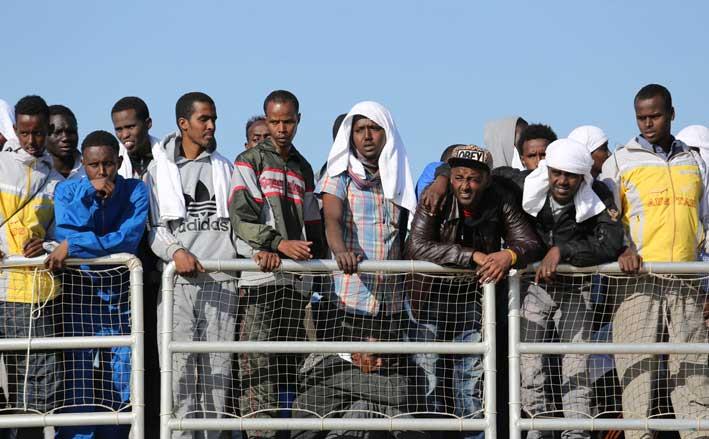
“For many people, once they reach Libya they feel the journey is complete and at that point nothing will stop them from attempting the crossing”.
He explained that the “push factors” are far too great and that solutions need to be found in Etitrea, Somalia, Syria… “We believe that if someone is happy at home, then they wouldn’t risk the crossing. Our concept of “happy at home” is different than someone who attempts the crossing. For us it would be about air conditioners, TV’s, manicured nails. but for an Eritrean - it would be different. As long as there is food on the table and a concept of work and children receiving an education, that represents happiness and safety”.
Some people in those countries have satellites and the internet – “and thus they see the same movies and adverts we do. We are enticed to buy brands in Europe, like Coca-Cola, cars - so that also plays a part in it”.
MOAS is a privately-funded mission to assist migrants at sea and was founded by Christopher and Regina Catrambone. Its primary aim is to reduce loss of life during dangerous migrant crossings from North Africa to Europe. The project was inspired by several recent catastrophes in the Mediterranean, which migrants regularly attempt to cross in unseaworthy vessels.