Emma Borg
The APS Mdina Cathedral Contemporary Art Biennale opens this November and will undoubtedly incite a riveting and intriguing dialogue on contemporary art, especially when considering the work of the local and foreign artists who will be participating. The Mdina Biennale is a bridge for local artists and art lovers to see what their contemporaries focus on and are inspired by across the Sea. It is an opportunity for us to observe the similarities and differences that we share with one another by means of this year's theme; 'The Mediterranean: A Sea of Conflicting Spiritualties'.
One of the Mdina Biennale's strengths is indeed that it draws inspiration from the past, as well as showcasing new art it in its own right. This is exercised in multiple forms; from exhibiting works by Maltese modern artists such as Esprit Barthet and Frank Portelli, to exhibiting site-specific installations that relate to the Mdina Cathedral Museum's permanent collection and the city's history. For the 2017 edition, it was decided to create a prelude to the Mdina Biennale itself by hosting an exhibition focusing on the nude figure drawings by Maltese artist and decorator Giuseppe Galea.
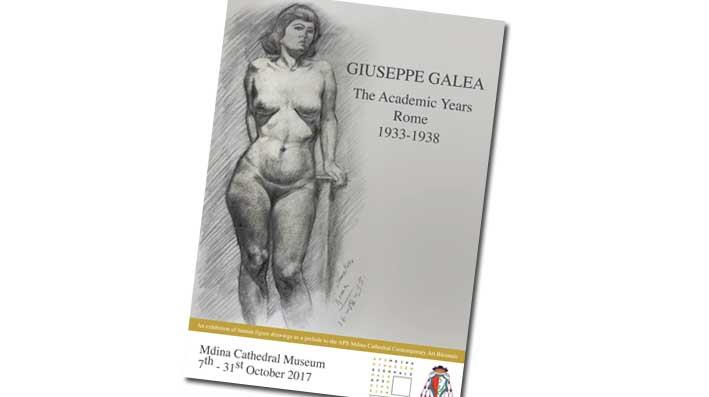
Giuseppe Galea is remembered as decorator of many churches. He was a master of sculpture and stucco work but his repertoire transcended these two mediums. He left Malta for Rome to study at the Accademia di Belle Arti in 1933 and there is where his art came to resemble a more classical style. During Galea's years studying in Rome we know that he became deeply interested in Ancient Roman statuary and this fascination with classical ideals of form became very evident in his works. Galea frequently visited sites in Rome where he could see original Roman statues, a tradition many artists throughout time have engaged in. Yet he did not solely draw inspiration from the Ancient Roman works he encountered. Another source of inspiration for the artist which is rarely mentioned was the art of Gianbattista Tiepolo. Tiepolo is famous for his delicate and at times almost poetic-like frescoes whilst also continuing traditional baroque style ceiling decorations. When one sees his life drawings one can clearly see from whence Galea drew his inspiration.
We know this interest truly developed during the time he attended evening classes at the British Academy of Arts in Rome. During his time there he had the privilege to study under the Maltese Master Antonio Sciortino, director of the British Academy and professor of life drawing classes. Galea was also greatly influenced by the Sciortino.
This introductory exhibition will feature a large series of life drawings produced between the years 1933 to 1938. The drawings are a rare insight into the artist's multifaceted career. As an artist largely known for his stucco works in churches, this is an opportunity to see a very different side to Galea's art. This will be the first time the drawings will be shown to the public, bridging the unseen images from the past with the contemporary newness of the Mdina Biennale.
The foundation of any artist's education, whether or not they continue along traditional lines or win the Turner prize for a performance piece, will, at some time or another, feature the learning of drawing skills. This exhibition reminds us of every artist's beginning, not just that of Galea. It is a reminder of not just a man's unique talent but also the talents of all those whose work predated his and those that follow him in a journey to find their own style and art through the practice of this tradition and others. The APS Mdina Cathedral Contemporary Art Biennale is a project that respects tradition and looks into the past to understand our present.