Ever since the Life Saving Buskett Project was launched in 2014, several students were given the opportunity to visit this beautiful woodland and grasp and retain new concepts in a fun and adventurous way. Besides the educational aspect of these visits, very much at heart was the aim at increasing public awareness and instilling in this young generation the importance of appreciating and safeguarding our environment.
Unfortunately, hardly any of the students were aware of this project - a project part-financed by the European Union Life+ programme being implemented by the Parks Directorate within the Ministry for the Environment, Sustainable Development and Climate Change. This lack of knowledge brought about the need for more public awareness as an integral part of the project aimed at increasing education and communicating the project objectives.
Throughout this project, education officer Neville Ebejer has been carrying out dissemination activities and regularly conducts organised and spontaneous tours around Buskett with the aim of making visitors aware of the importance of conserving our extant woodlands. Initially, these activities were planned to be restricted to the Buskett area, however these were then extended to schools, homes for the elderly and persons with disability, and public events held in Ta' Qali National Park, Pembroke area and Xrobb il-Għaġin Park to mention just a few. Although actions related to the awareness activities have been finalised and statistics show that 14,013 members of the public have been reached to date, exceeding the original target of 13,600, additional activities will continue being held to continue creating public awareness.
Having mentioned the elderly and the disabled, one cannot but share the amazing experience these people had while visiting Buskett. The elderly people were taken back in time and re-lived childhood memories of them helping out and running around in the fields, playing in the outdoors and being close to nature. Just the smell of the grass and soil while walking through this woodland were enough to make them smile and experience a sense of freedom. Surprisingly enough, the elderly were by far the most appreciative and knowledgeable about the hard work required to maintain these woodlands especially since most of them, when young, had worked in the fields and knew about the hardships encountered when building and repairing rubble walls, watering regularly and much more.
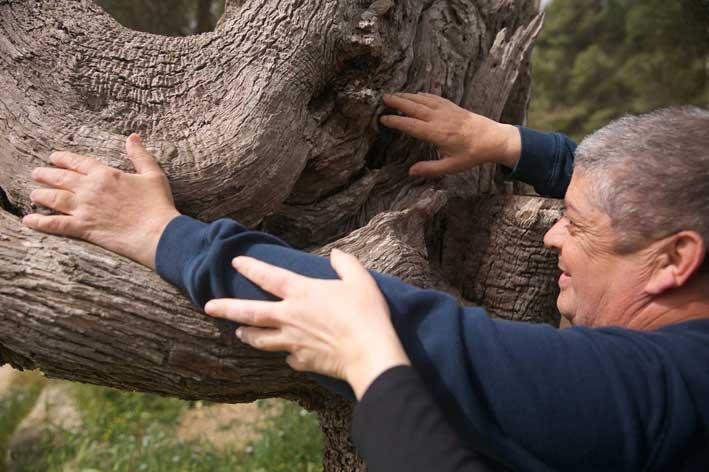
A very beautiful experience was the one shared by a group of visually impaired people who visited Buskett. Given these people were very limited in what they can see, the visit was mostly oriented towards a tactile and olfactory experience. They were first given a description of a particular tree and then allowed to feel the size, texture and shape of its trunk, branches and leaves. Through this, they could arrive to roughly envisage the age of the tree, how large it was and its overall spread and shape. Another exercise was that of smelling the different aromatic leaves of various trees and plants, like bay laurel and fennel. By doing this they could then talk about the different wild plants found in Buskett.
Walking through the area they experienced the different light intensities of the different locations depending on the density of trees in the area as well as the foliage of the trees. They could also hear the sound of the wind blowing through the trees and the singing of the birds. For those who were well-versed about song birds, this served as an exercise to try and identify the different birds present. What a remarkable and touching experience!
All this shows us how much perhaps there is yet to discover about the power and potential that nature has on all of us young, old or with an impairment and brings about the urgency to treasure and conserve places like Buskett, which to some extent can be even therapeutic to those who visit!