Sometime in the 19th century, when we were under British rule, a Maltese man named Nicholas, who was confidential assistant (more specifically known as an aide-de-camp) to the Governor, was struck by a fleeting moment of angst, provoked by a group of Maltese people. In his frustration, he theatrically waved and shook his umbrella at them. That brolly motion had more impact than he thought. Come carnival, and a large group of Maltese fought back at this moment by singing a song and marching around with shaking and wiggling umbrellas, in an act of criticism, of satire.
Sitting in front of hundreds of shelved, stacked books, varying in colour, thickness and subject matter, Professor Vicki Ann Cremona, who has spent years researching the dynamics of power between Carnival and politics, acknowledged this short snippet of performed satire as ‘a beautiful little story.’ It is just one of the many that she has succeeded in patching together over the years from several news articles which were penned about the carnivals many decades ago.
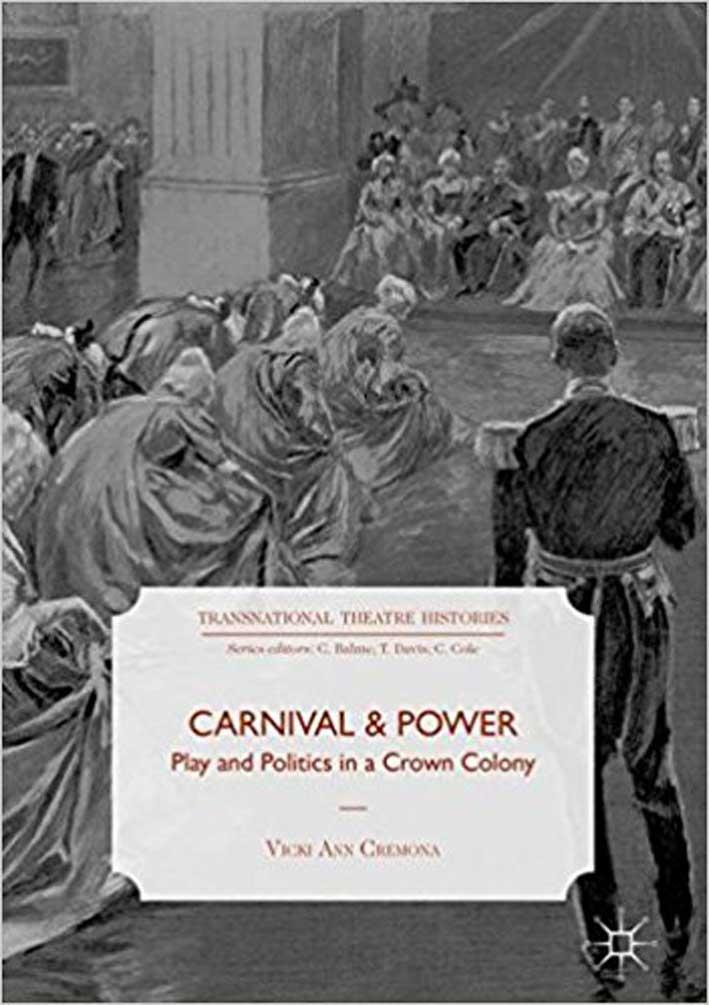
Her latest book ‘Carnival and Power - Play and Politics in a Crown Colony’, published merely a few weeks ago, gives insight into these power struggles that existed in Malta, between the colonisers and colonised, by observing Carnival as a power channel, a medium, of sorts, within which such frictions are articulated. The hardback book is the product of years of excessive research about such relationships and struggles, and how they manifested themselves throughout the British period; from when they arrived in the 19th century, until their departure.
The book is divided into themes; balls, street carnival, satires, amongst others, and goes on to cover the whole period of each one.
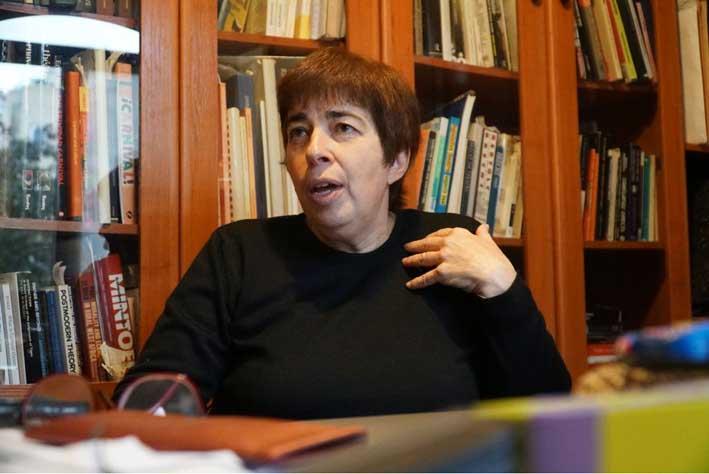
“It is about relations between Maltese and English people, but also Maltese and Maltese, and looking at these relations through the lens of carnival,” she explained. “It sounds absurd,” she laughed, “but if you research the topic, you find so much, it is very revealing of the power tensions that existed. People use and manipulate power even in leisure, and that is what I am trying to show.”
The book cover, a detailed drawing of a ball scene within the Grand Master’s Palace back in the 19th century, is an apt portrayal of the power struggle between the Governor and the public; a play of sorts. Cremona pointed her finger at the attire of the spectating public, consisting of both foreigners and Maltese, “the range of costumes worn is evident,” she stated. Power games were played at the ball, she explained, with “the British imposing things on the Maltese, and the Maltese resisting.”
Cremona’s has long been intrigued with Carnival, and the relationship between power and performance. “To get across, power has to perform,” she said.
The book also tries to establish parallels with other carnivals in colonised countries, for example with the carnival in Trinidad, which was occupied by the British two years before they colonised Malta, and gained its independence two years prior to Malta. “They had a carnival too,” she said. “Very different, but there are certain elements that link.”
Carnival, conflict and seizing satire
Since the late 19th century, the main Carnival conflicts between Maltese people were political conflicts. “Malta’s political parties were founded in the 1880s and were immediately two sides; pro and anti the English language,” she said. “Unfortunately, we have long had this dichotomy (in Maltese politics).”
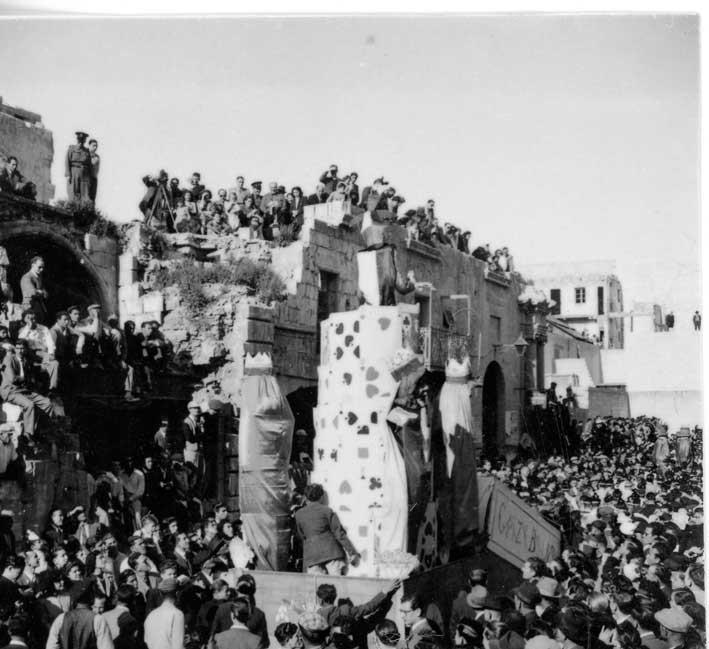
Back then, floats were somewhat simpler, yet their sting was sharp. People stood on trucks sporting big papier-mâché masks of politicians they wanted to criticise, as they acted out satirical scenes with placards; written in English, Italian or Maltese, depending on their political views. Some of these demonstrations were “very tough, very violent and highly critical.”
Cremona explained that although the colonised had far less liberty than we have today, some political attacks, especially from satirical newspapers were ‘astounding’. “We wouldn’t dare to talk to our politicians in that way today,” she said.
Questioning the alteration from then to now she said “nowadays it is a different ball game,” and the context in which the criticism takes place is different. She also expressed her belief that self-censorship has increased.
The author later mentioned another conflict within Maltese society under British rule; that of identity. “There was not only friction regarding language,” she said, “but also one with regards to determining an identity. The question was as to whether we will accept an identity imposed on us by the British Empire or one that defines us as Europeans.”
In 1935, what Cremona deemed a political “disaster” lingered over our country. “The constitution had been suspended, the British had reassumed power. It was a moment of great political repression.”
She explained that at that moment, the British could not afford being subjected to criticism, “not even in Carnival, because Carnival is a potent weapon of criticism.” And from that day, until 77 later, satire and carnival seized to co-exist. (Satire in carnival floats was only made legal again in 2012).
Boycotting carnival
Asked whether she believes that contemporary Carnivals contain the same displays of power struggle as in the past, Cremona stated her belief that “unfortunately, Carnival has been tainted with political interference.”
Noting it as one of the most interesting factors that she found during her research, and which has woven itself into two of the book’s eight chapters, Cremona was intrigued to discover the ways in which “the Carnival and Carnivalesque were used by the Labour Party in the 1950s.” She said that the Labour Party had “boycotted Carnival and used it as a tool to attract people to their side.”
“The fight between then Prime Minister Dom Mintoff and the British, and the fight between Mintoff and the church - it is an important part of the history,” she said. Though it was in that time too that people used the Carnival or Carnivalesque to “fight” each other.
“The Labour Party had organised its own Carnival parties, in Gzira and Mile End,” she continued. “Why were Carnival celebrations changed to May?” she asked, hinting that one should read the book in order to find the answer.
Her research also searched for answers to other questions. “Carnival in both Malta and Gozo used to be spontaneous,” she said, “how did it turn into something that is organised?”
“When Carnival started to be boycotted, many groups (who were big contributors to the celebration); like the Sliema Company and the banks, stopped participating because Carnival had taken on a political stance.”
Carnival today
Cremona, however, had nothing but praise and encouragement for the current Carnival. “Since it has moved back to Valletta, it has taken on a new interest,” she said; though the black and white pictures of masses of people amongst carnival floats showing up on her screen seemed gigantic in proportion to the crowds of today.
“The level of the costumes and the quality of our floats nowadays in astounding. They are works of art.”
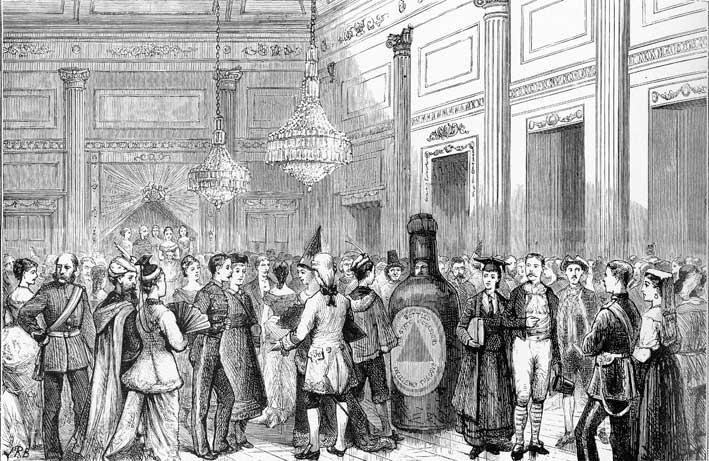
Looking at the rich visual material, another amusing sketch stands out; that of a man eccentrically dressed up as a beer bottle at a carnival ball in the 19th century, standing awkwardly underneath two (seemingly) very expensive and fragile chandeliers, and amidst a myriad of suave-looking people. Evidently, if there is one thing which has remained a constant in Maltese costumes, it is the bout of creativity and shamelessness.
The book Carnival and Power - Play and Politics in a Crown Colony is available on www.palgrave.com.