Growing up playing amid southern countryside has put in me a fascination of sorts for the rugged, haphazardly sectioned Maltese countryside. I thought of the fields as a 'beyond' - with their rubble walls, their elusive, seasonal ponds of tadpoles, their terrible wasp nests. Some - guarded by wall, dog or hunter - were impossible to get into, and remain undefined and tempting to this day.
In this countryside, however, there was one thing most enchanting and curious - the trees. I went out to the fields to climb trees, and spent a lot of time up on some leafy perch. Now that I'm in my early twenties (and very much still a child), I look back fondly on those moments, because they helped me establish an intimacy with nature.
Whenever I tell someone that I used to climb trees as a young boy, most tease me, drawing obvious comparisons to monkeys. I find this reaction utterly perplexing - to me the trees were like attractions in a playground. Predictably, I became more and more defensive of trees and nature in general.
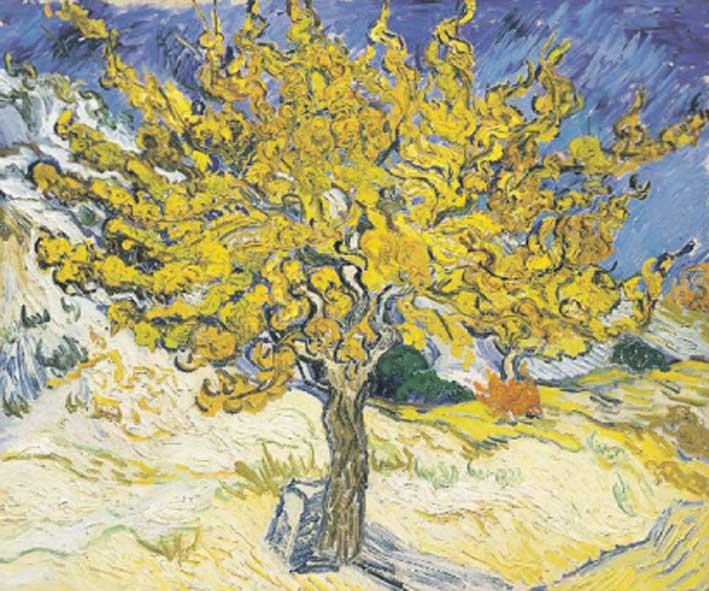
Vincent van Gogh, Mulberry Tree, 1889
Everyone knows the benefit of trees: they clean the air, especially our car-infested air; they protect the soil and the water; provide shade and cool air in our ever-hot summer months; and they provide shelter and habitat to our (albeit non-existent) fauna. Maybe not everyone knows that trees and greenery are beneficial to mental health - they reduce stress levels, increase rehabilitation success rates, and aids concentration. Studies show that businesses with more natural elements do better compared to those without.
An education that fostered my views on environmental issues was arts school and looking at lots of pictures of nature and trees. It's quite possible that the most heavily depicted subject throughout the history of art, apart from people (and locally Mdina), is trees.
An old, recurring depiction, for example, is that of the 'Tree of Life' and it is no poetic, fantastical creation - trees benefitted humans since we can remember. Egyptian, Greek, Norse and Indian mythologies have trees of knowledge and power and cosmic grandeur. Buddha was enlightened under an ancient fig tree. Modern fiction has great trees too - in Harry Potter and Tolkien's fantasy, even Game of Thrones.
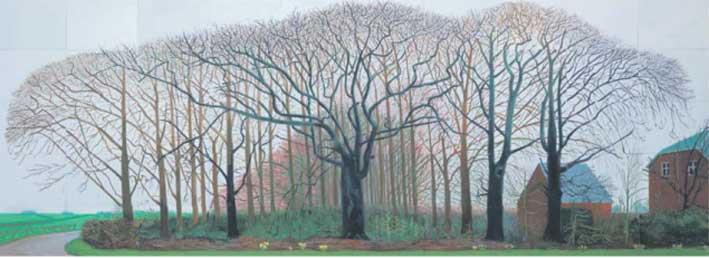
David Hockney, Bigger Trees Near Warter or/ou Peinture sur le Motif pour le Nouvel Age Post-Photographique, 2007
For the poetic and fantastical, but nonetheless true: trees have been towers for lookouts; a bed for lovers; gallows for hanging men; hideouts for the escaped; a respite for the chased. For me, confronting images as Klimt's Buchenwald I or Van Gogh's Mulberry Tree it is difficult to not feel some magic or allure. They exude a certain energy - Klimt loved painting the trees during his summer retreats in the forest, and Van Gogh wrote to his brother that this particular mulberry tree was his favourite in the asylum garden.
Before them the Romantics paid homage to the Tree, an almostsentient warden of nature beckoning the traveller forth to witness the immensity of nature. Later Manet would put the sexual freedom and voyeurism in the park, while Monet would paint colourful, waltzing trees, and Renoir make trees dance along Parisians in revelry.
Hockney's contemporary sycamore-and-beech painting series assert their looming majestic presence, dwarfing the buildings to the right. They speak grandeur, almost temple-esque, on par with Grecian deity statues, as if royalty on a theatrical stage (a remnant of Hockney's work in stage design). To me, this is reminiscent of the beautiful tree flanking Mdina gate, looking as old as time, or the trees that have become one with the ruined gates of the Cottonera lines, or the high looming rows of ficus trees found all over the island.
So when I'm confronted with the tearing down of trees in Malta, I wonder why trees are so indispensable to Maltese. Are decades old trees indispensable, or worth tearing down in the name of 'better' infrastructure? Are trees really the problem with our infrastructure? Do they even factor in? Has no one thought of aesthetic and contrast and shade and a little allure, or at least compromise? Does everyone have oh-so-many important things that no one stops and looks at a nature? How a tree catches the light or is framed by beautiful yellow bastions? Are we lazy and inconsistent? Or is it just weird me?
Especially horrifying is the nonchalance with which some shrug off the removal of trees, with an 'Uwijja, they grow back no?': the same disrespect we so called ultrapatriotic country gut down architectural heritage for brutal, 'modern' concrete apartments, as if secreted out of the foreheads of Minecraft addicted architects.
Does no one seriously find it sad that we are so subconsciously obsessed with our concrete blocks that even trees are cut into cubes? If we are so patriotic, so heritage and tradition loving, why do we not look to the most ancient of Maltese art and culture for inspiration - our own Tree of Life?