Let's make music
There is something special about a concert held in a private home. I suppose this is what the salons of old were like. I enjoyed such a concert in the home, in Ix-Xwieki, far from 'the madding crowd,' of Elizabeth and Ian Lochhead. This was a Lions Club Sliema Arts Committee fundraising event, Music A La Mode.
Two of the Lions Club Sliema scholarship students, soprano Gabrielle Sargent, clarinettist Beatrix Calleja and pianist and accompanist, Dr Véronique Vella, presented a varied programme. Beatrix played solos by Saint-Saëns and Poulenc and also two movements by Burgmüller with Dr Vella.
I admire anyone who is capable of opening their home to a considerable number of people and also providing them with a delicious finger buffet and enough drink not to deaden their senses. The Lockheads belong to this exclusive group of generous souls.
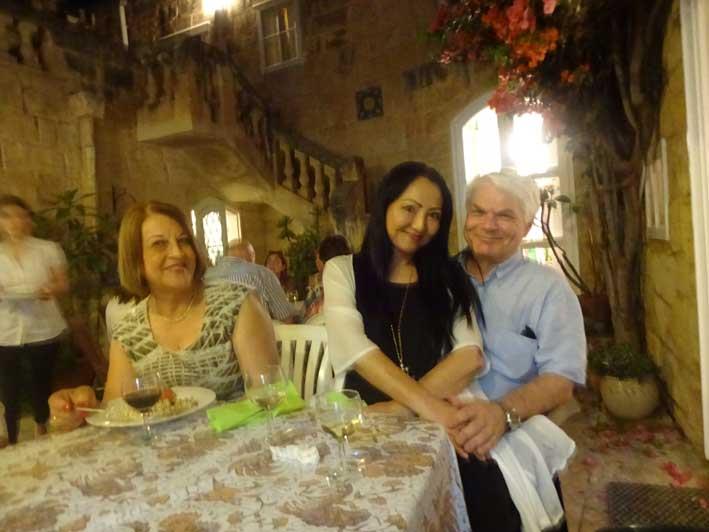
The chairperson of the Sliema Lions Arts Fund is none other than the managing director of Ta'Xbiex Perfumery, Victoria Muscat. She told me, "All merit goes to Lion Ian Lockhead. My only merit was putting the event through the Club Committee. Unfortunately the last phase of preparation coincided with my brother Joe's passing away and Ian took it all on himself." She said that many think of the Lions as just a social club but meetings all centre around raising funds for different causes. The day before they had had the official inauguration of the 4th Phase of the Restoration of St Agatha's Catacombs.
The starlets that evening - for they are not yet stars - were Dr Véronique Vella, pianist and composer, and the first Maltese woman to be conferred a Ph.D. in Music Composition whose music has been performed around Europe, Malaysia, Canada, Japan and the U.S. One of Véronique's most popular compositions 'Wens' for solo flute, was recently broadcast on BBC Radio 3. The work was commissioned by Irish flautist, Aisling Agnes, who has toured extensively with the piece.
I shall need yards of column inches if I am to write much more about Véronique's achievements. So, let me just say 'Bravissima'. She, too, was an Ian Tomlin scholarship holder.
That evening Dr Vella accompanied the soprano and clarinettist and participated in two ensemble pieces one of them Schubert's Shepherd on the Rock a Lied composed during the composer's last months of his life.
Most of the concert centred round the soprano who infused in her singing an Italianate warmth.
I first met Gabrielle at the Embassy of Ireland where the then ambassador, the energetic Jim Hennessy, engaged her many a time, to sing in one of several events he organised.
It was evident, right from the start, that she was gifted and had great stage presence. I had suggested she apply for a scholarship to the Ian Tomlin Trust, on which board I had sat since its inception, and gave her the contacts necessary to apply. It was no surprise that she won a scholarship in 2016. She moved to Edinburgh to commence her studies at the Edinburgh Napier University and has just finished her second year.
Gabrielle started her musical education at the age of 11, realising, no doubt, that this is what she wanted to do. Since then she has participated in a number of festivals and operas. In November she will be performing in Massenet's Cendrillon with the Fife Opera Company.
The third starlet that evening was clarinettist Beatrix Calleja. Beatrix, another Ian Tomlin scholarship winner, started learning the piano at age 8 and has a diploma in piano performance. She then commenced her clarinet studies and is proficient in both B flat and E flat clarinet. She has been performing as a soloist on both clarinet and piano at various venues.
Beatrix is not only a recipient of the Ian Tomlin Scholarship Award but also the Malta Arts Scholarship. She, like Gabrielle, has just finished her second year at Edinburgh Napier University.
The programme for the evening was varied. From Joaquin Rodrigo's madrigals, to Dvořák, Brahms, Saint-Saëns, Schubert, Verdi, Puccini, Poulenc and as an encore Thomas Arne's When daisies pied. I remember singing it at school with all of us looking forward to the cuckoo bit, which we sang heartily, never having heard or seen a cuckoo in our lives.
Gabrielle sang 'Quando m'en vo' from Puccini's La Bohème, surely one of the world's most popular arias. Puccini was the natural heir to Verdi at the top of the Italian opera composers' league. His first big operatic success was Manon Lescaut in 1893. After that, he had success after success after success: La Bohème in 1896, Tosca in 1900 and Madama Butterfly in 1904. In all, Puccini composed 12 operas, with Turandot his final one. He died with just a small part of the work still unwritten and at its premiere, the conductor, Arturo Toscanini stopped the orchestra playing exactly at the point where Puccini stopped composing. He turned to the audience and said: 'Here death triumphed over art.'
With Puccini's death and the premiere of Turandot, the Italian operatic composing tradition was also snuffed out. There are no more great Italian opera composers after him.
What is perhaps little known is that after Manon Lescaut, Puccini's immediate intention was to compose La lupa, based on a short story by Giovanni Verga, another of whose stories had formed the basis of Mascagni's Cavalleria rusticana. In the spring of 1894, Puccini visited Verga in Sicily in order to discuss details and to soak up the Sicilian atmosphere. While he was so far south, he took the opportunity to visit Malta. Here the British authorities arrested him on suspicion of being a spy when he was seen taking photographs of the naval fortifications.
By the time he returned to Torre del Lago, where he was living at the time, Puccini was beginning to have second thoughts about Verga's story. Since his return from Sicily and his conversations with Verga rather than feeling inspired by La Lupa he was assailed by a thousand doubts which made him decide to postpone the composition. Instead he plunged into La Bohème about which he had already been thinking.
Most of La Bohème was composed at Torre del Lago where Puccini had made a number of friends both among the village people and the small group of painters who worked in the vicinity. During the composition of the opera, his friends formed the Bohème Club, which met in an old hut to eat, drink and play cards. Puccini was the club's honorary president.
Another famous aria sung by Gabrielle that evening was 'Invocation to the Moon' from Dvořàk's fairytale opera, Rusalka, the little mermaid who tells her father she has fallen in love with a mortal and wants to become human. This song to the moon remains the shining-hit aria of the whole work.
We enjoyed some fine music that evening, some beautiful sounds. The sense of accomplishment both on the part of Sliema Lions and the musicians must have been great. As I watch my bones crumbling to dust beneath my parchment-like skin I say to myself that with all the help they are given these days these musicians have no excuse for not achieving some sort of success. In us all there exists a taste for calm, soft, fluffy music full of unthreatening sounds and nice tunes. The evening was mostly made up of such music.
[email protected]