The experience of this book begins from its dust jacket whereupon the surnames of the two artists featured inside merge and flow in a blaze of strident colours, giving us an inkling of their dynamic bond in life as in art. Indeed this is a book about a life cum travel experience in art, punctuated by occasional meetings with our islands. In the process the two artists unwittingly documented a strange shift in time, leaving an indelible visual memory of the islands as they once were, in not too distant a past. For an art lover this book can be captivating, but it is not only of interest to art aficionados.
Julian Trevelyan and Mary Fedden unwittingly created a vibrant documentation of times gone by, images of places and moments which reveal a reality at the brink of change.
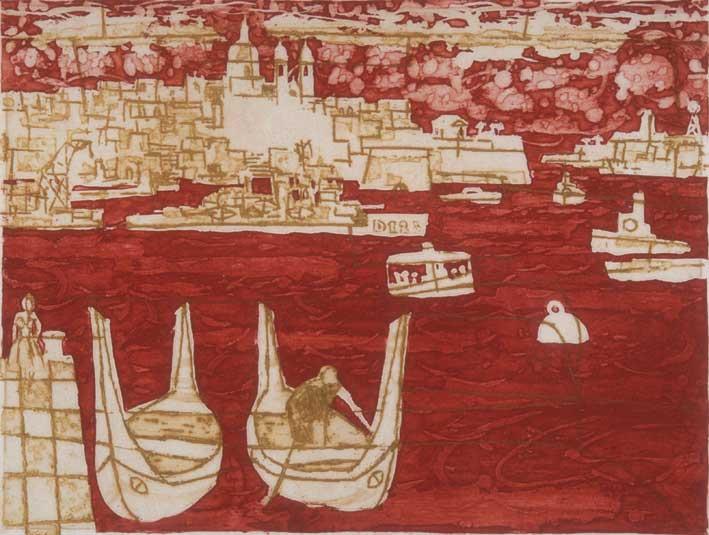
The English artists Julian Trevelyan and Mary Fedden came to Malta together only very few times in a timespan of 21 years - six times precisely. But during these visits, they sketched, drew and painted their way through the islands, even whilst Malta and Gozo were experiencing radical change in character, both physically and socially. However, looking at the art created by Trevelyan and Fedden, one feels the sensation that there, in those lines, forms and colours, change stopped for a while, moments became encapsulated, so that the daily goings on of people, in all their simplicity or pomp, got to be frozen in time. This is not about history with a capital 'H'. This is about the way things were before, in a day and age now quasi forgotten.
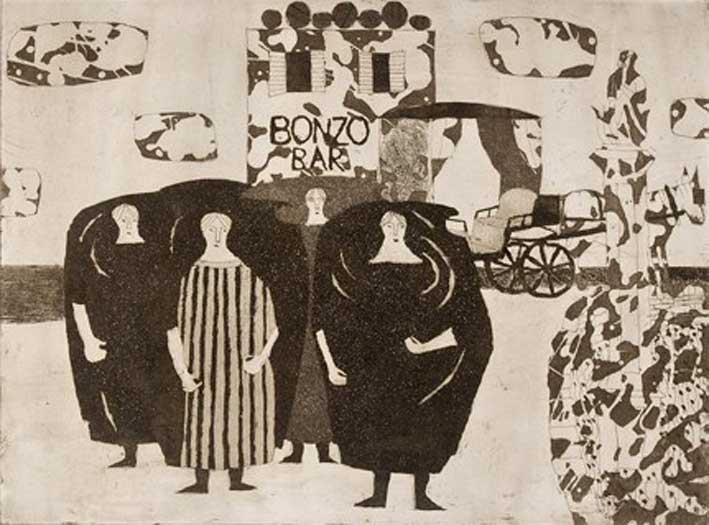
Author Lawrence Pavia has researched, written, documented, studied, interviewed, hunted, recorded and carefully selected copious material for this book, which is immense in its volume of content. From the first pages where one sees open country views of rolling fields, villagers, goats and water mills, it is obvious that both artists were taken in by the simple quaintness of island life. The calm pace of life as it was back when everybody seemed to be perhaps just a little bit closer to nature.
The author was likewise taken in by Trevelyan and Fedden's art, long before the book materialised. "I knew of the artists and their work and liked what I saw. I first discovered the artists at the (now defunct) Melitensia Art Gallery in Lija. Then, perchance, I was in Mdina for an architectural talk, after which I was chatting with the lecturer, Professor Conrad Thake. The topic was art, what else, and, in passing, he mentioned these Englishartisis, saying he felt their Malta and Gozo works deserved to be studied and documented. When I told him that I was familiar with both, he was pleasantly surprised. So, come my preparation for my MA,I seriously considered them, placing their names in a list of other artists on Malta. You see, I initially planned to study a wide spectrum of post-war British artists in Malta."
However Pavia quickly found so much material on just these two artists, that it was clearly evident he should concentrate solely on their works. In the process of his research which spanned from 2009 through to 2013 when he concluded his Masters thesis, and then on through to 2018 when work on this book was concluded, the author not only met several private collectors, but also managed to meet and speak with Mary Fedden herself before she passed in 2012.
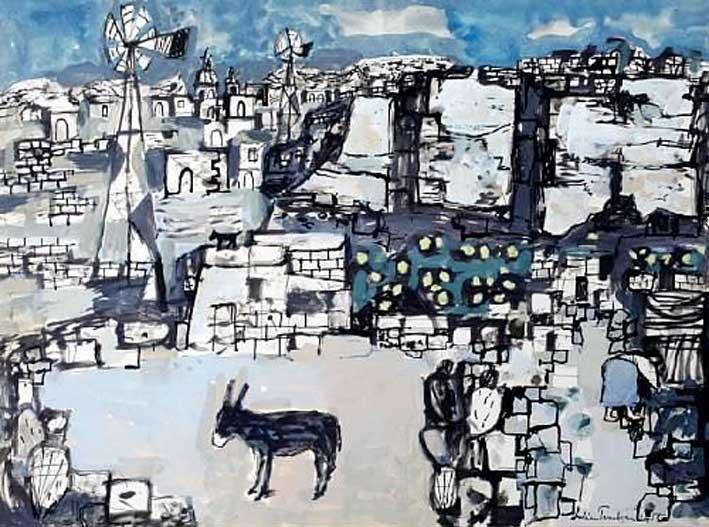
"Trevelyan died in 2008 but Fedden was still alive when I started my research. I needed to get her first-hand side of the story. I remember making an appointment with her through her agent in the UK. But the Eyjafjallajökull eruption of 2010 cancelled my first trip, a misunderstanding did not allow me to meet her on my second trip, and then, thankfully, I made the third trip to her home successfully. I was told I would only be allowed a 15-minute-long interview with her, which was a huge dismay. However, eventually my meeting with 95-year-old Mary Fedden stretched for nearly one hour during which time we discussed several of her works and her experience of Malta. That was in most probability, her last recorded interview, and a treasure for me to cherish and work upon."
Eventually her sketch books were found and he was allowed to obtain copies. "I was pretty much satisfied, even though I knew that Trevelyan also had several sketchbooks which I still had not had the opportunity of seeing. Just as I pruned and printed my MA thesis, Trevelyan's sketchbooks were made avaialble for me to research and thus, I started over."
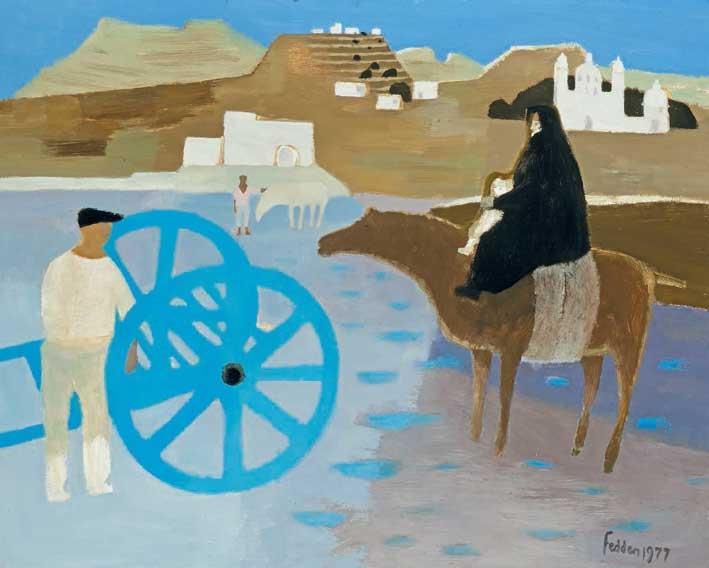
The works of both artists are fascinating. She had an effectively simple and romantic manner of painting the islands, corners of which took her fancy and ended up being immortalised. Such as her 'Garden-Gozo' (1963) or her 'Blue Plough and Horse' (1977). Pavia says, "Trevelyan was somehow more profound, painterly and somewhat philosophical in his choice and depiction of subjects. He had this underlying British humour which gave him the audacity to name a painting depicting a holy statue and festa fireworks 'Carnival' (1959). He aptly documented Malta's industrial heritage,as in his paintings and sketches of the dockyard as in 'Dockyard Cranes' (1958). Then again he documented masons working in a quarry and showed quarries in some detail as in 'Quarries III'(1958) or 'Quarries and Workmen' (1958). Nobody had ever interested themselves in this aspect of our island professions. But he seemed intrigued. Fortunately so."
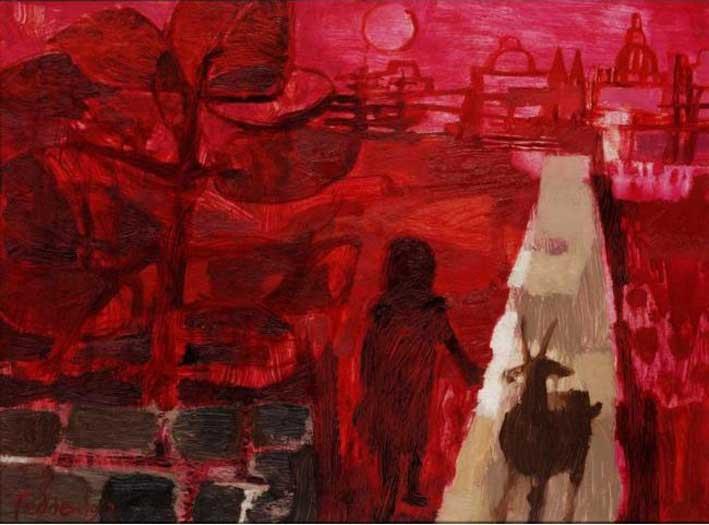
Although Trevelyan's last trip to Malta was in 1979, he continued to depict the islands in varied work. Fedden on the other hand, revisited Malta in 2002 and also continued depicting the islands with interest. In its totality 'Trevelyan and Fedden - Enounters with Malta and Gozo' is an exhaustive documentation of these two artists' 'oeuvre' related to the two islands, and is a treasure trove of information thanks to Pavia's cross-references and bibliographic detail. The author speaks of how the experience of writing and compiling this book has keenly increased his awareness of the changes the islands have and are still experiencing. "I hope that through this book, the reader will recognise the fact that we have already lost a lot of the islands' natural and architectural character and this continues to be lost very rapidly. Let us not lose more."
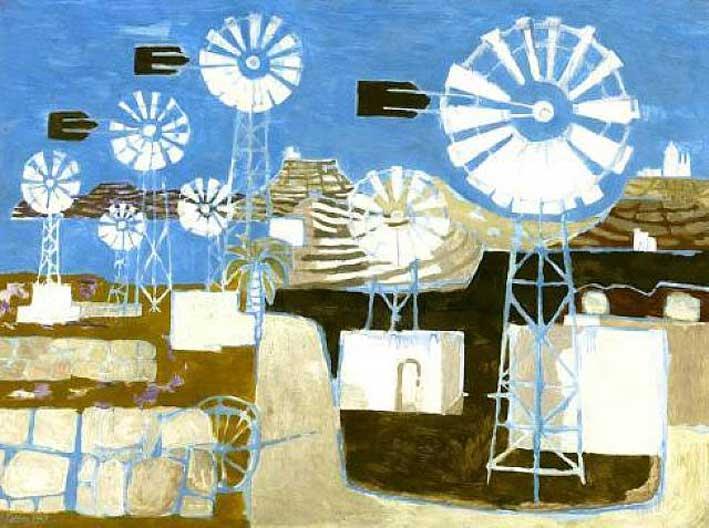
Trevelyan and Fedden - Encounters with Malta and Gozo by Lawrence Pavia is published by Fondazzjoni Patrimonju Malta and available from leading bookshops