I went to an inspiring talk by Dr Arthur Dahl (President of the International Environment Forum) at Hilltop recently. It was organised by Leyla Pappalettera whom I have known for many years. She had started Soroptimists International, an organisation for professional women and which is still going strong.
Leyla is very active in her own quiet way but keeps a low profile. Talking to her is always an inspiration and a comfort.
Dr Dahl, who packs so much in his life, spoke to us on the Importance of Youth in Society. Yes, we all agree that today's youth is immersed in a materialistic culture. They are absorbed by social networks designed to be addictive and pursued and cultivated by commercial interests whose aim is to maximize profit.
Our young people, he told his audience, are caught between youthful idealism and realism about the world which is in disintegration. They are growing up without hope for the future. Materialism and its vision which has produced today's consumer culture and its ephemeral goals, has become the dominant world faith. He went on to say that the breakdown of traditional morality has led to the triumph of animal impulses and hedonism. "Selfishness has become a prized commercial resource; falsehood reinvents itself as private information; greed, lust, indolence, pride, violence are broadly accepted and have social and economic value. Yet this materialism fills a vacuum in the absence of any deeper meaning in life, and youth take it for granted."
Materialism, he said, which is rooted in the West has now spread to every corner of the planet, breeding, in the name of a strong global economy and human welfare, a culture of consumerism. It skilfully and ingeniously promotes a habit of consumption that seeks to satisfy the basest and most selfish desires, while encouraging the expenditure of wealth so as to prolong and exacerbate social conflict. One result, he maintains, is a deepening confusion on the part of young people everywhere, a sense of hopelessness in the ranks of those who would drive progress, and the emergence of a myriad social maladies.
However, there is hope as youth are marching for change. He then went on to quote some of the recommendations in the UN Secretary-General 2030 Agenda.
The Agenda recommends lifelong learning opportunities for all and that no one should be left behind. "Young people," he told us, "will be the torch bearers... the first truly globalized, interconnected, and highly mobilized civil society and behind change and transformation."
The Agenda recommends lifelong opportunities for all in education and that ideally all should achieve literacy and numeracy. He spoke about ending all forms of malnutrition as well as all forms of discrimination against women and girls everywhere.
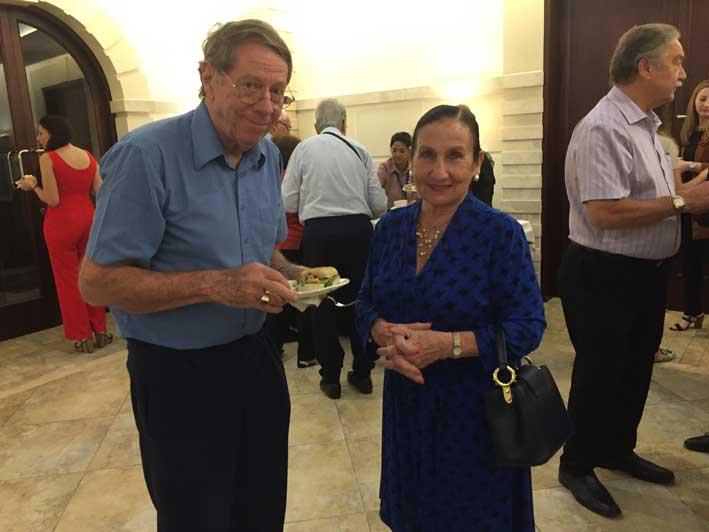
Dr Dahl and your Diarist
All our faith traditions have principles of generosity and solidarity, "doing unto others" that we can build on, Dr Dahl emphasised.
He is a follower of the Baha'i religion and believes that what is ailing the world and the young is a lack of spirituality. "The chief reason for the evils now rampant in society is a lack of spirituality. The materialistic civilization of our age has so much absorbed the energy and interest of mankind, that people in general no longer feel the necessity of raising themselves above the forces and conditions of their daily material existence. There is not sufficient demand for things that we should call spiritual to differentiate them from the needs and requirements of our physical existence. The universal crisis affecting mankind is, therefore, essentially spiritual in its causes. The spirit of the age, taken on the whole, is irreligious. Man's outlook upon life is too crude and materialistic to enable him to elevate himself into the high realms of the spirit."
Youth, he said, faces a loss of faith in the certainties of materialism and the progressive globalizing of human experience reinforce one another in the longing they inspire for understanding about the purpose of existence, he maintains."Loss of faith in traditional religion has been an inevitable consequence of failure to discover in it the guidance required to live with modernity, successfully and with assurance."
Parents, he told us, are no longer transmitting values to their children. Among the young, religious world views are being replaced by secularization, individualization and relativism, but youth want experience that will give them a values orientation. Growing children have questions, about death and dying for example, that religion can help to answer.
At puberty, faith may be caught between poles or contradictions: power - powerlessness, justice - injustice, meaning - lack of meaning.
How, Dr Dahl asks, can we resolve the paralyzing contradiction that, on the one hand, we desire a world of peace and prosperity, while, on the other, much of economic and psychological theory depicts human beings as slaves to self-interest. "The faculties needed to construct a more just and sustainable social order - moderation, justice, love, reason, sacrifice and service to the common good - have too often been dismissed as naive ideals. Yet it is these and related qualities that must be harnessed to overcome patterns of unsustainable consumption and production."
He then spoke about restoring the influence of religion. Unity is a condition of the human spirit, he said. Education can support and enhance it, as can legislation, but they can do so only once it emerges and has established itself as a compelling force in social life. "A global intelligentsia, its prescription largely shaped by materialistic misconceptions of reality, clings tenaciously to the hope that imaginative social engineering, supported by political compromise, may indefinitely postpone the potential disasters that few deny look over humanity's future. As unity is the remedy for the world's ills, its one certain source lies in the restoration of religion's influence in human affairs.
With the approach of adulthood comes a responsibility, shared by one's generation, not to allow worldly pursuits to blind one's eyes to injustice and privation. Over time, these qualities and attitudes help individuals to see past the illusions that, at every stage of life, the world uses to pull attention away from service and towards the self... raising consciousness of the need to manage one's material affairs in keeping with the divine teachings."
He advices a new standard for economic conduct. For example eschewing dishonesty in one's transactions or the economic exploitation of others. There should be no contradiction between one's economic conduct and one's beliefs. By applying in one's life principles of fairness and equity, each person can uphold a standard far above the low threshold by which the world measures itself, he said.
Social justice will be attained only when every member of society enjoys a relative degree of material prosperity and gives due regard to the acquisition of spiritual qualities. The solution, then, of prevailing economic difficulties is to be sought as much in the application of spiritual principles as in the implementation of scientific methods and approaches.
The acquisition of wealth is acceptable and praiseworthy to the extent that it serves as a means for achieving higher ends such as providing people with basic necessities, fostering social progress, promoting the welfare of society, contributing to the establishment of a world civilization.
Regrettably, a number of today's leaders - political, social, and religious - as well as some of the directors of financial markets, executives of multinational corporations, chiefs of commerce and industry and ordinary people who succumb to social pressure and ignore the call of their conscience and justify any means in order to achieve their goals, Dr Dahl emphasised.
Certain approaches to obtaining wealth - so many of which involve the exploitation of others, the monopolization and manipulation of markets, and the production of goods that promote violence and immorality are unworthy and unacceptable, he maintained.
The challenges ahead will require an enormous expansion in access to knowledge on the part of individuals and organizations alike. He again spoke of universal education "but the effort will succeed only to the extent that both individuals and groups in every sector of society are able to acquire knowledge and to apply it to the shaping of human affairs," he warned.
Education should help people to develop the knowledge, values, attitudes and skills necessary to earn a livelihood and to contribute confidently and constructively to shaping communities that reflect principles of justice, equity and unity."
Successful education will cultivate virtue as the foundation for personal and collective well-being. And will nurture in individuals a deep sense of service. Man's merit lies in service and virtue and not in the pageantry of wealth and riches, Dr Dahl pointed out. "Don't dissipate your life in the pursuit of evil and corruption and don't let your endeavours be spent in promoting your personal interest. Guard against idleness and sloth, and cling onto that which profits mankind in general", he urged.
If only we could heed these words.
If you wish to know more about Dr Dahl and his views and work just google him. He has his own blog as well as Facebook page.
[email protected]