I find that one of the enjoyments in life is receiving a new issue of a magazine or a pile of new books even if you've ordered them yourself and the contents are no surprise. I love receiving Treasures of Malta as even if I don't read it from cover to cover I can be certain that there is going to be something in it which interests me and which I am going to enjoy thoroughly.
The Christmas 2019 issue is no exception. To start off with the editorial is full of good news. The Editor of Treasures, Judge Giovanni Bonello, announces the publishing of "a comprehensive, intensely documented and lavishly illustrated volume on the origins and development of classical ballet in Malta." As a matter of fact, in a recent issue of Treasures, I enjoyed an excellent article about the woman who started it all in Malta, Princess Nathalie Poutiatine.
The editor also promises us a new website "which will include facilities for browsing all previous Patrimonju publications and saved records of past events and current projects."
For lovers of Gozo and/or of churches Prof. Mario Buhagiar, in his second instalment of The Nadur Basilica: an aesthetic appraisal, discusses the legacy of Lazzaro Pisani, the stained glass windows, and the artistic holdings of the Nadur Basilica in Gozo.
After reading these articles I now see the basilica of Nadur with new and hopefully more educated eyes.
When admiring the paintings on the ceilings of a church, any church, including those in the Nadur basilica, I always imagined some poor artist, hanging onto scaffolding for dear life, brush in hand, desperately struggling with the wings of a couple of putti, and eventually, emerging from this stressful experience with a very strained neck. Of course this must have happened for a great many years. However according to Professor Buhagiar, Lazzaro Pisani broke away from the tradition of painting directly on the primed stonework and used marouflage "which permitted him to produce his paintings on canvas and glue them to the walls and ceiling using an impermeable white-lead ore adhesive."
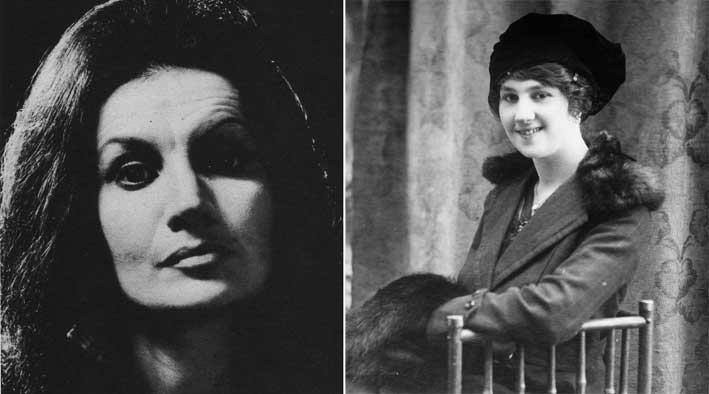
Ethel Farrugia, portrait by Derek Balmer, 1975. Courtesy: Marco Galea. Ugo Cali signed portrait of ‘pupa’. Courtesy: Giovanni Bonello
In this issue there is an article about another member of the gifted Calì family, this time Ugo Calì, the artist and portrait photographer of the early 20th century. The author is Caroline Tonna, now curator of Palazzo Falson Historic Home Museum in Mdina. She specialises in 19th century dress history and photography in Malta. Ms Tonna writes that "Some surviving photographs taken by Ugo are testimony to his artistic qualities in professional portrait photography. They stand out from the work of other contemporary photographers, which was mainly commercial. Professor Margaret Harker claims that his style was the nearest to one of Britain's most important and innovative photographers, Julia Margaret Cameron (1815-1879) whose photography was a rare combination of the intimate and aesthetic dimensions of soft-focus imagery; a revolutionary new style in the art of photography..."
This article is well illustrated with some outstanding portrait photos of Ugo's sister Margaret, Eugenia Degiorgio née Testaferrata Bonici, Adelina de Piro and perhaps the most charming photo portrait of all is of an unknown lady referred to as "pupa".
Dr Isabella Grima, who is not only a community pharmacist, but also has a Master's degree in Baroque studies and a doctorate in history, wrote A Vase with a Broken Lip in which she traces the provenance, history and significance of a charming apothecary jar or albarello held in MUŻA's reserve collection. In her research Dr Grima concludes that "there can be no reasonable doubt that this, in fact, is the polychromatic albarello with the broken lip which was inventoried in 1672 as one of the apothecary jars used at the spezieria of the Sacra Infermeria in Valletta."
* * *
Joseph Borg in his article Frank Stella's 'Malta Series' Relief Works reflects on the celebrated American artist's impressions of the Maltese Islands and how they led to the development of a series of relief works executed in the 1980s. The author writes that Frank Stella, apart from St John's Cathedral, explored various other locations around Malta and Gozo and although not necessarily always a positive one, "the whole experience had a profound and inspiring impact."
* * *
Paul Xuereb's Women in Twentieth-Century Maltese Theatre at once caught my attention as I was browsing through Treasures. There were so many familiar faces in the photos: Lina Galea, Karmenu Gruppetta, Bice Bisazza, Lena Ganado, Karmen Azzopardi, Marie Therese Vassallo Mallia, Terry Lubrano, Terry Bencini, Ethel Farrugia, Paul Xuereb himself and others. This comprehensive paper will interest anyone who has ever stepped into a Maltese theatre and for me, as it will be for others, it was sheer nostalgia, remembering actors and actresses whom I had seen and admired regularly on the Maltese stage, at a time when I went to many more theatre productions than I do now.
In his Notes Dr Xuereb explains that "Since it is the editorial policy of Treasures of Malta to limit the scope of its articles to personalities who are dead, or, at least no longer active, I feel the need to list the following personalities omitted from my article," and here, the author lists many actresses whose names are familiar.
* * *
Other articles in this December issue, with its vibrant Esprit Barthet Rooftops cover, are about the Conservation of Notary Mamo's Manuscripts at the Notarial Archives by Theresa Zammit Lupi, Chanelle Briffa and Simon Sultana Harkins and Joseph Agius's My Favourite Object which is a popular series. Mr Agius writes: "My art collection reads like a diary, each piece behaving like a Proustian madeleine, evoking and rekindling memories and deep feelings of warmth." His favourite object: George Fenech's Study of a Nude, certainly an expressive piece of art which he analysis so well.
This Christmas issue ends with a Cultural Review by Cecilia Xuereb, reminding us of what we may have missed and a book review.
Last but not least there is a useful subject index to the illustrations in Treasures of Malta, Volume XXV.
Another satisfactory read. We are blessed with hardworking researchers who have the willpower, stamina and interest to spend time in archives and libraries here and abroad and through their hard work broaden our knowledge of our heritage. Thank you.