Tchaikovsky, the composer of Christmas at San Anton Palace
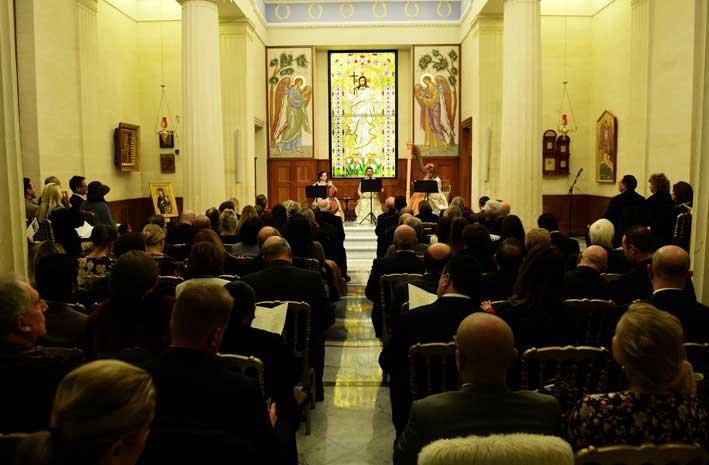
The annual concert to celebrate the Russian Orthodox Christmas which takes place two weeks after the Catholic Christmas, took place at the Russian chapel, San Anton Palace, the official residence of the President of Malta. Those on the invitation list look forward to this now well-established event as invariably we are treated to great music.
The small and historic 19th century chapel, designed by General Sir George Whitmore, was constructed for Protestant worship. When Queen Victoria's second son, Alfred Ernest Albert was stationed in Malta with his wife Grand Duchess Maria Alexandrovna, they took up residence at San Anton Palace, and the chapel was adapted for the religious requirements of the Grand Duchess, who also happened to be the Tsar Alexander II's daughter, and a Russian Orthodox Christian. I believe mass is celebrated in the chapel on Sundays.
This year the Russian Centre for Science & Culture in Valletta is organising a number of events marking the 180th birth anniversary of Pyotr Ilyich Tchaikovsky.
The Russian Centre supported by the Russian Embassy and the Office of the President of Malta opened the milestone year with an exceptional concert in this chapel.
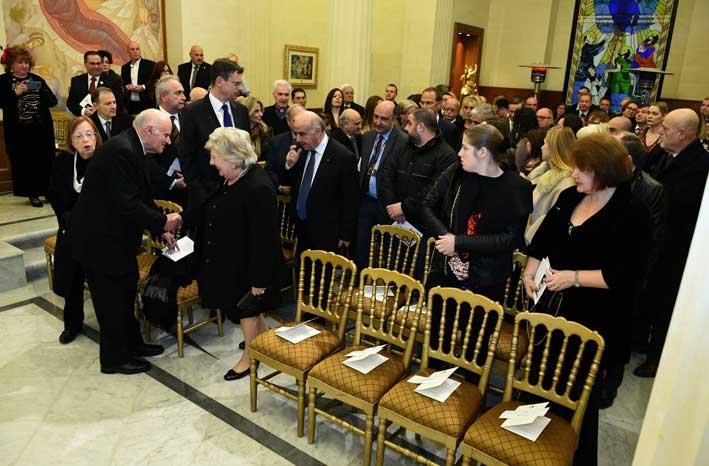
This eagerly awaited annual event was attended by His Excellency George Vella, President of the Republic of Malta and Mrs Vella, Chargé d'affaires of Russia in the Republic of Malta, Andrey Biryukov; former President Dr Hugo Mifsud Bonnici and Mrs Mifsud Bonnici; heads of foreign diplomatic missions; members of the diplomatic corps and others engaged in culture.
The concert started with well-loved pieces from Tchaikovsky's Nutcracker, Sleeping Beauty and Swan Lake.
Tchaikovsky's music features in hundreds of advertising jingles, his Christmas ballets and waltzes air every year particularly in December. The Nutcracker is practically the soundtrack of Christmas. This much loved composer is widely considered the most popular Russian composer in history. You think Russian music, you think Tchaikovsky.
For Russians he is also "the father of Romance". The Russian equivalent of the German Lied was the most popular genre in Russian music during the 19th century. The "Romance" became a crucial part of Tchaikovsky's music as well, and it enjoyed enormous popularity among Russian audiences.
His piano miniatures, frequently published in collections, still sell exceptionally well. His charming miniatures The Seasons, the set of 12 pieces that take us through the calendar year, from the fireside in January to Christmas in December became another signature of the composer.
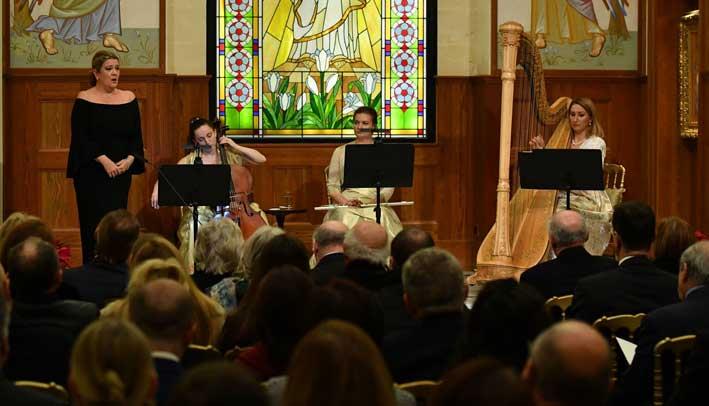
The ArtFlute ensemble, made up of three talented young ladies Anna Shkurovskaya (harp), Ekaterina Galkina (cello) and Polina Rybakova (flute), the latter the ensemble's artistic director, gave us a most pleasurable evening.
They performed a number of pieces of Tchaikovsky including the famous Waltz of the Flowers, Marche and a Chinese dance also known as Tea from Nutcracker. Tchaikovsky's music has great joy, passion and is very melodic. Russians aren't ashamed of expressing their innermost thoughts and emotions. And that's what Tchaikovsky is all about. This was a most agreeable set of highlights especially when played as spiritedly and elegantly as it was that evening.
Another Russian composer celebrated that evening was Alexander Borodin.
Few of the great 19th century Russian composers made music their principal profession and Borodin, no exception, was essentially an amateur. He was highly successful as a research chemist - which explains why he wrote so little music and why several of his largest works were left unfinished at his death. But what he did write had enormous originality, with a particular feeling for memorable melody and oriental exoticism. These come into play in his greatest work, the opera Prince Igor, source of his famous Polovtsian Dances which the ensemble played so beautifully that evening. But even after 18 years of work Prince Igor remained incomplete at his death and was finished off by Glazunov, who reputedly recomposed the overture from his memory of hearing Borodin improvising it on the piano.
The ArtFlute ensemble also entertained us to Alexander Glazunov's Harp Solo from his colourful ballet Raymonda, Op 57 and the Spanish Serenade for violincello in A Major, Op 20, No 2. Glazunov not only helped to complete Borodin's but also Mussorgsky's music.
It is understandable that in a concert such as this Russian composers would predominate.
Mikhail Glinka is considered the father of Russian classical music, the man who brought it up-to-date and into the European mainstream without sacrificing its national identity. And so a lively Waltz from the opera, A Life of the Tsar from the talented ladies on the stage. And who doesn't enjoy a waltz?
Sergei Rachmaninoff's Italian polka was bright and energetic and made me want to stand up and dance, even if my dancing days are over.
We also enjoyed modern Russian music. The soundtract to the film Metel composed by Georgy Sviridov which is based on the novel by Pushkin and another soundtrack by Isaak Dunayevsky to the film Vesna, both the music and the films unknown to me, alas.
Ah ha! Une vie d'amour, the meaningful lyrics written by Charles Aznavour. It was not sung that evening but the music is beautiful, too.
Last but not least we were lucky enough that the soprano Andriana Yordanova was special guest singer and sang Schubert's Ave Maria and Puccini's O Mio Babbino Caro from his opera Gianni Schicchi, the latter aria sung vividly. Andriana is not the kind to do 'pretty and demure'.
The story goes that Puccini had a clear perception of his musical talents when he listened to Verdi's Aïda in 1876. His best loved operas Madama Butterfly, La Fanciulla del West - the first Italian Western - Manon Lescaut, Tosca, Turandot and others filled the theatres when they were composed and still do.
At the end of the concert President Vella said: "This concert is yet another cultural event that celebrates the ways and means how our history and culture make us unique thanks to the broad range of connections and relations. It is my pleasure to regularly host cultural events proposed by the various embassies and representations in Malta and with whom our country also shares close diplomatic ties and bilateral relations."
This was an evening of music played with equal measure of elegance, warmth and adrenalin. The three ladies gave us an enticing performance as did the soprano.
This is but the first of a series of events to celebrate the 180th year of Tchaikovsky's birth. This is a great chance to reconnect with Tchaikovsky's musical world. I shall look out for other events which I am sure will be open to the public.
For Igor Stravinsky, another great Russian composer, pianist, and conductor, Tchaikovsky was "the most Russian of us all". Is there anyone out there who doesn't enjoy T's music?
The concert was followed by a lively reception. I noted that the canapés were more alluring than usual. I should be locked up for a month with just water after such an indulgent Christmas and New Year. But there you go.
[email protected]